Credential evaluation and sending academic records directly
Immigration bodies, professional councils and universities often refuse academic records handed over by the applicant; they must arrive directly from the institution or an evaluation service. The work therefore has two halves: producing compliant documents and arranging accepted direct delivery.
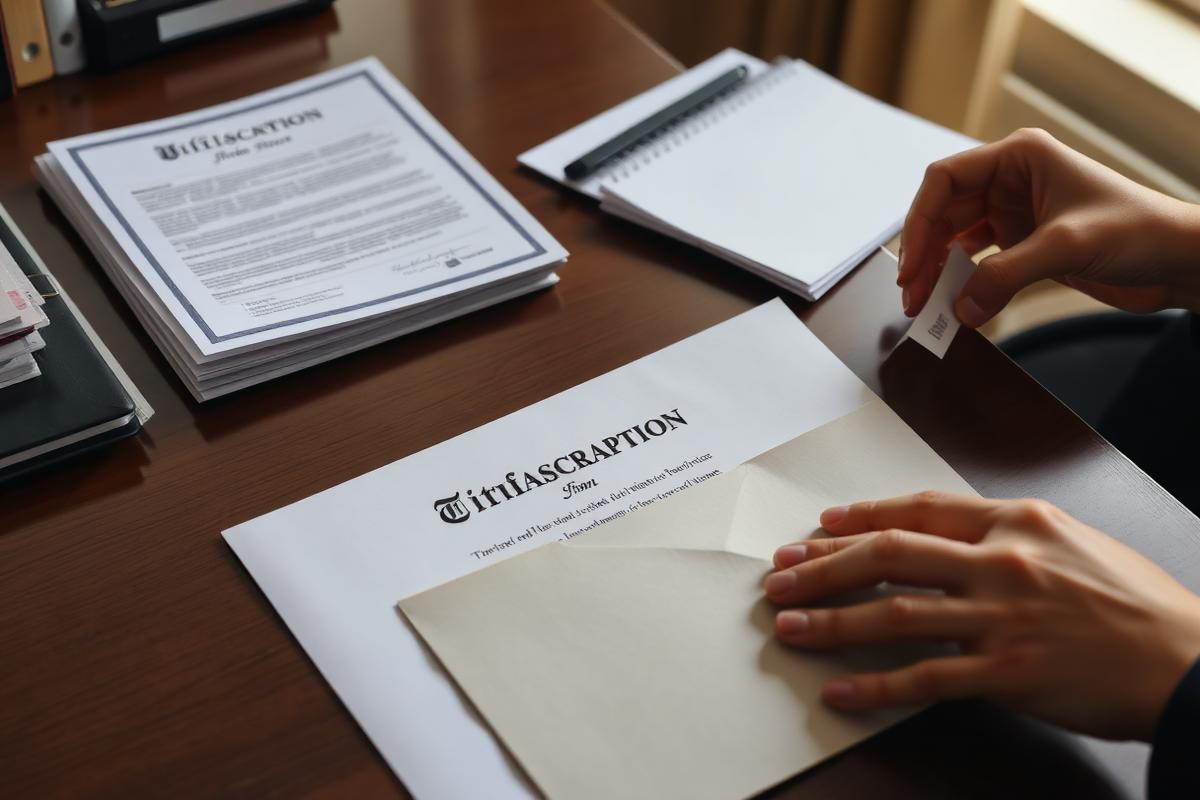
Documents to prepare
- English-language transcripts issued by the institution in a sealed, stamped envelope
- The degree certificate or a certificate of completion
- A statement of the grading system, where requested
- The passport, to fix name spelling
- Proof of name change if the degree name differs from the passport
- Destination details such as a recipient code or dedicated mailing address
Step-by-step procedure
1. Check the evaluator's rules
Sealing, sender and delivery channel differ between services.
2. Request documents from the institution
Ask the registrar for English versions sealed in the required format.
3. Certify translations of Thai-language content
Course titles, grades and stamp text must all be translated.
4. File the evaluation application
Complete the online form and pay the evaluator directly at its own rates.
5. Track until receipt is confirmed
Keep tracking numbers and confirmation emails.
Pitfalls that get documents rejected
- An opened envelope is void even if the contents are correct.
- Many evaluators refuse documents forwarded by the applicant.
- Name mismatches always require a change-of-name document.
- Queues lengthen around intake deadlines — plan backwards.
Advisory notes from our team
- Order several sealed sets at once; each application consumes one.
- Photograph the sealed flap before dispatch.
- Share your application deadline so the schedule can be built in reverse.
An advisory team, not just a filing agent
NYC Visa & Translation has handled cross-border documentation for over 15 years. Every case starts with the destination requirement — who receives the document, in what form, and under which certification route — before we sequence the work so it is done right the first time.
Frequently asked questions
How does credential evaluation differ from translation?
Evaluation is an independent body — WES, an ECA-designated organisation or similar — determining how a Thai qualification compares to the destination country's system. Translation renders the text without judging equivalence. Almost every evaluation requires translations as supporting material, but a translation alone never substitutes for an evaluation report. Always work from the published requirements of the specific body you are filing with.
How must transcripts be sent to be accepted?
Most evaluators require the institution to send documents directly, or to supply them in a sealed envelope with the institution's stamp across the flap. If the applicant opens the envelope, the set is usually rejected and must be reordered. Many Thai institutions now support digital delivery through channels the evaluator recognises. Confirm with both the issuing institution and the evaluator before ordering, so you pick a route that does not have to be repeated.
What standard should academic translations meet?
Line-by-line correspondence with the original: course titles, credits, grades, the grading scale, stamps and signatures. Do not localise degree names to look like destination equivalents — the evaluator performs that comparison itself, and pre-interpreted titles raise doubts. Where no direct equivalent exists, translate descriptively and keep the original term in brackets, with a translator's certification giving contactable details.
How long does the whole process take?
Three phases behave differently. Obtaining documents from the institution depends on that institution's rules and queue. Translation and certification is the phase you can actually plan. The evaluator's assessment depends on its queue and on whether your file is complete. No private provider can accelerate an institution's or evaluator's queue; what genuinely saves time is running phases in parallel and filing a complete set the first time.
What causes most rejections?
The applicant's name on the transcript not matching the passport after a name change or different transliteration; a sealed envelope that was opened; a missing reverse page explaining the grading scale; translations that omit stamps; and sending a certificate of graduation in place of the full transcript. Build a checklist directly from the evaluator's published requirements and tick each item before dispatch.
How far can your team take this?
We read the evaluator's requirements with you, coordinate the institution for sealed sets, translate academic records with translators familiar with the Thai qualification framework, run two-stage terminology review, ship by tracked courier and follow the file until it is accepted. Our advisers have handled academic document chains for over 15 years and will warn you in advance which Thai institutions are slow at which step.
Continue in this cluster
Prefer not to run the queues yourself? We handle it end to end.
Prefer not to handle the queues yourself, or worried about a rejection? Send us photos of your documents for a free pre-check. We handle the full chain — obtaining certified copies, translation, certification and submission — and keep you updated at each step. Reach us on LINE, phone or email during business hours.