ข้ามไปเนื้อหาหลัก / Skip to main content
N
NYC Visa.
Visa & Translation
Case studies

WES / ECA credential evaluation — case studies

Real engagements published with client permission, including the document timeline step by step.

These pages describe our actual working process using material the client permitted us to publish. Decisions rest with the receiving authority in each case, so no approval outcome is guaranteed.

Credential evaluation (WES / ECA)

individual

Situation

A Canadian PR applicant had to submit Thai credentials for evaluation, with the institution sending documents directly to the assessor.

What we checked

  • Completeness and validity window of originals
  • Name consistency across every document
  • Latest requirements of the receiving authority

Supporting documents

  • Freshly issued originals
  • Passport / Thai ID
  • Power of attorney where we act on the client's behalf

Work timeline

  1. Case assessment and document plan

    An adviser confirms the destination rules and sequences the work

  2. Retrieve or reissue the originals

  3. Certified translation with two-step review

  4. File for certification or legalization via the correct channel

  5. Hand over with guidance on using the set abroad

Process notes

Our advisers track status daily and confirm each milestone to the client in writing.

What we delivered

Coordinated direct institutional dispatch and supplied a certified translation set the assessor accepts.

credential-evaluation

Service Knowledge Base

Credential Evaluation & Transcript Knowledge Base

Common questions about evaluating Thai qualifications abroad, sealed transcripts and academic document translation. (8+ search topics covered)

How long does the whole process take?

Three phases behave differently. Obtaining documents from the institution depends on that institution's rules and queue. Translation and certification is the phase you can actually plan. The evaluator's assessment depends on its queue and on whether your file is complete. No private provider can accelerate an institution's or evaluator's queue; what genuinely saves time is running phases in parallel and filing a complete set the first time.

What causes most rejections?

The applicant's name on the transcript not matching the passport after a name change or different transliteration; a sealed envelope that was opened; a missing reverse page explaining the grading scale; translations that omit stamps; and sending a certificate of graduation in place of the full transcript. Build a checklist directly from the evaluator's published requirements and tick each item before dispatch.

How far can your team take this?

We read the evaluator's requirements with you, coordinate the institution for sealed sets, translate academic records with translators familiar with the Thai qualification framework, run two-stage terminology review, ship by tracked courier and follow the file until it is accepted. Our advisers have handled academic document chains for over 15 years and will warn you in advance which Thai institutions are slow at which step.

How does credential evaluation differ from translation?

Evaluation is an independent body — WES, an ECA-designated organisation or similar — determining how a Thai qualification compares to the destination country's system. Translation renders the text without judging equivalence. Almost every evaluation requires translations as supporting material, but a translation alone never substitutes for an evaluation report. Always work from the published requirements of the specific body you are filing with.

How must transcripts be sent to be accepted?

Most evaluators require the institution to send documents directly, or to supply them in a sealed envelope with the institution's stamp across the flap. If the applicant opens the envelope, the set is usually rejected and must be reordered. Many Thai institutions now support digital delivery through channels the evaluator recognises. Confirm with both the issuing institution and the evaluator before ordering, so you pick a route that does not have to be repeated.

What standard should academic translations meet?

Line-by-line correspondence with the original: course titles, credits, grades, the grading scale, stamps and signatures. Do not localise degree names to look like destination equivalents — the evaluator performs that comparison itself, and pre-interpreted titles raise doubts. Where no direct equivalent exists, translate descriptively and keep the original term in brackets, with a translator's certification giving contactable details.
Topics covered
เทียบวุฒิต่างประเทศ: WES · ECA · IQAS · credential evaluation
เอกสารการศึกษา: ทรานสคริปต์ · ใบปริญญาบัตร · ซองปิดผนึก · แปลรับรอง

Need your documents reviewed or your case assessed? Ask our team by phone, LINE, or email. We reply during business hours (Mon–Fri 9:00–18:00, Sat 9:00–15:00, ICT).
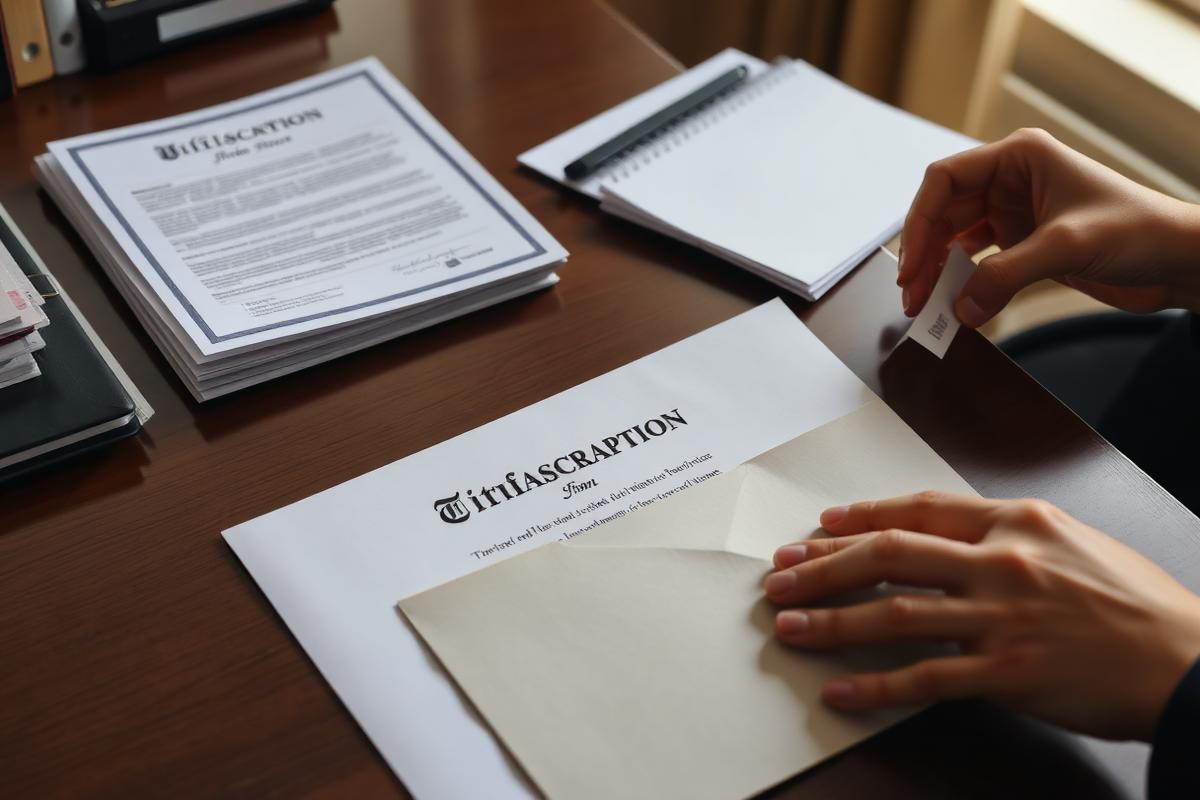
Transcripts and diploma prepared in a sealed envelope for overseas credential evaluation
Transcripts and diploma prepared in a sealed envelope for overseas credential evaluationFrom actual casework by the NYC Visa & Translation team
Service Playbook

Credential evaluation and sending academic records directly

Immigration bodies, professional councils and universities often refuse academic records handed over by the applicant; they must arrive directly from the institution or an evaluation service. The work therefore has two halves: producing compliant documents and arranging accepted direct delivery.

Documents to prepare

  • English-language transcripts issued by the institution in a sealed, stamped envelope
  • The degree certificate or a certificate of completion
  • A statement of the grading system, where requested
  • The passport, to fix name spelling
  • Proof of name change if the degree name differs from the passport
  • Destination details such as a recipient code or dedicated mailing address

Step-by-step process

  1. 1. Check the evaluator's rules Sealing, sender and delivery channel differ between services.
  2. 2. Request documents from the institution Ask the registrar for English versions sealed in the required format.
  3. 3. Certify translations of Thai-language content Course titles, grades and stamp text must all be translated.
  4. 4. File the evaluation application Complete the online form and pay the evaluator directly at its own rates.
  5. 5. Track until receipt is confirmed Keep tracking numbers and confirmation emails.

Pitfalls and rejection causes

  • An opened envelope is void even if the contents are correct.
  • Many evaluators refuse documents forwarded by the applicant.
  • Name mismatches always require a change-of-name document.
  • Queues lengthen around intake deadlines — plan backwards.

Tips from our team

  • Order several sealed sets at once; each application consumes one.
  • Photograph the sealed flap before dispatch.
  • Share your application deadline so the schedule can be built in reverse.

Prefer not to handle the queues yourself, or worried about a rejection? Send us photos of your documents for a free pre-check. We handle the full chain — obtaining certified copies, translation, certification and submission — and keep you updated at each step. Reach us on LINE, phone or email during business hours.

Route Comparison

Credential evaluation: Thai authority vs foreign evaluators

Know who decides: the receiving institution, a government body, or a designated evaluation service.

RouteWhen to useCertifying authorityApprox. durationRejection risk
Recognition by the Thai education authorityUsing a foreign qualification for work or study in ThailandThe responsible education authority for that levelVariable with review cyclesFiling copies not certified by the issuing institution
A designated credential evaluation serviceImmigration or a professional body lists approved evaluatorsAn evaluator on the receiving authority's listVariable — allow several weeks including institutional deliveryUsing an unlisted evaluator voids the report entirely
Institution-to-institution transcriptsThe destination university requires direct deliveryThe issuing institutionVariable with the institution's issuing cycleStudent-held copies are not treated as official

Timelines above are practical estimates from live casework and can change with each authority's policy; confirm with the receiving authority before you plan. If you would rather not test routes by trial and error, our advisers (15+ years of casework) can assess your case and handle the whole chain for you.

Advisory Service

We do not just process documents — we advise you through the whole case

Our team has worked on cross-border documents, certified translation and government liaison for over 15 years. Most rejections we see are not caused by missing paperwork but by choosing the wrong route on day one, so we always start with a case assessment.

Route assessment

We look at your destination, purpose and deadline, then tell you which certification route applies — and which steps you can skip.

Pre-submission review

Name spelling, consistency across documents, document age and translation format are checked before anything reaches a counter.

Timeline planning

We sequence the steps around your appointment or travel date and flag bottlenecks in advance.

Rejection recovery

We read the refusal reasons, identify the underlying cause, and plan a resubmission that answers what the authority asked for.

Rather not learn by trial and error? Send your case details and document photos for a review — reach us on LINE, phone or email during business hours.

Practical Q&A

Practical questions · Near me / DIY / Required documents

Is there a service point near me?

Our main offices are Lat Phrao 95 (Bangkok), Khon Kaen and Udon Thani. We serve the whole country through scans and document courier, and can meet at city rail stations or malls. Ask our team by phone, LINE or email for the most convenient option.

Can I handle this myself?

Many steps can be done personally under the relevant authority's rules. What usually costs time is the wrong sequence, a translation format that does not match the requirement, or a source document version the recipient will not accept. Check the destination checklist before starting and ask us if anything is unclear.

Which documents should I prepare?

Generally the original document from the competent authority, the owner's ID or passport, a translation in the format the destination requires, and a power of attorney if someone acts for you. Details vary by service type — ask our team for a case-specific checklist.
Practical advice & cautions

Expat, relocation and education: advice and cautions

Before you start
  • Prepare dependants' documents in the same batch

    Marriage and birth certificates for dependants usually need the same translation and certification as the principal's file.

  • Match health insurance to the visa conditions

    Some visa categories set minimum coverage conditions. Verify the policy against the published requirement rather than informal advice.

  • Sequence documents before booking flights or signing a lease

    Visas, work permits, housing and school places are interdependent. Start with the longest-lead document to avoid schedule clashes.

  • Request English-language academic records from the institution

    Transcripts issued in English by the awarding institution often reduce translation steps, though legalisation may still be required abroad.

Common reasons documents get rejected
  • Missing reporting or accommodation-notification deadlines

    Missed reports can carry legal consequences and affect the next extension even when other documents are complete.

  • Insurance cover ending before the permitted stay

    A policy expiring before the end of the requested period typically triggers additional requests or delays the decision.

  • Translating qualification titles inconsistently

    Degree or subject names that differ from the institution's official wording can trigger extra requests or refusal by assessment bodies.

  • Submitting plain copies instead of institution-issued records

    Many assessment bodies accept only documents issued or sent directly by the institution; ordinary photocopies are commonly rejected.

Requirements differ by authority and destination country and can change. Confirm current conditions with the receiving authority, or ask our team by phone, LINE or email.

Related services

What clients usually handle next

One document set often moves through several stages — translation, notarial certification, legalization and finally a visa filing. The links below follow that real sequence.

External authority references

Authority requirements change. Verify with the receiving authority before filing, or ask our team by phone, LINE or email.