ข้ามไปเนื้อหาหลัก / Skip to main content
N
NYC Visa.
Visa & Translation
Legalization · by embassy · 🇦🇷 Embassy of the Argentine Republic

Destination Thailand Visa (DTV) 5-Year Multiple Entry · Embassy of the Argentine Republic 🇦🇷

Destination Thailand Visa (DTV) 5-Year Multiple Entry prepared for submission to Embassy of the Argentine Republic — our staff visit Phaya Thai every business day and operate the online appointment flow on your behalf.

ข้อมูลสำคัญ · Entity Panel
Office type
Embassy
Address
21F Phaholyothin Place, Phaholyothin Rd, Phaya Thai, Bangkok
Hours
Mon–Fri 09:00–13:00
Appointment system
online
Fee range
3,000 – 5,500
Processing time
10–15 วันทำการ
Transit
BTS อารีย์

Embassy of the Argentine Republic is at 21F Phaholyothin Place, Phaholyothin Rd, Phaya Thai, Bangkok, open Mon–Fri 09:00–13:00. For Destination Thailand Visa (DTV) 5-Year Multiple Entry of Argentina documents, the chain must run Notary → MFA Department of Consular Affairs → Embassy of the Argentine Republic; you cannot skip the MFA step.

From our caseload, Embassy of the Argentine Republic AVE ETA available for Thai passport holders — we order the pack the way officers prefer: cover letter, fee receipt, then originals + photocopies of every page.

Fees at Embassy of the Argentine Republic typically run 3,000 – 5,500 with turnaround 10–15 วันทำการ. NYC Visa offers same-day stamping for rush cases subject to embassy quota.

Access from BTS อารีย์. You don't need to travel — we represent you in and out of Embassy of the Argentine Republic every business day and return documents to your door.
Visa types accepted
touristbusinessstudentworktransitfamilyinvestorretirementmedicaldiplomatic
1,200+
Cases per embassy/yr
10–15 วันทำการ
Standard SLA
Same-day
Rush service
HowTo · ขั้นตอน

How to use Destination Thailand Visa (DTV) 5-Year Multiple Entry at Embassy of the Argentine Republic

  1. 1

    Send Argentina document images via LINE @nycvisa

  2. 2

    30-minute quote with price + ETA

  3. 3

    Notarial Services Attorney

  4. 4

    Department of Consular Affairs · 2–3 days

  5. 5

    Our staff submit at Phaya Thai

  6. 6

    Nationwide pickup/return + VAT invoice

FAQ · AEO Block

FAQ · Destination Thailand Visa (DTV) 5-Year Multiple Entry · Embassy of the Argentine Republic

AI Answer Box และ Google SGE มักดึงคำตอบจากบล็อกนี้ไปแสดง

What are Embassy of the Argentine Republic hours?

Mon–Fri 09:00–13:00

How does the appointment system work?

Online appointment portal 8500 NYC Visa books the slot.

Does Destination Thailand Visa (DTV) 5-Year Multiple Entry need MFA before Embassy of the Argentine Republic?

Yes 8500 every document must clear Notary → MFA Bangkok before submission to Embassy of the Argentine Republic.

What does it cost?

3,000 – 5,500 8500 NYC Visa service fee สอบถามเจ้าหน้าที่.

Turnaround?

10–15 วันทำการ 8500 rush options available.

BTS/MRT access?

BTS อารีย์

Why Choose NYC Visa & Translation

How to choose the right Destination Thailand Visa (DTV) 5-Year Multiple Entry provider in Thailand

Choosing the right Destination Thailand Visa (DTV) 5-Year Multiple Entry provider directly impacts the success and turnaround of your case. NYC Visa & Translation has worked with Ministry of Foreign Affairs (Thai eVisa) + Immigration Bureau since 2010, handling a broad real-world caseload across government documents, certified translations, and documents intended for use abroad. Every case is verified through a three-layer QA process: name spelling, document numbers, official seals, and signatures on every page are checked before delivery.

Our team understands official procedures end-to-end — appointments, filings, and coordination with the relevant authorities. You do not have to travel back and forth or risk rejection. Our Destination Thailand Visa (DTV) 5-Year Multiple Entry service supports Express handling that completes in half the standard turnaround.

We provide nationwide pickup and delivery via Kerry Express, Flash Express, and EMS. Bangkok and metropolitan customers receive free delivery; up-country customers can choose home delivery with real-time tracking through our LINE Official account.

Our clients include individuals, students, expatriates, business travellers, multinational companies, and academic institutions. We handle every document type — house registration, ID card, passport, marriage certificate, birth certificate, diploma, transcript, employment certificate, power of attorney, business contracts, and medical records.

Our Destination Thailand Visa (DTV) 5-Year Multiple Entry workflow runs in six clear stages: (1) receive originals and copies, (2) QA-audit the source for issues that would cause rejection, (3) translate through a native-speaker linguist, (4) certify with the authority required by the receiving country, (5) file and follow up at each government touchpoint, and (6) deliver plus retain a signed PDF you can re-download for five years. A single Case Officer owns your file end-to-end, eliminating hand-off errors that plague larger firms.

We invest continuously in compliance practices aligned with ISO/IEC 27001 (information security), Thailand PDPA (personal-data protection), and AES-256 file encryption. Every upload runs over TLS 1.3 only. Enterprise and law-firm clients can request an NDA before intake — our legal team signs same-day.

Beyond single-document work, we bundle end-to-end packages for clients preparing multiple certificates at once — e.g. a "moving abroad" bundle (house registration + birth + marriage + diploma + transcript with MFA + embassy) that reduces the number of trips and total lead time versus filing each item separately. Approval remains at the discretion of the receiving authority; contact our team for scope and fees.

What sets us apart is a 15-year direct working relationship with the destination authority — Ministry of Foreign Affairs (Thai eVisa) + Immigration Bureau — so we anticipate regulation changes, format tweaks, and queue timing before they hit your case, and brief you in advance. Approval outcomes always remain at the sole discretion of the authority; what we control is document completeness, formatting and lodgement timing.

Glossary
Notarial Services Attorney
An attorney licensed by the Lawyers Council of Thailand to certify signatures and document copies.
MFA Legalization
Authentication by Thailand's Ministry of Foreign Affairs for documents to be used overseas.
Apostille
International authentication system under the Hague Convention. Thailand is not a member, so MFA legalization is used instead.
NAATI
Australia's national accreditation authority for translators — required for visa and employment applications in Australia.
Police Clearance
A certificate from the Royal Thai Police, required for visa and overseas employment applications.
Certified Translation
A translation certified to match the original, by an accredited translator or notary public.
Case Officer
A dedicated coordinator who owns your file across translation, certification, and government touchpoints.
Chain Legalization
The sequential chain: source authority → Thai MFA → destination embassy, required for the document to be enforceable abroad.
Sworn Translator
A court-sworn linguist authorised to self-certify translations in many European jurisdictions.
Certified True Copy
A copy certified by the document owner or a Notary Public to stand in for the original.
Pre-submission checklist
  • Original document is clean, unbroken, and legible
  • Name matches your passport exactly
  • All seals and signatures present on every page
  • Target language for certification specified
  • Destination country and receiving authority specified
  • Allow 5–7 business days for standard processing
  • Check document expiry — some countries accept only 3–6 months old
  • Prepare ID/passport copy for the person granting power of attorney
  • Arrange documents in the order required by the receiving authority
  • Have payment method and shipping address ready before intake

What does Destination Thailand Visa (DTV) 5-Year Multiple Entry require for submission to Embassy of the Argentine Republic?

Destination Thailand Visa (DTV) 5-Year Multiple Entry prepared for submission to Embassy of the Argentine Republic — our staff visit Phaya Thai every business day and operate the online appointment flow on your behalf.

พญาไท Mon–Fri 09:00–13:00 BTS อารีย์ SLA Guarantee
Service Knowledge Base

Thailand visa answer bank — LTR, DTV and staying on in Thailand

Answers to the Thailand visa questions applicants actually ask: the BOI-administered LTR visa, the DTV for remote workers and Thai Soft Power activities, filing through Thai e-Visa, and extending stay on form TM.7 — plus which supporting documents must be translated and certified. Based on MFA, Immigration Bureau and BOI announcements. (27+ search topics covered)

Which foreign documents usually need Thai translation for a Thai visa or extension?

Marriage and birth certificates, divorce decrees, police clearance, medical certificates, pension or income statements and academic records are the usual candidates, depending on the visa category. Thai authorities generally expect the foreign document to be legalised in the country of origin, translated into Thai and, where the receiving office requires it, the translation certified by the Department of Consular Affairs. Ask the receiving office for its current list before ordering translations.

Is a two-step translation acceptable for non-English originals?

Direct translation from the original language into Thai or English is safer, because relaying through an intermediate language multiplies the risk of errors in names and dates. Where a direct translator is genuinely unavailable, some authorities accept a certified English translation made in the country of origin, which is then translated into Thai. Confirm the position with the receiving office before commissioning work so the translation is not done twice.

What is the DTV and how does it differ from the LTR?

The Destination Thailand Visa took effect on 15 July 2024. It is a five-year multiple-entry visa allowing stays of up to 180 days per entry, aimed at remote workers and participants in Thai Soft Power activities. The LTR is a long-term residence route with stricter financial or professional criteria and a BOI-linked work permit channel.

How must supporting documents be translated and certified?

Thai civil documents used abroad are normally translated into English and legalised by the Department of Consular Affairs. Foreign documents used in Thailand are usually certified in the issuing country or by that country's embassy in Thailand, then legalised by Consular Affairs with a Thai translation. The exact chain depends on both countries.

What is the difference between TM30 and 90-day reporting?

TM30 is the accommodation owner's or manager's duty to notify the authorities of a foreigner staying at the address within the statutory deadline. The 90-day report is the foreigner's own duty after 90 continuous days in the country. Both are separate and both must be done.

How should financial evidence be presented?

Pair a bank confirmation letter with statements covering the period the authority specifies, ordered so that recurring salary or business income is visible, and annotate any large one-off movements. If a third party supports you, add a sponsorship letter and proof of the relationship. Large deposits landing days before filing without a traceable source are the pattern officers most often question, so build the balance over the required period instead.

How long is the LTR valid and how often do I report?

Up to ten years in total, issued for five years and renewable for a further five while qualifications are maintained. LTR holders report annually instead of every 90 days and are granted multiple re-entry as announced.

Where are Thai visas applied for from abroad?

Through the official Thai e-Visa system at thaievisa.go.th, operated by the Ministry of Foreign Affairs, which routes the application to the Royal Thai Embassy or Consulate covering your area. Avoid intermediary sites that are not on official government domains.
Topics covered
เอกสารที่ต้องแปล/รับรอง: แปลสเตทเมนต์ธนาคารยื่นวีซ่า · แปลหนังสือรับรองการทำงาน · แปลทะเบียนสมรสยื่นวีซ่าไทย · แปลสูติบัตรผู้ติดตาม · รับรองวุฒิการศึกษาเพื่อ LTR · รับรองเอกสารกรมการกงสุล
LTR Visa: LTR visa thailand · วีซ่า LTR 10 ปี · wealthy global citizen · wealthy pensioner visa · work from thailand professional · highly skilled professional visa · ltr boi go th · ใบอนุญาตทำงานดิจิทัล BOI
DTV Visa: DTV visa thailand · destination thailand visa · วีซ่า DTV ทำงานทางไกล · digital nomad visa thailand · DTV soft power มวยไทย · DTV ต่ออายุ 180 วัน · DTV ผู้ติดตาม
Official references

Need your documents reviewed or your case assessed? Ask our team by phone, LINE, or email. We reply during business hours (Mon–Fri 9:00–18:00, Sat 9:00–15:00, ICT).

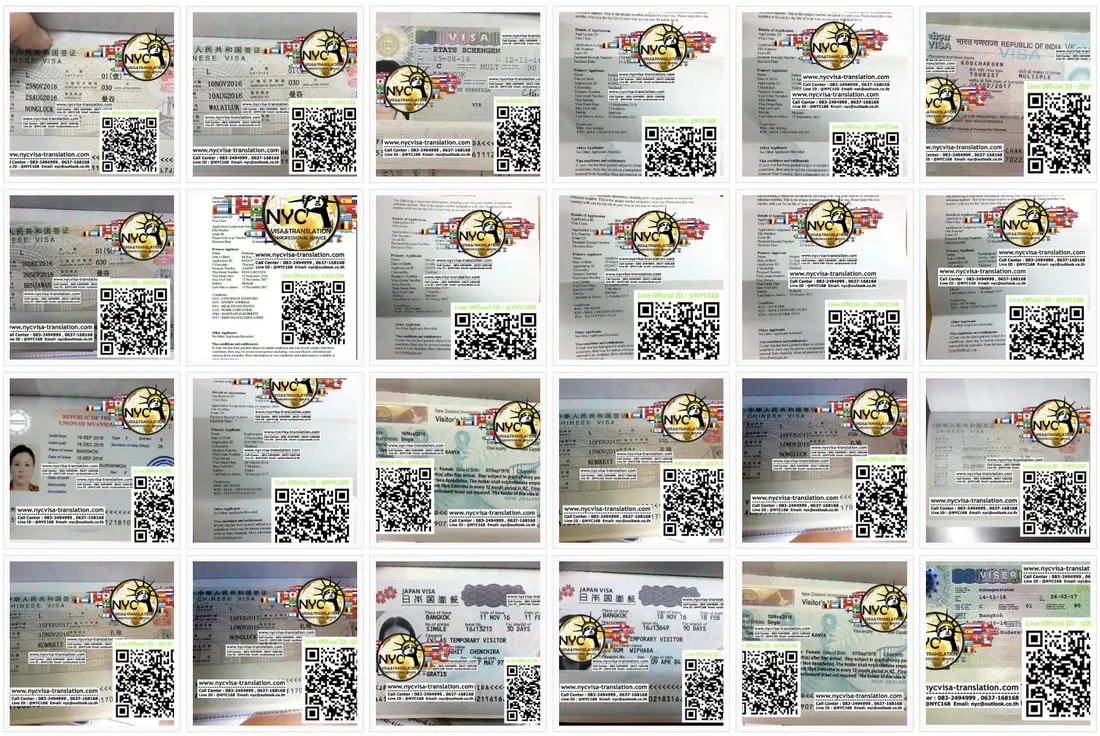
Example of a long-stay visa obtained by an applicant
Example of a long-stay visa obtained by an applicantFrom actual casework by the NYC Visa & Translation team
Service Playbook

Thai visas and extensions — documents, steps and common mistakes

Keep three concepts separate: the visa (permission to travel), the permission to stay stamped at entry, and the work permit. A visa never guarantees admission — the immigration officer at the border decides.

Documents to prepare

  • Passport with sufficient validity and blank pages
  • The application form for your category plus compliant photos
  • Proof of address in Thailand and a TM.30 filed by the housemaster
  • Financial evidence meeting the category rules, seasoned for the required period
  • Category-specific support: marriage certificate, company affidavit or school acceptance letter
  • Foreign documents translated and legalised through the inbound chain

Step-by-step process

  1. 1. Match the category to your purpose Confirm eligibility criteria before assembling any paperwork.
  2. 2. Prepare and translate documents Foreign records need home-country certification plus a Thai-accepted translation.
  3. 3. File through the correct channel Thai embassy abroad, the e-Visa system, or an immigration office in Thailand as applicable.
  4. 4. Post-approval obligations TM.30 notification, 90-day reporting, and a re-entry permit before leaving the country.

Pitfalls and rejection causes

  • Leaving Thailand without a re-entry permit cancels an extension of stay immediately.
  • 90-day reporting is not a visa extension — they are unrelated obligations.
  • Funds must be seasoned for the stated period, not deposited the day before filing.
  • Holding a visa is not permission to work; a separate work permit is required.

Tips from our team

  • Keep copies of every entry stamp and TM.30 for smoother extensions.
  • Read your permitted-to-stay date from the stamp, not the visa validity.
  • Always carry a spare document set; offices differ in copy requirements.

Prefer not to handle the queues yourself, or worried about a rejection? Send us photos of your documents for a free pre-check. We handle the full chain — obtaining certified copies, translation, certification and submission — and keep you updated at each step. Reach us on LINE, phone or email during business hours.

Route Comparison

Comparing routes into a Thai visa

Applying abroad, applying online, or adjusting status inside Thailand give different lengths of stay and later flexibility.

RouteWhen to useCertifying authorityApprox. durationRejection risk
Apply at a Thai embassy or consulate abroadYou can plan ahead and want the correct category from the outsetRoyal Thai Embassy or Consulate-GeneralVariable by postDocument lists and residency rules differ per post — check that specific post
Official e-Visa systemYour category and country of residence are supported onlineMFA Thailand e-Visa systemVariable — file well before the travel dateFiles not matching the system's format specification are auto-rejected
Change or extend status inside ThailandYou are already in Thailand and meet the published criteriaImmigration BureauVariable — file several days before expiryToo few days remaining forces you to leave and re-apply

Timelines above are practical estimates from live casework and can change with each authority's policy; confirm with the receiving authority before booking travel. If you would rather not test routes by trial and error, our advisers can assess which route fits your case.

Advisory Service

We do not just process documents — we advise you through the whole case

Our team has worked on cross-border documents, certified translation and government liaison for over 15 years. Most rejections we see are not caused by missing paperwork but by choosing the wrong route on day one, so we always start with a case assessment.

Route assessment

We look at your destination, purpose and deadline, then tell you which certification route applies — and which steps you can skip.

Pre-submission review

Name spelling, consistency across documents, document age and translation format are checked before anything reaches a counter.

Timeline planning

We sequence the steps around your appointment or travel date and flag bottlenecks in advance.

Rejection recovery

We read the refusal reasons, identify the underlying cause, and plan a resubmission that answers what the authority asked for.

Rather not learn by trial and error? Send your case details and document photos for a review — reach us on LINE, phone or email during business hours.

Practical Q&A

Practical questions · Near me / DIY / Required documents

Where is document legalisation done in Thailand?

Legalisation is handled by the Legalization Division, Department of Consular Affairs, Ministry of Foreign Affairs, whose main office is on Chaeng Watthana Road, plus selected regional passport offices that accept legalisation under the department's announcements. If travelling there is inconvenient, we collect and submit on your behalf from Lat Phrao 95, Khon Kaen and Udon Thani.

Can I submit it myself instead of using an agent?

Yes. The Department of Consular Affairs accepts walk-in and online-booked submissions from the public. The practical risk is sequence and format: official documents must be the issuing authority's version, then translated and certified in the correct order, or they are returned. An agent mainly saves repeat trips and pre-checks the format.

What do I need to bring for legalisation?

Typically the original document issued by the competent authority, a complete and accurate translation, a copy of the document owner's ID or passport, and a power of attorney with the representative's ID copy if someone submits for you. Foreign-issued documents must first be authenticated in the country of origin and by the relevant embassy.
Practical advice & cautions

Legalization & apostille: practical advice and cautions

Before you start
  • Separate public documents from private ones

    Public records such as house registration, birth and marriage certificates enter the certification chain directly. Private documents such as powers of attorney, affidavits and contracts must first be attested by a Notarial Services Attorney.

  • Allow for each step's queue

    Total turnaround depends on the current workload of the consular office and of the destination embassy. Plan ahead rather than against a tight travel date; we can give a case-specific range by phone, LINE or email.

  • Keep a scanned backup at every stage

    Photograph or scan every page before submission and again after each stamp, so you have a reference if a document is lost in transit.

  • Prepare translations in the format the certifying office actually uses

    The Department of Consular Affairs certifies translations presented in its expected format. Self-formatted translations are frequently sent back for correction, costing a full queue cycle.

Common reasons documents get rejected
  • Assuming a Thai lawyer is a common-law notary public

    Thailand has no common-law notary public. The equivalent role is a Notarial Services Attorney registered with the Lawyers Council of Thailand. Describing it incorrectly can cause the receiving party to reject the document.

  • Signature mismatch

    Signature attestation is compared against the signature on the ID card or passport. A different signature style will be refused at the counter.

  • Mixing both routes

    Requesting an apostille and an embassy legalization at the same time when only one is required wastes time and can raise questions at the destination. Pick the single route that matches the destination's convention status.

  • Certifying a copy that no longer matches the register

    If a registry entry changes after the copy was issued, for example a name change or address move, the certified copy will contradict the database. Re-issue before starting.

Requirements differ by authority and destination country and can change. Confirm current conditions with the receiving authority, or ask our team by phone, LINE or email.

What people search for

Frequently searched topics about legalisation

Apostille versus embassy legalisation
Which route applies depends on whether the destination country is a party to the Apostille Convention.
Legalisation by the Department of Consular Affairs
Document legalisation in Thailand is handled by the Legalization Division, Department of Consular Affairs, MFA.
Company documents for overseas use
Obtain a recent certified extract of company records before beginning translation and legalisation.
Foreign documents for use in Thailand
They must first be certified in the issuing country, then translated and legalised in Thailand.

These topics reflect the rules and practice of the relevant authorities and can change. Confirm with the receiving authority, or ask our team by phone, LINE or email.

Related services

What clients usually handle next

One document set often moves through several stages — translation, notarial certification, legalization and finally a visa filing. The links below follow that real sequence.

External authority references

Authority requirements change. Verify with the receiving authority before filing, or ask our team by phone, LINE or email.

Choosing a Thai visa consultant as a foreign national

Choose a Thai visa consultant by how well they match a visa category to your actual situation and long-term plan, not by the fastest route in. Ask them to explain the conditions for maintaining status after approval, including 90-day reporting and re-entry permits, and to separate government fees from their service fee.

How to evaluate a provider

  • Matches the category to your real situationThe wrong category at the start can make later extensions impossible.
  • Explains status-maintenance obligations90-day reporting, re-entry permits and financial conditions affect every extension.
  • Separates government fees from service feesYou should know which part the state collects.
  • Tracks regulatory changesNewer long-stay categories are revised periodically.
  • Plans the extension from day oneExtensions depend on evidence gathered during the first period of stay.

Questions to ask before you commit

  1. How many working days does it actually take, counted from a complete file?
  2. If the receiving authority rejects or asks for changes, do you correct it, and under what terms?
  3. How can I track status, and who physically holds the original documents?
  4. Which visa category fits my situation and my long-term plan?
  5. After approval, what must I do to maintain status and qualify for an extension?

Your options, and who each suits

OptionBest forWhat to know
Apply yourselfApplicants comfortable reading official notices with complete documentsYou must track condition changes and reporting deadlines yourself.
Consultant for the first application onlyNew arrivalsPlan the extension path at the first application, not near expiry.
Ongoing annual supportLong-stay residents and familiesDefine whether reporting and extensions are inside the scope.

FAQ on choosing a provider

Which Thai visa consultant is recommended?
Choose one that identifies the category matching your actual situation, explains the post-approval conditions such as 90-day reporting and re-entry permits, and clearly separates government fees from the service fee. Ask how the first application sets up your future extensions.
Can I change visa category later?
Some categories can be changed in-country, while others require a fresh application at a Thai embassy abroad. That is why the category should match your long-term plan from the first application rather than the quickest available entry.

แหล่งอ้างอิงทางการ · Authoritative Sources

  1. Embassy of the Argentine RepublicEmbassy official site
  2. MFA Department of Consular AffairsThai legalization authority
  3. Ministry of Foreign Affairs (Thai eVisa) + Immigration BureauService-specific authority