ข้ามไปเนื้อหาหลัก / Skip to main content
N
NYC Visa.
Visa & Translation
Marriage Registration · Thai Abroad · 🇹🇭 → 🇸🇪

🇹🇭 Thai × 🇸🇪 Sweden

End-to-end concierge for Thai nationals registering marriage in Sweden — single status affidavit, MFA + embassy legalization, local-language translation, foreign registry appointment, and recording back to the Royal Thai Embassy.

ข้อมูลสำคัญ · Entity Panel
Royal Thai Embassy / Foreign Registry
Royal Thai Embassy, Stockholm
Foreign authority
Skatteverket
Local language
Swedish / English
Apostille country
Yes (Hague 1961)
Standard timeline
2–4 weeks impediment certificate + ceremony
Spouse visa pathway
Sambo / spouse residence permit pathway

🇹🇭 → 🇸🇪 SwedenSambo / spouse residence permit pathway.

End-to-end concierge for Thai nationals registering marriage in Sweden — single status affidavit, MFA + embassy legalization, local-language translation, foreign registry appointment, and recording back to the Royal Thai Embassy.

Thais marrying in Sweden must complete a three-stage authentication chain: single-status affidavit issued by the amphoe → MFA Thailand legalization → Sweden embassy in Bangkok authentication, with translation into Swedish / English before the appointment with Skatteverket, and recording back to Thailand via Royal Thai Embassy, Stockholm.
6-step registration pathway
Step 1
Amphoe affidavit
Single-status affidavit issued in Thailand
Step 2
MFA Thailand
Chaeng Wattana legalization
Step 3
🇸🇪 Embassy BKK
Sweden embassy authentication
Step 4
Translation
Certified Swedish / English translation
Step 5
🇸🇪 Skatteverket
2–4 weeks impediment certificate + ceremony
Step 6
Record in TH
Royal Thai Embassy, Stockholm → amphoe record
Thai-party documents to prepare
Thai National ID card
Tabien Baan (household registration)
Single-status affidavit (amphoe)
Birth certificate (if requested)
Divorce decree / spouse death certificate
Name-change documents (if applicable)
Passport valid 6+ months
Recent passport photos
Apostille is acceptable — issued via MFA
1,500+
Couples processed
30
Destination countries
3 layers
Pre-submission QA
2–4
Standard timeline
HowTo · ขั้นตอน

Thai marriage registration in Sweden

  1. 1

    Submit Thai ID, tabien baan, and prior marital records via LINE @nycvisa.

  2. 2

    Issued at the registrant's amphoe (district office) in Thailand.

  3. 3

    MFA Chaeng Wattana legalizes; Sweden embassy in Bangkok authenticates.

  4. 4

    Translation to Swedish / English by a sworn translator accepted by Skatteverket.

  5. 5

    Skatteverket performs the marriage; 2–4 weeks impediment certificate + ceremony.

  6. 6

    Royal Thai Embassy, Stockholm authenticates; MFA Thailand finalises; amphoe records in tabien baan.

  7. 7

    Sambo / spouse residence permit pathway

FAQ · AEO Block

FAQ · Thai marrying in Sweden

AI Answer Box และ Google SGE มักดึงคำตอบจากบล็อกนี้ไปแสดง

What does a Thai need to marry in Sweden?

Single status affidavit from a Thai amphoe, MFA Thailand legalization, Sweden embassy authentication, certified Swedish / English translation, and an appointment with Skatteverket.

How long does the process take?

Foreign side: 2–4 weeks impediment certificate + ceremony. Document prep in Thailand: 2–3 weeks (MFA + embassy + translation).

Do I need to record the marriage back in Thailand?

Yes — Royal Thai Embassy, Stockholm authenticates the foreign marriage certificate; recording at the amphoe in Thailand updates tabien baan and is required for Thai pension, inheritance, and surname rights.

Can I file the spouse visa immediately?

Sambo / spouse residence permit pathway

Is Sweden a Hague Apostille party?

Yes — apostille issued by MFA Thailand is sufficient once Thailand accedes (transitional embassy-chain still applies for now).

Other destinations

Thai Citizens Marrying in Sweden

End-to-end concierge for Thai nationals registering marriage in Sweden — single status affidavit, MFA + embassy legalization, local-language translation, foreign registry appointment, and recording back to the Royal Thai Embassy.

🇹🇭 × 🇸🇪 2–4 weeks impediment certificate + ceremony 6-step verified
Service Knowledge Base

Marriage, divorce & family-document questions for cross-border use

Answers on marrying a foreign national in Thailand, registering a divorce, and preparing family records (marriage certificate, Kor Ror 2/6, single-status letter) for use with Thai district offices and foreign authorities, following Department of Provincial Administration and MFA Consular procedure. (25+ search topics covered)

What does a Thai district office need before registering a marriage with a foreign national?

The foreign party normally provides an affirmation of freedom to marry issued or witnessed by their embassy in Thailand, translated into Thai and certified by the Department of Consular Affairs, together with a passport and, where applicable, evidence that a previous marriage ended. The district office applies the Civil and Commercial Code and its own registration rules, and it decides whether the file is complete. Requirements differ by nationality, so obtain the embassy's own checklist first.

How is a Thai marriage certificate used abroad?

Request a certified extract from the registrar, have it translated, legalised at the Department of Consular Affairs, and then certified by the destination country's embassy where required. Some countries additionally require the marriage to be recorded in their own civil register.

How long does the process take?

We commit to the translation deadline in writing. Processing rounds at the MFA and at embassies follow those authorities' own queues, so we publish a timeline based on their latest announced schedule rather than a fixed total number of days.

Must both spouses attend every step?

Both parties must attend the registration itself with witnesses. Translation, MFA legalisation and embassy submission can be handled by us where that authority accepts filing by an authorised representative.

How are name spellings kept consistent?

All names must match the passport across every document. Where older records differ, we add a translator's note or advise requesting a same-person certificate from the registrar, so the destination authority does not reject the file.

How recent must marriage documents be for a spouse visa?

Many missions require civil-status extracts issued within roughly three to six months, but the exact window varies by country and visa type. We check the mission's published requirement before scheduling the date you obtain the extract.

What is the documentary difference between an administrative and a court divorce?

A consent divorce at the registrar produces the divorce register (Kor Ror 6) and divorce certificate (Kor Ror 7). A court divorce is evidenced by the judgment plus a certificate of finality. Foreign authorities usually ask for the complete set.

Does Thailand issue apostilles yet?

Not yet — the Convention has not entered into force for Thailand. Thai documents still follow MFA legalisation plus embassy attestation. Our apostille status block states the entry-into-force date with the source link.
Topics covered
ขั้นรับรองต่อเนื่อง: รับรองเอกสารสมรสกรมการกงสุล · รับรองใบสมรสสถานทูต · นิติกรณ์เอกสารครอบครัว · แปลรับรองเอกสารสมรสยื่นต่างประเทศ · รับรองใบหย่าเพื่อใช้ต่างประเทศ
ใช้ต่อกับวีซ่าและทะเบียนต่างประเทศ: เอกสารสมรสยื่นวีซ่าคู่สมรส · spouse visa document thailand · แจ้งทะเบียนสมรสที่ต่างประเทศ · เอกสารรับรองบุตรเพื่อยื่นวีซ่า · เอกสารครอบครัวยื่นตรวจคนเข้าเมือง
คำค้นหลัก: จดทะเบียนสมรสกับชาวต่างชาติ · ขั้นตอนจดทะเบียนสมรสต่างชาติ · marriage registration thailand foreigner · หนังสือรับรองโสด · certificate of freedom to marry thailand · จดทะเบียนหย่ากับชาวต่างชาติ · แปลใบสำคัญการสมรส
Official references

Need your documents reviewed or your case assessed? Ask our team by phone, LINE, or email. We reply during business hours (Mon–Fri 9:00–18:00, Sat 9:00–15:00, ICT).

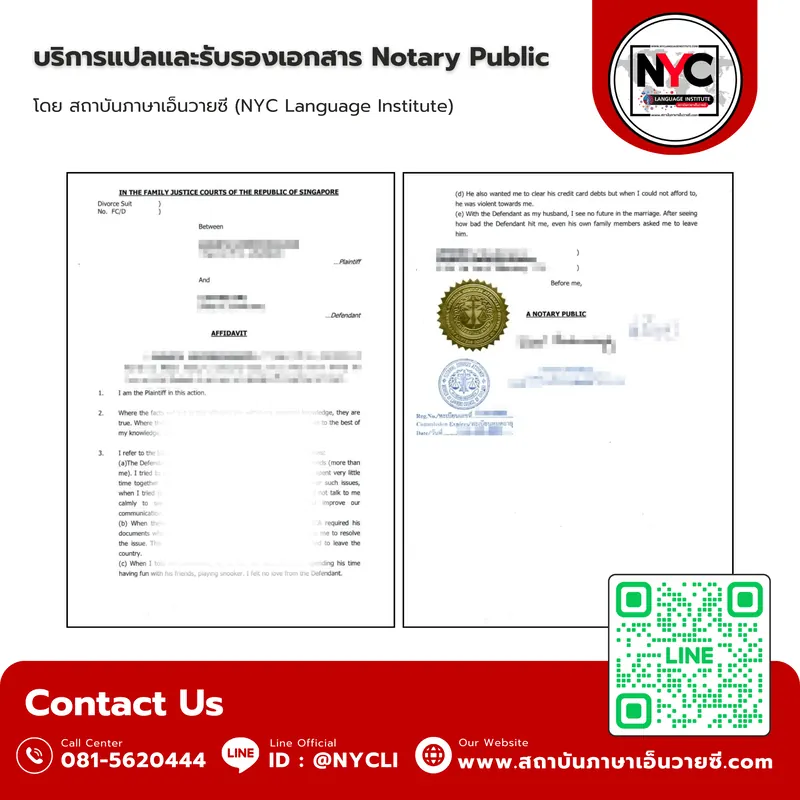
Single-status affidavit with notarial signature certification
Single-status affidavit with notarial signature certificationFrom actual casework by the NYC Visa & Translation team
Service Playbook

Marriage and family documents — two directions to keep apart

Cross-border family paperwork always runs in one of two directions: registered in Thailand for use abroad (outbound), or registered abroad for use in Thailand (inbound). Documents and sequence differ completely.

Documents to prepare

  • Passports and ID cards of both parties
  • Affirmation of freedom to marry for the foreign national, from their authority or embassy
  • Divorce decree or death certificate of a previous spouse where applicable
  • Thai translations of every foreign document
  • House registration of the Thai party
  • Two witnesses with ID on the registration day

Step-by-step process

  1. 1. Obtain the affirmation The foreign national requests it from their embassy or home authority.
  2. 2. Legalise and translate Certify at the issuing embassy, then translate into Thai and legalise at the Department of Consular Affairs.
  3. 3. Register at the district office File the full set with two witnesses present.
  4. 4. Use the record abroad Obtain certified extracts, translate, and follow the destination country's legalisation chain.

Pitfalls and rejection causes

  • Many destinations require both the certificate and the register extract.
  • Affirmations of single status have very short validity — book the registration date first.
  • Spellings must match the passport across every document.
  • Marriage does not by itself grant residence or the right to work.

Tips from our team

  • Book the district appointment and arrange an interpreter in advance if needed.
  • Request several certified extracts on registration day.
  • Tell us early if several countries are involved so the order can be planned.

Prefer not to handle the queues yourself, or worried about a rejection? Send us photos of your documents for a free pre-check. We handle the full chain — obtaining certified copies, translation, certification and submission — and keep you updated at each step. Reach us on LINE, phone or email during business hours.

Route Comparison

Comparing cross-national marriage registration routes

Registering in Thailand or abroad produces different paperwork and different certification chains.

RouteWhen to useCertifying authorityApprox. durationRejection risk
Register the marriage in ThailandBoth partners are in Thailand and need a Thai marriage certificateDistrict office, with an affirmation of freedom to marry from the foreign partner's embassyVariable — often a few working days once the file is completeThe affirmation has not been translated and certified as the district office requires
Register abroad, then record the family status in ThailandThe couple lives abroad, or the destination requires local registrationThat country's registry, then the Thai district registrarVariable, including international legalisation timeSkipping the Thai family-status recording, leaving Thai records showing the previous status

Timelines above are practical estimates from live casework and can change with each authority's policy; confirm with the receiving authority before booking travel. If you would rather not test routes by trial and error, our advisers can assess which route fits your case.

Advisory Service

We do not just process documents — we advise you through the whole case

Our team has worked on cross-border documents, certified translation and government liaison for over 15 years. Most rejections we see are not caused by missing paperwork but by choosing the wrong route on day one, so we always start with a case assessment.

Route assessment

We look at your destination, purpose and deadline, then tell you which certification route applies — and which steps you can skip.

Pre-submission review

Name spelling, consistency across documents, document age and translation format are checked before anything reaches a counter.

Timeline planning

We sequence the steps around your appointment or travel date and flag bottlenecks in advance.

Rejection recovery

We read the refusal reasons, identify the underlying cause, and plan a resubmission that answers what the authority asked for.

Rather not learn by trial and error? Send your case details and document photos for a review — reach us on LINE, phone or email during business hours.

Practical Q&A

Practical questions · Near me / DIY / Required documents

Where does a foreigner start to marry in Thailand?

Start at your embassy in Thailand for an Affirmation of Freedom to Marry, have it translated into Thai and legalised by the Legalization Division of the Department of Consular Affairs, then register at any district office (khet/amphoe) under the Department of Provincial Administration.

Can we do it ourselves, and is an interpreter required?

Every step is open to the couple. On registration day, many registrars require an interpreter and witnesses if the foreign spouse does not understand Thai. Call the specific district office in advance, as interpreter and witness practice varies by office.

What documents are needed, and what if we use the certificate abroad?

Typically: the foreign spouse's original passport, the Thai spouse's ID card and house registration, the legalised affirmation with Thai translation, and divorce or death certificates if previously married. To use the Thai marriage certificate abroad, have it translated and legalised at the Department of Consular Affairs first, then certified by the destination country's embassy where required.
Practical advice & cautions

Family and civil-registration matters: advice and cautions

Before you start
  • Registration and legalisation are two separate steps

    Marriage and divorce are registered at a district office, while certification for overseas use is handled by the Legalization Division of the Department of Consular Affairs. Getting the order right avoids repeating steps.

  • Foreign divorce papers need a complete certification chain

    Foreign judgments or divorce certificates must be certified under the issuing country's system (apostille or embassy legalisation) before Thai translation and certification. Reversing the order usually means starting again.

  • Match name spelling to the passport exactly

    Names in translations, registration records and supporting documents must match the passport character for character. A single-letter difference is the most common rejection cause.

  • Foreign nationals usually need an affirmation from their embassy

    Many district offices require a single-status or marital-status affirmation issued by the applicant's embassy or consulate, translated into Thai and legalised before submission. Confirm the format with your embassy first.

Common reasons documents get rejected
  • Submitting translations that were never legalised

    Most documents for overseas use require translation certification by the Department of Consular Affairs. A translation agency stamp alone is often not accepted.

  • Filing at the wrong district office

    Some civil-registration matters are tied to the district recorded in the house registration. Filing elsewhere may be refused or take longer.

  • Assuming Thai lawyers act as international notaries public

    Thailand has no notary public system. Lawyers registered with the Lawyers Council of Thailand act as Notarial Services Attorneys, and some countries require further certification by the Department of Consular Affairs.

  • Overlooking the foreign spouse's documents

    Files are often complete on the Thai side while the foreign party's documents still lack the correct certification chain, blocking submission on the appointment day.

Requirements differ by authority and destination country and can change. Confirm current conditions with the receiving authority, or ask our team by phone, LINE or email.

What people search for

Frequently searched topics about family and civil registration

Using a foreign divorce decree in Thailand
It must be certified in the issuing country first, then translated and legalised in Thailand.
Recording family status in Thailand
Marriages or divorces performed abroad may need to be recorded at a Thai registry office for consistency.
Marriage registration with a foreign national
District offices commonly require an affirmation of status from the foreign party's embassy, translated and legalised.
Child travel consent letters
The accepted format and certifier are set by the receiving authority; confirm before drafting.

These topics reflect the rules and practice of the relevant authorities and can change. Confirm with the receiving authority, or ask our team by phone, LINE or email.

Related services

What clients usually handle next

One document set often moves through several stages — translation, notarial certification, legalization and finally a visa filing. The links below follow that real sequence.

External authority references

Authority requirements change. Verify with the receiving authority before filing, or ask our team by phone, LINE or email.

Choosing a document translation provider in Thailand

Pick a translation provider by the destination, not by turnaround alone. If the file goes to the Thai Department of Consular Affairs or an embassy, the translator must know the format that office accepts, not just the meaning. Verify three things: the certifier is named and identifiable, the destination accepts that certification format, and names, dates and document numbers match the passport character for character.

How to evaluate a provider

  • The certifier is named and identifiableConsular offices and embassies check who certified the translation, not only the wording.
  • Knows the format the destination acceptsEach embassy differs: attached source copy, letterhead, or prior consular legalization.
  • Character-level verificationMismatched name spelling and dates against the passport is the most common rejection cause.
  • Owns corrections after rejectionSubmissions run on appointment dates; slow corrections cost the applicant the slot.
  • Documented custody of originalsSome civil registry documents are hard to reissue, so intake and return must be traceable.

Questions to ask before you commit

  1. Who will certify this translation, and will the certifier be named on the document?
  2. Does my destination require consular or embassy legalization afterwards?
  3. How many working days does it actually take, counted from a complete file?
  4. If the receiving authority rejects or asks for changes, do you correct it, and under what terms?
  5. How can I track status, and who physically holds the original documents?

Your options, and who each suits

OptionBest forWhat to know
Freelance translatorInformal use where no authority certification is requiredMany embassies will not accept an uncertified translation.
Translation agency with certificationVisa, study and civil registry filingsConfirm the agency also handles the legalization step if the destination requires it.
End-to-end provider (translate + legalize)Files with a fixed appointment deadlineAsk which steps are in-house and which are subcontracted.

FAQ on choosing a provider

Which translation service is recommended for embassy submissions?
Choose one that names the certifier on the translation, knows the exact format your embassy accepts, and verifies names and dates against the passport before certifying. Ask whether they also handle consular legalization so the file does not stall between two vendors.
Does a cheaper translation get rejected more often?
Rejection correlates with format and verification, not price. A translation is rejected when the certifier cannot be identified, the layout does not match the receiving office's requirement, or a name or date differs from the passport.

แหล่งอ้างอิงทางการ · Authoritative Sources

  1. Royal Thai Embassy, StockholmRoyal Thai Embassy in Sweden
  2. MFA Department of Consular AffairsThai legalization bridge
  3. SkatteverketForeign registry authority