Court & justice documents · MoJ
Translating and legalizing Thai court documents
Documents from Thai courts and justice agencies — judgments, divorce decrees, custody orders, powers of attorney — usually need translation and several legalization steps before use abroad. We help obtain certified originals, translate, and coordinate the Ministry of Justice, MFA and embassy steps.
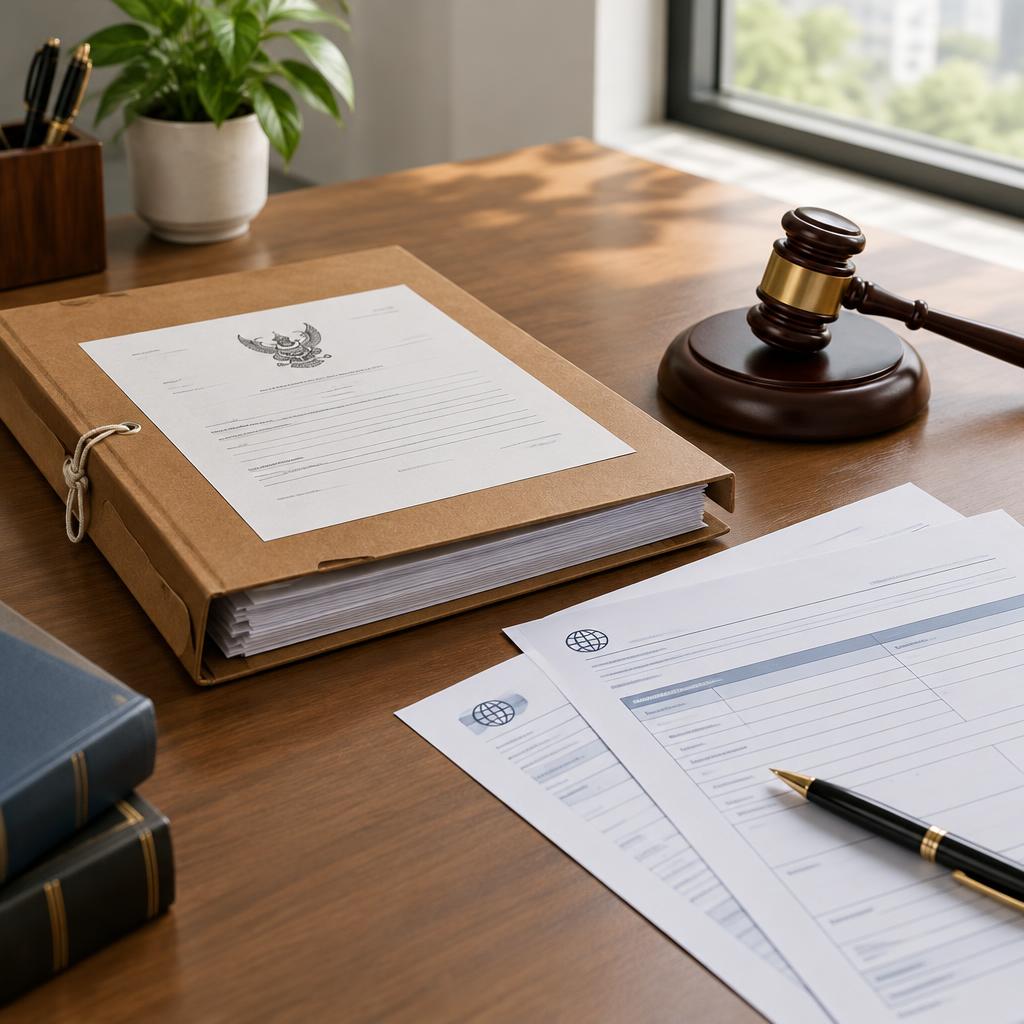
Send the document type and destination country for a quotationIllustrative preparation image — not a client or an official document.
The overall steps
- Step 1
Identify the document and destination
Tell us the document type — judgment, divorce decree, power of attorney — and the country of use, because each receiving authority sets different steps.
- Step 2
Obtain the original or certified copy
Court documents must be requested as certified copies from the issuing court, the Legal Execution Department or the Legal Affairs Division, depending on the document.
- Step 3
Translate and proofread
A legal translator translates the document; names, case numbers and dates are proofread against the original.
- Step 4
Legalize in sequence
The documents are legalized at the relevant Thai authority, the Ministry of Foreign Affairs, and the destination country's embassy where required.
- Step 5
Deliver after checking
Every stamp and certification wording is checked before delivery so the documents are ready for the receiving authority.
What to know before proceeding
- Each court document type is issued by a different body — the Courts of Justice, the Legal Execution Department or the Legal Affairs Division — and must be requested from the correct source.
- Thailand is not a party to the Apostille Convention; most documents for use abroad need MFA legalization and possibly the destination embassy's legalization.
- Translation and legalization do not guarantee the receiving authority will accept the documents; always check the recipient's requirements first.
- Documents concerning persons, such as custody or adoption orders, may require supporting papers from the Ministry of Social Development or other agencies.
Official fees of the courts, the Ministry of Justice and the MFA are published by each agency. Our service fee is given separately in a written quotation.
Frequently asked questions
Where do I request court documents?
Certified copies of judgments or court orders are requested from the court that heard the case; some certificates are issued by the Legal Affairs Division of the Ministry of Justice.
Is a court criminal-record certificate the same as Police Clearance?
No. A court certificate shows case status in the courts, while Police Clearance is issued by the Royal Thai Police. Some receiving authorities ask for both.
How many legalization steps are needed?
It depends on the destination country: typically the relevant Thai authority, the MFA, and that country's embassy. We do not fix the steps until the destination is known.
Can a power of attorney be signed abroad?
Yes. It is generally signed before a Notarial Services Attorney or a Thai embassy in that country, then legalized in Thailand as required.
How long does it take?
It depends on the document type, the availability of the original and each authority's further steps; we do not promise a fixed period and give a timeframe after review.
What does it cost?
It depends on the number of documents, the translation language and the number of legalization steps. We quote after review. No guarantee of outcome and no refund policy.
Official sources
- กระทรวงยุติธรรม — กองนิติการ / Ministry of Justice, Legal Affairs Division
- กระทรวงการต่างประเทศ — การรับรองนิติกรณ์เอกสาร / Ministry of Foreign Affairs, Legalization
- ศาลยุติธรรม — ขอสำเนาคำพิพากษาและเอกสารคดี / Courts of Justice
Head office Ladprao 95 · replies within 2 hours in business hours, Mon–Sat 09:00–18:00 (Thailand time)
We do not guarantee any authority's decision, and the company has no refund policy.
Contact our staff