Not found.
Thailand visa answer bank — LTR, DTV and staying on in Thailand
Answers to the Thailand visa questions applicants actually ask: the BOI-administered LTR visa, the DTV for remote workers and Thai Soft Power activities, filing through Thai e-Visa, and extending stay on form TM.7 — plus which supporting documents must be translated and certified. Based on MFA, Immigration Bureau and BOI announcements. (27+ search topics covered)
How does a visa differ from permission to stay?
What is the DTV and how does it differ from the LTR?
Does the Immigration Bureau accept documents in English without translation?
Can a DTV holder work for a Thai company?
How should financial evidence be presented?
Can I change visa category inside Thailand?
What is the LTR visa and who decides it?
What is the difference between TM30 and 90-day reporting?
- Thai e-Visa Official Portal (กระทรวงการต่างประเทศ) — ช่องทางยื่นวีซ่าเข้าประเทศไทยอย่างเป็นทางการ
- สำนักงานตรวจคนเข้าเมือง (Thai Immigration Bureau) — ระเบียบการต่อวีซ่า รายงานตัว 90 วัน และ re-entry permit
- สำนักงานคณะกรรมการส่งเสริมการลงทุน (BOI) — LTR Visa และ SMART Visa
- LTR Visa – Thailand Board of Investment
Need your documents reviewed or your case assessed? Ask our team by phone, LINE, or email. We reply during business hours (Mon–Fri 9:00–18:00, Sat 9:00–15:00, ICT).
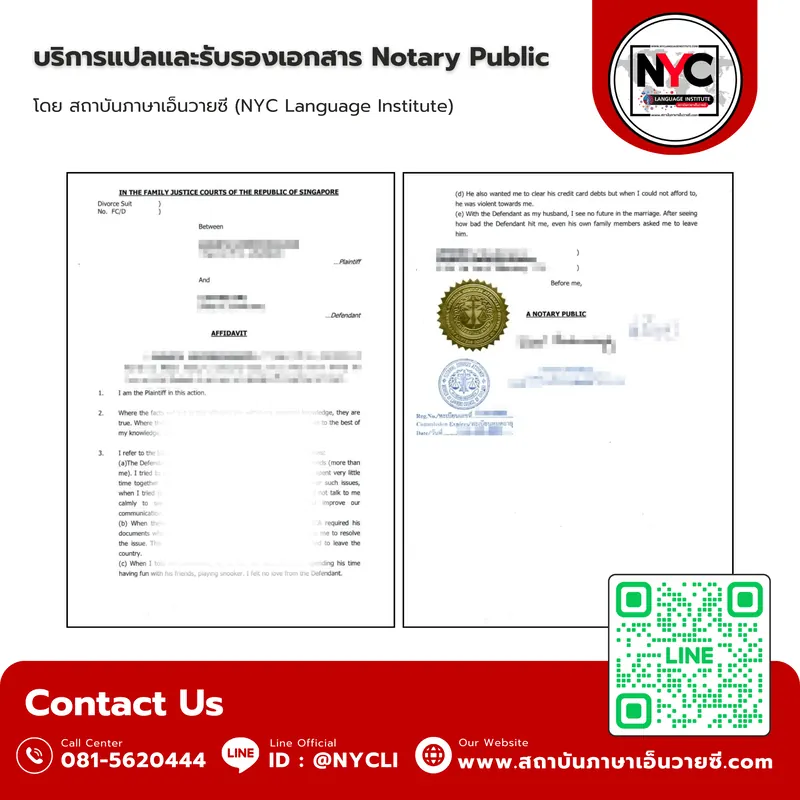
Thai visas and extensions — documents, steps and common mistakes
Keep three concepts separate: the visa (permission to travel), the permission to stay stamped at entry, and the work permit. A visa never guarantees admission — the immigration officer at the border decides.
Documents to prepare
- • Passport with sufficient validity and blank pages
- • The application form for your category plus compliant photos
- • Proof of address in Thailand and a TM.30 filed by the housemaster
- • Financial evidence meeting the category rules, seasoned for the required period
- • Category-specific support: marriage certificate, company affidavit or school acceptance letter
- • Foreign documents translated and legalised through the inbound chain
Step-by-step process
- 1. Match the category to your purpose — Confirm eligibility criteria before assembling any paperwork.
- 2. Prepare and translate documents — Foreign records need home-country certification plus a Thai-accepted translation.
- 3. File through the correct channel — Thai embassy abroad, the e-Visa system, or an immigration office in Thailand as applicable.
- 4. Post-approval obligations — TM.30 notification, 90-day reporting, and a re-entry permit before leaving the country.
Pitfalls and rejection causes
- • Leaving Thailand without a re-entry permit cancels an extension of stay immediately.
- • 90-day reporting is not a visa extension — they are unrelated obligations.
- • Funds must be seasoned for the stated period, not deposited the day before filing.
- • Holding a visa is not permission to work; a separate work permit is required.
Tips from our team
- • Keep copies of every entry stamp and TM.30 for smoother extensions.
- • Read your permitted-to-stay date from the stamp, not the visa validity.
- • Always carry a spare document set; offices differ in copy requirements.
Prefer not to handle the queues yourself, or worried about a rejection? Send us photos of your documents for a free pre-check. We handle the full chain — obtaining certified copies, translation, certification and submission — and keep you updated at each step. Reach us on LINE, phone or email during business hours.
Comparing routes into a Thai visa
Applying abroad, applying online, or adjusting status inside Thailand give different lengths of stay and later flexibility.
| Route | When to use | Certifying authority | Approx. duration | Rejection risk |
|---|---|---|---|---|
| Apply at a Thai embassy or consulate abroad | You can plan ahead and want the correct category from the outset | Royal Thai Embassy or Consulate-General | Variable by post | Document lists and residency rules differ per post — check that specific post |
| Official e-Visa system | Your category and country of residence are supported online | MFA Thailand e-Visa system | Variable — file well before the travel date | Files not matching the system's format specification are auto-rejected |
| Change or extend status inside Thailand | You are already in Thailand and meet the published criteria | Immigration Bureau | Variable — file several days before expiry | Too few days remaining forces you to leave and re-apply |
Timelines above are practical estimates from live casework and can change with each authority's policy; confirm with the receiving authority before booking travel. If you would rather not test routes by trial and error, our advisers can assess which route fits your case.
We do not just process documents — we advise you through the whole case
Our team has worked on cross-border documents, certified translation and government liaison for over 15 years. Most rejections we see are not caused by missing paperwork but by choosing the wrong route on day one, so we always start with a case assessment.
Route assessment
We look at your destination, purpose and deadline, then tell you which certification route applies — and which steps you can skip.
Pre-submission review
Name spelling, consistency across documents, document age and translation format are checked before anything reaches a counter.
Timeline planning
We sequence the steps around your appointment or travel date and flag bottlenecks in advance.
Rejection recovery
We read the refusal reasons, identify the underlying cause, and plan a resubmission that answers what the authority asked for.
Rather not learn by trial and error? Send your case details and document photos for a review — reach us on LINE, phone or email during business hours.
Practical questions · Near me / DIY / Required documents
Where does a foreigner start to marry in Thailand?
Can we do it ourselves, and is an interpreter required?
What documents are needed, and what if we use the certificate abroad?
Family and civil-registration matters: advice and cautions
Match name spelling to the passport exactly
Names in translations, registration records and supporting documents must match the passport character for character. A single-letter difference is the most common rejection cause.
Registration and legalisation are two separate steps
Marriage and divorce are registered at a district office, while certification for overseas use is handled by the Legalization Division of the Department of Consular Affairs. Getting the order right avoids repeating steps.
Foreign divorce papers need a complete certification chain
Foreign judgments or divorce certificates must be certified under the issuing country's system (apostille or embassy legalisation) before Thai translation and certification. Reversing the order usually means starting again.
Obtain freshly issued civil records
Receiving authorities often limit how old a certified copy may be. Ask about the accepted validity period first, then request the copy and start translation.
Overlooking the foreign spouse's documents
Files are often complete on the Thai side while the foreign party's documents still lack the correct certification chain, blocking submission on the appointment day.
Using records older than the accepted validity period
Old certified copies of house registration, single-status affirmations or birth certificates can be refused even when the content is correct.
Submitting translations that were never legalised
Most documents for overseas use require translation certification by the Department of Consular Affairs. A translation agency stamp alone is often not accepted.
Filing at the wrong district office
Some civil-registration matters are tied to the district recorded in the house registration. Filing elsewhere may be refused or take longer.
Requirements differ by authority and destination country and can change. Confirm current conditions with the receiving authority, or ask our team by phone, LINE or email.
Frequently searched topics about family and civil registration
- Marriage registration with a foreign national
- District offices commonly require an affirmation of status from the foreign party's embassy, translated and legalised.
- Child travel consent letters
- The accepted format and certifier are set by the receiving authority; confirm before drafting.
- Using a foreign divorce decree in Thailand
- It must be certified in the issuing country first, then translated and legalised in Thailand.
- Recording family status in Thailand
- Marriages or divorces performed abroad may need to be recorded at a Thai registry office for consistency.
These topics reflect the rules and practice of the relevant authorities and can change. Confirm with the receiving authority, or ask our team by phone, LINE or email.
What clients usually handle next
One document set often moves through several stages — translation, notarial certification, legalization and finally a visa filing. The links below follow that real sequence.
- Thailand visas for foreign nationalsNew applications, extensions, status changes and 90-day reporting
- Thai work permitsNew applications, renewals and amendments under Department of Employment rules
- BOI, LTR and SMART VisaInvestment promotion privileges and long-term visas for specialists
- Thai–foreign marriage registrationAffirmation of freedom to marry, embassy certification and district office registration
- Thai citizenship & permanent residenceEligibility tracks, supporting documents and interview preparation
- MFA legalization at the Department of Consular AffairsThe step after translation for documents used abroad or filed with an embassy
- Thai e-Visa Official Portal (กระทรวงการต่างประเทศ) — ช่องทางยื่นวีซ่าเข้าประเทศไทยอย่างเป็นทางการ
- สำนักงานตรวจคนเข้าเมือง (Thai Immigration Bureau) — ระเบียบการต่อวีซ่า รายงานตัว 90 วัน และ re-entry permit
- สำนักงานคณะกรรมการส่งเสริมการลงทุน (BOI) — LTR Visa และ SMART Visa
- LTR Visa – Thailand Board of Investment
Authority requirements change. Verify with the receiving authority before filing, or ask our team by phone, LINE or email.