Work permit track not found.
Work permits, BOI/IEAT privileges, Treaty of Amity and APEC card — practical answers
First-party answers on Thai work authorisation: the standard Department of Employment route, BOI and IEAT channels for skilled experts, US company rights under the Treaty of Amity, and the APEC Business Travel Card for Thai nationals — including which supporting documents must be translated and legalised first. (19+ search topics covered)
Must authorisation be obtained before starting work?
Is a work permit the same as a visa in Thailand?
Why are Thai work permit applications commonly returned?
What must be done when changing employer or job title?
How are foreign degrees and experience letters used for a Thai work permit?
What happens to the permit if I change employer or job title?
Can I start working while the application is pending?
Which authority decides a work permit, and what does it not cover?
- สำนักงานตรวจคนเข้าเมือง (Thai Immigration Bureau) — ระเบียบการต่อวีซ่า รายงานตัว 90 วัน และ re-entry permit
- Thai e-Visa Official Portal (กระทรวงการต่างประเทศ) — ช่องทางยื่นวีซ่าเข้าประเทศไทยอย่างเป็นทางการ
- กรมการจัดหางาน (Department of Employment) — ใบอนุญาตทำงาน (work permit) และ Digital Workpermit
Need your documents reviewed or your case assessed? Ask our team by phone, LINE, or email. We reply during business hours (Mon–Fri 9:00–18:00, Sat 9:00–15:00, ICT).
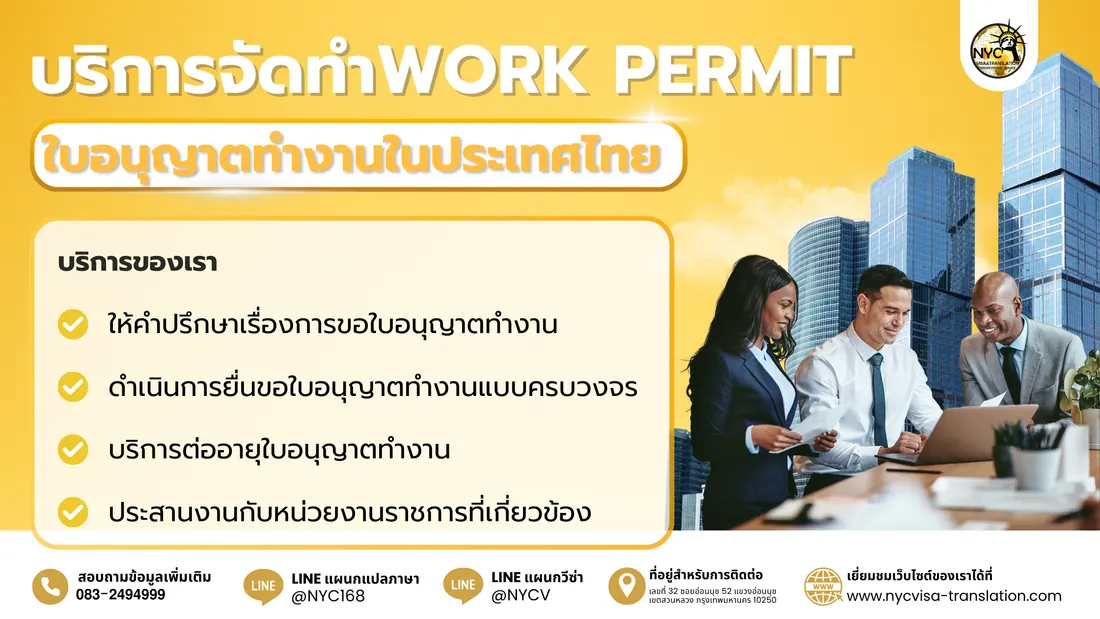
Thai work permit — company-side and employee-side documents
Work permits are issued by the Department of Employment and are tied to the employer, position and workplace. Changing job, role or location requires a new filing.
Documents to prepare
- • Company side: current affidavit, shareholder list, financial statements, social security filings
- • Employee side: passport, the correct visa category, and the required medical certificate
- • Degrees and experience letters, legalised at source and translated for Thai use
- • Employment contract and job description
- • Workplace map and photographs where requested
- • Power of attorney for the company's filing agent
Step-by-step process
- 1. Check company and role eligibility — Registered capital, Thai-to-foreign staff ratio and reserved occupations are verified first.
- 2. Prepare foreign documents — Qualifications and experience letters must be legalised abroad and translated before filing.
- 3. File the application — Through the Department of Employment, or a dedicated channel such as the BOI One Stop Service.
- 4. Collect and comply — Work only within the stated role and location, and renew before expiry.
Pitfalls and rejection causes
- • Working outside the stated role or location breaches the permit conditions.
- • A permit belongs to the employer — it cannot follow you to a new company.
- • Visa and permit expire on different dates; track both.
- • Company documents older than the accepted window must be reissued.
Tips from our team
- • Set reminders at least 45 days before either expiry date.
- • Maintain a standing company document pack to speed up future filings.
- • BOI-promoted companies should use the dedicated channel to cut steps.
Prefer not to handle the queues yourself, or worried about a rejection? Send us photos of your documents for a free pre-check. We handle the full chain — obtaining certified copies, translation, certification and submission — and keep you updated at each step. Reach us on LINE, phone or email during business hours.
Comparing Thai work permit routes
Different employer types use different channels, and each channel pairs with a different visa category.
| Route | When to use | Certifying authority | Approx. duration | Rejection risk |
|---|---|---|---|---|
| Standard filing with the Department of Employment | The employer is an ordinary Thai company without BOI promotion | Department of Employment, Ministry of Labour | Variable, driven by how complete the employer's file is | Thai-to-foreign staff ratios and registered capital not meeting thresholds is the common refusal ground |
| BOI-promoted company channel | The employer holds a promotion certificate and the position is on the approved list | BOI together with the Immigration Bureau and Department of Employment | Generally faster than the standard route, still variable | A position that differs from the approved list requires an amendment first |
| Conditional or short-term work authorisation | Short assignments or job types covered by specific published rules | Department of Employment under the notification in force | Shorter than a full application | Working beyond the authorised scope is an offence even when a permit exists |
Timelines above are practical estimates from live casework and can change with each authority's policy; confirm with the receiving authority before booking travel. If you would rather not test routes by trial and error, our advisers can assess which route fits your case.
We do not just process documents — we advise you through the whole case
Our team has worked on cross-border documents, certified translation and government liaison for over 15 years. Most rejections we see are not caused by missing paperwork but by choosing the wrong route on day one, so we always start with a case assessment.
Route assessment
We look at your destination, purpose and deadline, then tell you which certification route applies — and which steps you can skip.
Pre-submission review
Name spelling, consistency across documents, document age and translation format are checked before anything reaches a counter.
Timeline planning
We sequence the steps around your appointment or travel date and flag bottlenecks in advance.
Rejection recovery
We read the refusal reasons, identify the underlying cause, and plan a resubmission that answers what the authority asked for.
Rather not learn by trial and error? Send your case details and document photos for a review — reach us on LINE, phone or email during business hours.
Practical questions · Near me / DIY / Required documents
Where is a Thai work permit filed, and must the employee attend?
How must foreign supporting documents be translated and certified?
Can I handle the application myself?
Visa and immigration matters: advice and cautions
Check passport validity and blank pages
Many countries set a minimum remaining validity and number of blank pages. Verify before your appointment.
Keep every receipt and acknowledgement
Photograph all filing receipts and stamps; they are key evidence in any later verification.
Order documents to the authority's checklist
Assembling the bundle in the required order with an index speeds up assessment and reduces requests for more documents.
Plan around expiry dates
Extensions, reporting and re-entry permits should be handled well ahead of the deadline; queues and public holidays can make last-minute filing impossible.
Refiling immediately without fixing the cause
Analyse the refusal grounds and address them; resubmitting the same file usually produces the same result.
Form data contradicting the attachments
Dates, addresses or travel history that conflict with supporting documents are a frequent refusal ground and may be read as misrepresentation.
Expired supporting documents
Civil registry extracts, medical certificates and police clearances have limited validity; old copies make the bundle incomplete.
Believing guaranteed-approval claims
No provider can guarantee an outcome; only the immigration authority or embassy decides. Our role is to make the file accurate and complete so avoidable rejections are reduced.
Requirements differ by authority and destination country and can change. Confirm current conditions with the receiving authority, or ask our team by phone, LINE or email.
Frequently searched topics about visas and immigration
- Extensions and periodic reporting
- Long-stay holders must report at the intervals set by the Immigration Bureau.
- A visa is not a work authorisation
- Holding a visa does not automatically grant work rights; a work permit is a separate matter.
- Notification of residence for foreign nationals
- House owners or occupiers must notify the stay of foreign nationals under Thai immigration law.
- Documents required for a visa application
- Checklists are set by the embassy or receiving authority; always follow their current published notice.
These topics reflect the rules and practice of the relevant authorities and can change. Confirm with the receiving authority, or ask our team by phone, LINE or email.
What clients usually handle next
One document set often moves through several stages — translation, notarial certification, legalization and finally a visa filing. The links below follow that real sequence.
- Thailand visas for foreign nationalsNew applications, extensions, status changes and 90-day reporting
- Thai work permitsNew applications, renewals and amendments under Department of Employment rules
- BOI, LTR and SMART VisaInvestment promotion privileges and long-term visas for specialists
- Thai–foreign marriage registrationAffirmation of freedom to marry, embassy certification and district office registration
- Thai citizenship & permanent residenceEligibility tracks, supporting documents and interview preparation
- MFA legalization at the Department of Consular AffairsThe step after translation for documents used abroad or filed with an embassy
- Thai e-Visa Official Portal (กระทรวงการต่างประเทศ) — ช่องทางยื่นวีซ่าเข้าประเทศไทยอย่างเป็นทางการ
- สำนักงานตรวจคนเข้าเมือง (Thai Immigration Bureau) — ระเบียบการต่อวีซ่า รายงานตัว 90 วัน และ re-entry permit
- สำนักงานคณะกรรมการส่งเสริมการลงทุน (BOI) — LTR Visa และ SMART Visa
- LTR Visa – Thailand Board of Investment
Authority requirements change. Verify with the receiving authority before filing, or ask our team by phone, LINE or email.