ข้ามไปเนื้อหาหลัก / Skip to main content
N
NYC Visa.
Visa & Translation
Corporate documents · B2B / Investment · 🏛️ BOI · Board of Investment

Notary Public (Notarial Services Attorney) · BOI · Board of Investment 🏛️

Notary Public (Notarial Services Attorney) for BOI · Board of Investment 🏛️ — corporate clients include MNCs, listed companies, and foreign JVs needing parent-company papers valid in Thailand.

ข้อมูลสำคัญ · Entity Panel
Authorities involved
Board of Investment Thailand, One Stop Service Center (OSOS) at Chamchuri Square
Target clients
BOI-promoted foreign companies, Smart Visa holders working at BOI-certified firms
Corporate documents we handle
8 corporate docs
Source jurisdictions
japan, usa, germany, china
Visa / Work Permit categories
4 visa categories

Foreign parent-company documents for BOI applications need Apostille or Embassy Legalization + certified Thai translation before filing at OSOS Chamchuri — B2B work differs from personal cases: corporate notarization, state-of-registration Apostille, and DBD/BOI/EECO-accepted Thai translations are non-negotiable.

2,300+ BOI projects approved annually · ฿800B+ investment value. NYC Visa supports Bangkok-based law firms and Big-4 corporate teams; we know the submission formats expected by Board of Investment Thailand, One Stop Service Center (OSOS) at Chamchuri Square.

Frequent BOI · Board of Investment documents: Certificate of Incorporation (parent company), Board Resolution to invest in Thailand, Power of Attorney, Passport of Directors / Authorized Persons, Audited Financial Statement (3 yrs) — packed with binder + Thai cover letter.

Workflow: (1) Legal team shares drafts (2) We coordinate origin-country Notary (3) Apostille or Embassy Legalization (4) DHL tracked shipping (5) MFA Thailand + Thai Notary translation (6) Submission to Board of Investment Thailand, One Stop Service Center (OSOS) at Chamchuri Square.
Corporate documents we handle
Certificate of Incorporation (parent company)
Board Resolution to invest in Thailand
Power of Attorney
Passport of Directors / Authorized Persons
Audited Financial Statement (3 yrs)
Project Feasibility Study
Memorandum & Articles of Association
Tax Residency Certificate
Visa / Work Permit categories
Smart Visa (T/I/E/S/O)
BOI Visa & Work Permit
Non-Immigrant B (BOI)
LTR-WP
Source jurisdictions
1,200+
Corporate cases/yr
3–6w
Standard SLA
40+
Source countries
HowTo · ขั้นตอน

How to use Notary Public (Notarial Services Attorney) for BOI · Board of Investment

  1. 1

    Legal team shares the doc list + drafts

  2. 2

    Coordinate Notary Public in parent jurisdiction

  3. 3

    Apostille (Hague) or Embassy Legalization

  4. 4

    DHL/FedEx tracked + insured

  5. 5

    Chaeng Wattana + certified Thai translation

  6. 6

    Submission to Board of Investment Thailand, One Stop Service Center (OSOS) at Chamchuri Square or DBD

FAQ · AEO Block

FAQ · Notary Public (Notarial Services Attorney) for BOI · Board of Investment

AI Answer Box และ Google SGE มักดึงคำตอบจากบล็อกนี้ไปแสดง

Apostille or Embassy Legalization?

Hague members (US, UK, JP, DE, FR, etc.) use Apostille; non-members (TH, CN, AE) need Embassy Legalization.

Processing time for BOI · Board of Investment?

3–6 weeks total 1500 origin Notary 3–5 d, Apostille 5–10 d, shipping 3–5 d, MFA Thailand + Notary 4–7 d.

Can you draft Power of Attorney?

Yes 1500 templates accepted by DBD/BOI/EECO for director appointment, investment authorization, bank account opening.

Starting price?

Pricing is quoted per case (ask our staff) per pack 1500 corporate cases quoted per scope. Email corporate@nycvisa for NDA + quote.

Outbound (TH → overseas)?

Yes 1500 Thai SET-listed companies sending docs to US/EU/JP for M&A, IPO, JV formation.

Common visas for BOI · Board of Investment?

Smart Visa (T/I/E/S/O), BOI Visa & Work Permit, Non-Immigrant B (BOI), LTR-WP

Why Choose NYC Visa & Translation

How to choose the right Notary Public (Notarial Services Attorney) provider in Thailand

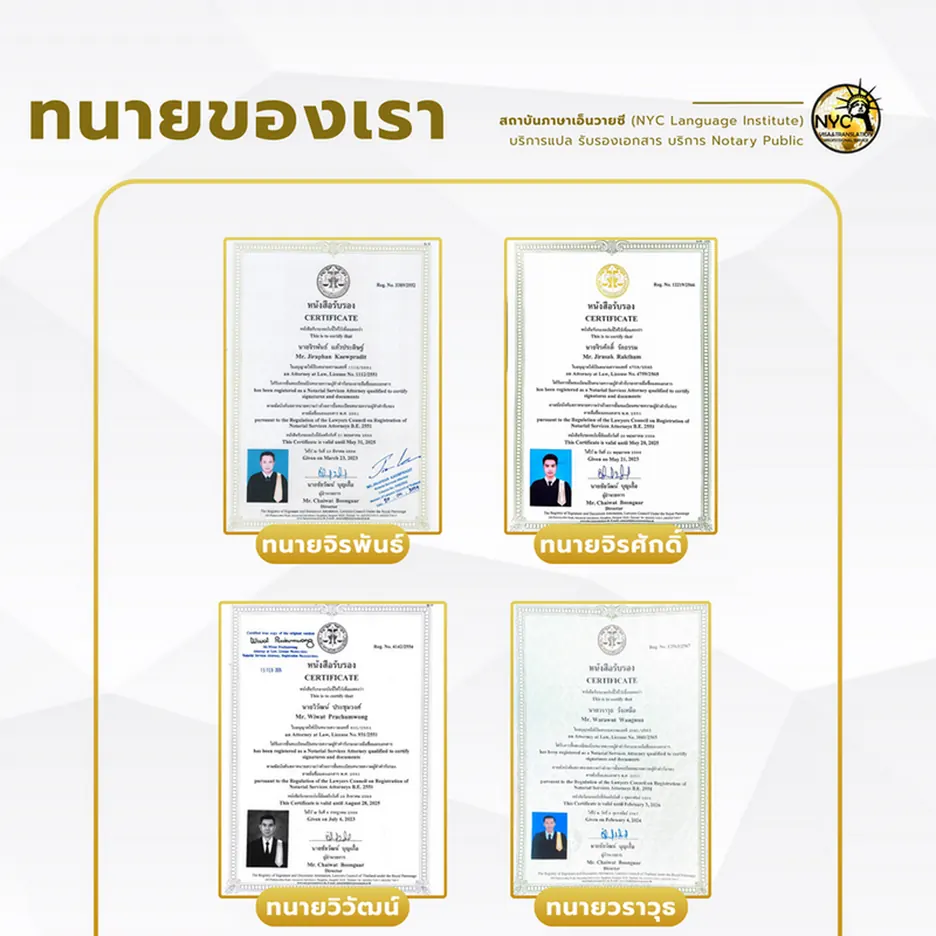
Choosing the right Notary Public (Notarial Services Attorney) provider directly impacts the success and turnaround of your case. NYC Visa & Translation has worked with Lawyers Council of Thailand under the Royal Patronage since 2010, handling a broad real-world caseload across government documents, certified translations, and documents intended for use abroad. Every case is verified through a three-layer QA process: name spelling, document numbers, official seals, and signatures on every page are checked before delivery.

Our team understands official procedures end-to-end — appointments, filings, and coordination with the relevant authorities. You do not have to travel back and forth or risk rejection. Our Notary Public (Notarial Services Attorney) service supports Express handling that completes in half the standard turnaround.

We provide nationwide pickup and delivery via Kerry Express, Flash Express, and EMS. Bangkok and metropolitan customers receive free delivery; up-country customers can choose home delivery with real-time tracking through our LINE Official account.

Our clients include individuals, students, expatriates, business travellers, multinational companies, and academic institutions. We handle every document type — house registration, ID card, passport, marriage certificate, birth certificate, diploma, transcript, employment certificate, power of attorney, business contracts, and medical records.

Our Notary Public (Notarial Services Attorney) workflow runs in six clear stages: (1) receive originals and copies, (2) QA-audit the source for issues that would cause rejection, (3) translate through a native-speaker linguist, (4) certify with the authority required by the receiving country, (5) file and follow up at each government touchpoint, and (6) deliver plus retain a signed PDF you can re-download for five years. A single Case Officer owns your file end-to-end, eliminating hand-off errors that plague larger firms.

We invest continuously in compliance practices aligned with ISO/IEC 27001 (information security), Thailand PDPA (personal-data protection), and AES-256 file encryption. Every upload runs over TLS 1.3 only. Enterprise and law-firm clients can request an NDA before intake — our legal team signs same-day.

Beyond single-document work, we bundle end-to-end packages for clients preparing multiple certificates at once — e.g. a "moving abroad" bundle (house registration + birth + marriage + diploma + transcript with MFA + embassy) that reduces the number of trips and total lead time versus filing each item separately. Approval remains at the discretion of the receiving authority; contact our team for scope and fees.

What sets us apart is a 15-year direct working relationship with the destination authority — Lawyers Council of Thailand under the Royal Patronage — so we anticipate regulation changes, format tweaks, and queue timing before they hit your case, and brief you in advance. Approval outcomes always remain at the sole discretion of the authority; what we control is document completeness, formatting and lodgement timing.

Glossary
Notarial Services Attorney
An attorney licensed by the Lawyers Council of Thailand to certify signatures and document copies.
MFA Legalization
Authentication by Thailand's Ministry of Foreign Affairs for documents to be used overseas.
Apostille
International authentication system under the Hague Convention. Thailand is not a member, so MFA legalization is used instead.
NAATI
Australia's national accreditation authority for translators — required for visa and employment applications in Australia.
Police Clearance
A certificate from the Royal Thai Police, required for visa and overseas employment applications.
Certified Translation
A translation certified to match the original, by an accredited translator or notary public.
Case Officer
A dedicated coordinator who owns your file across translation, certification, and government touchpoints.
Chain Legalization
The sequential chain: source authority → Thai MFA → destination embassy, required for the document to be enforceable abroad.
Sworn Translator
A court-sworn linguist authorised to self-certify translations in many European jurisdictions.
Certified True Copy
A copy certified by the document owner or a Notary Public to stand in for the original.
Pre-submission checklist
  • Original document is clean, unbroken, and legible
  • Name matches your passport exactly
  • All seals and signatures present on every page
  • Target language for certification specified
  • Destination country and receiving authority specified
  • Allow 5–7 business days for standard processing
  • Check document expiry — some countries accept only 3–6 months old
  • Prepare ID/passport copy for the person granting power of attorney
  • Arrange documents in the order required by the receiving authority
  • Have payment method and shipping address ready before intake

What parent-company documents do BOI · Board of Investment applicants need for Notary Public (Notarial Services Attorney)?

Notary Public (Notarial Services Attorney) for BOI · Board of Investment 🏛️ — corporate clients include MNCs, listed companies, and foreign JVs needing parent-company papers valid in Thailand.

🏛️ BOI · Board of Investment NDA-ready
Service Knowledge Base

Work permits, BOI/IEAT privileges, Treaty of Amity and APEC card — practical answers

First-party answers on Thai work authorisation: the standard Department of Employment route, BOI and IEAT channels for skilled experts, US company rights under the Treaty of Amity, and the APEC Business Travel Card for Thai nationals — including which supporting documents must be translated and legalised first. (19+ search topics covered)

How are foreign degrees and experience letters handled?

They usually must be translated into Thai or English as required and legalised through the diplomatic chain: certified in the issuing country (apostille where that country is a Convention party), then endorsed by the Royal Thai Embassy, or endorsed by that country's embassy in Thailand and then legalised by the Legalization Division of the Department of Consular Affairs before submission.

Can dependants of a permit holder work?

Dependant status does not create work rights. A dependant who wants to work needs their own employer and their own work permit under the normal conditions. Family documents such as marriage and birth certificates usually need translation and legalisation for both immigration and labour filings.

Can dependants of a work-permit holder work?

Permission to stay as a dependant and permission to work are separate matters. Dependants admitted on the basis of the principal's status do not gain an automatic right to work; they need an employer and their own work permit application under the normal criteria. Children entering school require a separate process, including certified translations of academic records.

What must be done when changing employer or job title?

A work permit is tied to the conditions recorded in it, including employer, position and place of work, so material changes must be notified or amended under the applicable law before working under the new conditions. Changing employer also usually affects employment-based permission to stay, so the two processes should be planned together. Typical documents are a letter from the new employer, corporate registration papers and the new employment contract; verify the current procedure with the Department of Employment.

What is the IEAT route?

Operators inside industrial estates governed by the Industrial Estate Authority of Thailand may be permitted to bring in skilled workers, experts and their families under the IEAT Act. It is a separate legal basis from BOI promotion, but the work permit and stay formalities still have to be completed with the responsible agencies.

Which comes first, the visa or the work permit?

In the usual sequence, the foreign national first holds a non-immigrant visa consistent with the intended employment, then applies for a work permit under the law on managing the employment of foreign workers, administered by the Department of Employment. Continued stay afterwards is decided separately by the Immigration Bureau. The three systems are distinct but interlocking, and a gap in one blocks the next.

Which authority decides a work permit, and what does it not cover?

The Department of Employment under the Ministry of Labour administers work authorisation for foreign nationals; the Immigration Bureau separately administers the right to stay. A work permit does not extend your permission to stay, and a valid visa does not authorise work. Both must be kept aligned, because expiry of one commonly triggers problems with the other at the next renewal.

Is a work permit the same as a visa in Thailand?

No. A visa such as Non-Immigrant B is issued by a Thai embassy or consulate, extensions of stay are approved by the Immigration Bureau, while the work permit itself is issued by the Department of Employment under the Emergency Decree on Managing the Work of Aliens B.E. 2560 (2017). Holding a valid visa does not by itself authorise employment, and working before authorisation carries legal penalties, so both tracks must be planned together.
Topics covered
คำค้นหลัก: ขอใบอนุญาตทำงานคนต่างชาติ · work permit thailand requirements · BOI work permit e-Expert · one stop service center visa work permit · IEAT work permit นิคมอุตสาหกรรม · treaty of amity company registration · บัตรเอเปค APEC Business Travel Card
เอกสารที่มักต้องแปล/รับรอง: ปริญญาบัตร/ทรานสคริปต์ · หนังสือรับรองประสบการณ์ทำงาน · ใบอนุญาตประกอบวิชาชีพ · หนังสือรับรองบริษัทต่างประเทศ · หนังสือมอบอำนาจ (Power of Attorney) · ทะเบียนสมรส/สูติบัตรของผู้ติดตาม
หน่วยงานที่เกี่ยวข้อง: กรมการจัดหางาน (DOE) · สำนักงานคณะกรรมการส่งเสริมการลงทุน (BOI) · การนิคมอุตสาหกรรมแห่งประเทศไทย (กนอ./IEAT) · กรมพัฒนาธุรกิจการค้า (DBD) · สำนักงานตรวจคนเข้าเมือง (ตม.) · กรมการกงสุล กระทรวงการต่างประเทศ
Official references

Need your documents reviewed or your case assessed? Ask our team by phone, LINE, or email. We reply during business hours (Mon–Fri 9:00–18:00, Sat 9:00–15:00, ICT).

Certified true copy prepared for overseas use
Certified true copy prepared for overseas useFrom actual casework by the NYC Visa & Translation team
Service Playbook

Thai work permit — company-side and employee-side documents

Work permits are issued by the Department of Employment and are tied to the employer, position and workplace. Changing job, role or location requires a new filing.

Documents to prepare

  • Company side: current affidavit, shareholder list, financial statements, social security filings
  • Employee side: passport, the correct visa category, and the required medical certificate
  • Degrees and experience letters, legalised at source and translated for Thai use
  • Employment contract and job description
  • Workplace map and photographs where requested
  • Power of attorney for the company's filing agent

Step-by-step process

  1. 1. Check company and role eligibility Registered capital, Thai-to-foreign staff ratio and reserved occupations are verified first.
  2. 2. Prepare foreign documents Qualifications and experience letters must be legalised abroad and translated before filing.
  3. 3. File the application Through the Department of Employment, or a dedicated channel such as the BOI One Stop Service.
  4. 4. Collect and comply Work only within the stated role and location, and renew before expiry.

Pitfalls and rejection causes

  • Working outside the stated role or location breaches the permit conditions.
  • A permit belongs to the employer — it cannot follow you to a new company.
  • Visa and permit expire on different dates; track both.
  • Company documents older than the accepted window must be reissued.

Tips from our team

  • Set reminders at least 45 days before either expiry date.
  • Maintain a standing company document pack to speed up future filings.
  • BOI-promoted companies should use the dedicated channel to cut steps.

Prefer not to handle the queues yourself, or worried about a rejection? Send us photos of your documents for a free pre-check. We handle the full chain — obtaining certified copies, translation, certification and submission — and keep you updated at each step. Reach us on LINE, phone or email during business hours.

Route Comparison

Comparing Thai work permit routes

Different employer types use different channels, and each channel pairs with a different visa category.

RouteWhen to useCertifying authorityApprox. durationRejection risk
Standard filing with the Department of EmploymentThe employer is an ordinary Thai company without BOI promotionDepartment of Employment, Ministry of LabourVariable, driven by how complete the employer's file isThai-to-foreign staff ratios and registered capital not meeting thresholds is the common refusal ground
BOI-promoted company channelThe employer holds a promotion certificate and the position is on the approved listBOI together with the Immigration Bureau and Department of EmploymentGenerally faster than the standard route, still variableA position that differs from the approved list requires an amendment first
Conditional or short-term work authorisationShort assignments or job types covered by specific published rulesDepartment of Employment under the notification in forceShorter than a full applicationWorking beyond the authorised scope is an offence even when a permit exists

Timelines above are practical estimates from live casework and can change with each authority's policy; confirm with the receiving authority before booking travel. If you would rather not test routes by trial and error, our advisers can assess which route fits your case.

Advisory Service

We do not just process documents — we advise you through the whole case

Our team has worked on cross-border documents, certified translation and government liaison for over 15 years. Most rejections we see are not caused by missing paperwork but by choosing the wrong route on day one, so we always start with a case assessment.

Route assessment

We look at your destination, purpose and deadline, then tell you which certification route applies — and which steps you can skip.

Pre-submission review

Name spelling, consistency across documents, document age and translation format are checked before anything reaches a counter.

Timeline planning

We sequence the steps around your appointment or travel date and flag bottlenecks in advance.

Rejection recovery

We read the refusal reasons, identify the underlying cause, and plan a resubmission that answers what the authority asked for.

Rather not learn by trial and error? Send your case details and document photos for a review — reach us on LINE, phone or email during business hours.

Practical Q&A

Practical questions · Near me / DIY / Required documents

Where can I find a notary public near me in Thailand?

Thailand has no US/UK-style notary public. The authorised signatory is a “Notarial Services Attorney” licensed by the Lawyers Council of Thailand under Royal Patronage, so the work must be done at a firm with such a licensed lawyer. Our main offices are Lat Phrao 95 (Bangkok), Khon Kaen and Udon Thani, with meeting points near BTS/MRT stations and city malls. Ask our team by phone, LINE or email for the most convenient point.

Can I notarise a document myself without a firm?

No. Only a lawyer holding the Lawyers Council notarial-services licence may certify. What you can prepare yourself is the paperwork: the correct original or true copy, and your ID. Signature certification requires you to sign in front of the attorney, so do not sign the document in advance.

Which documents do I need to bring for notarisation?

At minimum: (1) your original passport or Thai ID card; (2) the exact document version you will submit; (3) for company signatories, a company affidavit dated within the period your recipient accepts, plus the seal if used; (4) the destination country and receiving authority, because the wording of the certificate and any onward steps (for example whether MFA legalisation is needed afterwards) depend on the destination.
Practical advice & cautions

Notarial services in Thailand: advice and cautions

Before you start
  • Confirm whether you actually need a notary

    Requests described as notarisation are often really consular legalisation of a government document or certification of a translation. Clarifying this first avoids repeated work.

  • Bring original documents, not photos or scans

    A certified true copy must be compared against the original in person. If the original is abroad or lost, obtain a certified reissue from the issuing authority first.

  • The signer must sign in front of the attorney

    Signature certification confirms the signature was made in person, so bring a valid original ID card or passport and do not sign the document in advance.

  • Tell us the destination authority first

    What happens after notarisation differs by country and receiving authority. Some accept the attorney's certification alone; others require further authentication by the Department of Consular Affairs and the destination embassy. Naming the country and authority up front lets us sequence the work correctly.

Common reasons documents get rejected
  • Expecting an apostille issued in Thailand

    Thailand is not a party to the Apostille Convention. Documents for overseas use follow authentication by the Department of Consular Affairs and the destination embassy instead.

  • Stopping before the follow-on steps

    Many files are rejected because they stop at the attorney's certification when the recipient also required consular and embassy authentication. Plan the full chain from the beginning.

  • Believing certification validates the content

    Certification covers facts observed in person — that the person signed, or that a copy matches the original. It does not certify that the statements are true or legally effective abroad.

  • Assuming Thailand has a common-law notary public

    It does not. Certification is performed by a Notarial Services Attorney registered with the Lawyers Council of Thailand. If your recipient specifically requires a Notary Public, confirm in advance that they accept this form of certification.

Requirements differ by authority and destination country and can change. Confirm current conditions with the receiving authority, or ask our team by phone, LINE or email.

Related services

What clients usually handle next

One document set often moves through several stages — translation, notarial certification, legalization and finally a visa filing. The links below follow that real sequence.

External authority references

Authority requirements change. Verify with the receiving authority before filing, or ask our team by phone, LINE or email.

Choosing a Notarial Services Attorney in Thailand

Thailand has no notary public in the common-law sense. Notarization is performed by a lawyer registered as a Notarial Services Attorney with the Lawyers Council of Thailand. Verify the registration, confirm the receiving party accepts a Thai notarial attestation, and check whether the document also needs consular legalization afterwards.

How to evaluate a provider

  • Registered Notarial Services AttorneyOnly registered attorneys may perform notarial acts in Thailand; the registration is verifiable.
  • Correct act for your purposeSignature witnessing, true-copy certification and affidavits are different acts with different acceptance.
  • Confirms downstream acceptanceSome receiving parties additionally require consular legalization after notarization.
  • Identity verification on recordThe attestation depends on documented identity checks at signing.
  • Clear appointment and location termsNotarial acts require the signer in person; location and timing affect feasibility.

Questions to ask before you commit

  1. How many working days does it actually take, counted from a complete file?
  2. If the receiving authority rejects or asks for changes, do you correct it, and under what terms?
  3. How can I track status, and who physically holds the original documents?
  4. Are you registered with the Lawyers Council of Thailand as a Notarial Services Attorney?
  5. Which notarial act does my document need, and will the receiving party accept it as is?

Your options, and who each suits

OptionBest forWhat to know
Law firm notarial serviceContracts, affidavits and corporate documentsConfirm the specific attorney performing the act is registered.
Your own embassy in BangkokDocuments for your home country that require its own consular officerAppointment availability and accepted act types vary by embassy.
Notarization plus legalization packageDocuments going to a foreign authorityAsk whether the legalization step is quoted separately.

FAQ on choosing a provider

Which notary service is recommended in Bangkok?
Choose a registered Notarial Services Attorney who first confirms which act your document needs and whether the receiving party requires consular legalization afterwards. Ask to see the registration and confirm the attorney performing the act is the one registered.
Is a Thai notarization accepted abroad?
It depends on the receiving authority. Some accept the notarial attestation alone; others require subsequent authentication by the Department of Consular Affairs and the destination embassy. Confirm the requirement with the receiving party before booking.

แหล่งอ้างอิงทางการ · Authoritative Sources

  1. Board of Investment Thailand, One Stop Service Center (OSOS) at Chamchuri SquareInvestment promotion authority
  2. MFA Department of Consular AffairsThai legalization authority
  3. Lawyers Council of Thailand under the Royal PatronageService-specific authority