Corporate vertical not found.
Notarial Services Attorney (Notary Public) Knowledge Base
Common questions about signature and document certification by a Notarial Services Attorney in Thailand, and the follow-on MFA legalisation step. (64+ search topics covered)
What can a Thai notarial services attorney certify?
How do I verify that the attorney is properly registered?
How long does the whole chain take?
Does Thailand have notaries public?
What does a company need to bring?
How are fees calculated?
Is a notarial certificate enough for use abroad?
Affidavit or statutory declaration — which one do I need?
- สภาทนายความในพระบรมราชูปถัมภ์ (Notarial Services Attorney) — ผู้มีอำนาจรับรองลายมือชื่อและเอกสารแบบ Notarial Services ในประเทศไทย
- กองสัญชาติและนิติกรณ์ กรมการกงสุล กระทรวงการต่างประเทศ — หน่วยงานรับรองนิติกรณ์เอกสาร (legalization) ของประเทศไทย
- HCCH – Apostille Section (อนุสัญญากรุงเฮก 1961) — รายชื่อรัฐภาคีและสถานะการใช้ Apostille
Need your documents reviewed or your case assessed? Ask our team by phone, LINE, or email. We reply during business hours (Mon–Fri 9:00–18:00, Sat 9:00–15:00, ICT).
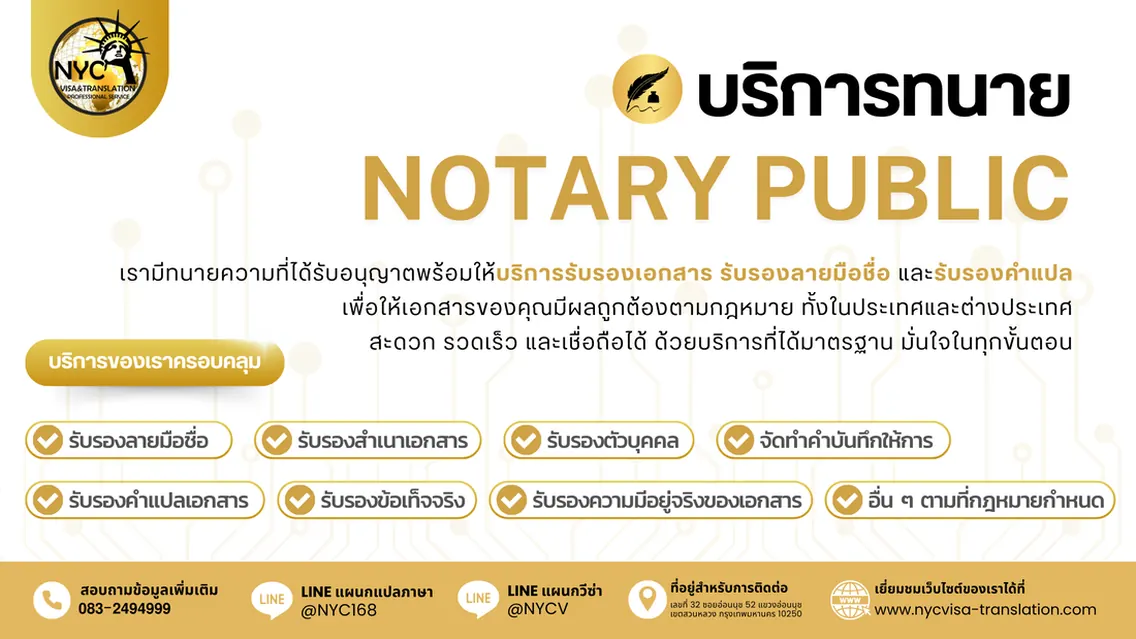
Notarial Services Attorney in Thailand — scope and documents
Thailand has no separate notary profession. Certification is performed by a Notarial Services Attorney licensed by the Lawyers Council, who certifies signatures and signing in their presence — not the truth of the content.
Documents to prepare
- • The document to be signed, left unsigned until the appointment
- • Original passport or Thai ID of every signatory
- • Recent company affidavit if signing for a legal entity
- • Company seal where the articles require it
- • Any wording template the destination requires
- • An interpreter or translation if a signatory cannot read the document language
Step-by-step process
- 1. Send the draft for review — We confirm which form of certification and wording the destination expects.
- 2. Attend the signing — Signatories appear in person with original identification.
- 3. Attorney issues the certificate — The certification carries the attorney's seal and registration number.
- 4. Continue the chain if needed — For foreign government use, the file proceeds to consular legalisation and beyond.
Pitfalls and rejection causes
- • Pre-signed documents cannot be certified as signed in the attorney's presence.
- • Signature certification is not a statement that the content is correct or enforceable.
- • Some jurisdictions demand specific certificate wording — check before booking.
- • Company affidavits older than the destination's limit are commonly rejected.
Tips from our team
- • Coordinate multi-party signings into a single appointment.
- • Prepare two spare sets in case several wet-ink copies are needed.
- • Tell us the document language ahead so an interpreter can be arranged.
Prefer not to handle the queues yourself, or worried about a rejection? Send us photos of your documents for a free pre-check. We handle the full chain — obtaining certified copies, translation, certification and submission — and keep you updated at each step. Reach us on LINE, phone or email during business hours.
Notarial services attorney vs government certification
Many cases lose weeks simply because the wrong certifying party was chosen at the start.
| Route | When to use | Certifying authority | Approx. duration | Rejection risk |
|---|---|---|---|---|
| Notarial services attorney | The receiving party is private — a university, bank or overseas counterparty | Attorney licensed by the Lawyers Council of Thailand | Usually same day | Some foreign government bodies require a further consular layer on top |
| Consular legalisation | The receiving party is a foreign government authority | Department of Consular Affairs, MFA Thailand | Variable, by queue and channel | Some private documents must have signatures notarised before consular submission is possible |
| Layered certification (attorney + consular + embassy) | Commercial contracts, powers of attorney, or documents used in foreign legal proceedings | Attorney with the Department of Consular Affairs and the destination embassy | Variable — allow several weeks | Skipping a layer usually means the whole bundle is rejected |
Timelines above are practical estimates from live casework and can change with each authority's policy; confirm with the receiving authority before booking travel. If you would rather not test routes by trial and error, our advisers can assess which route fits your case.
We do not just process documents — we advise you through the whole case
Our team has worked on cross-border documents, certified translation and government liaison for over 15 years. Most rejections we see are not caused by missing paperwork but by choosing the wrong route on day one, so we always start with a case assessment.
Route assessment
We look at your destination, purpose and deadline, then tell you which certification route applies — and which steps you can skip.
Pre-submission review
Name spelling, consistency across documents, document age and translation format are checked before anything reaches a counter.
Timeline planning
We sequence the steps around your appointment or travel date and flag bottlenecks in advance.
Rejection recovery
We read the refusal reasons, identify the underlying cause, and plan a resubmission that answers what the authority asked for.
Rather not learn by trial and error? Send your case details and document photos for a review — reach us on LINE, phone or email during business hours.
Practical questions · Near me / DIY / Required documents
Where can I find a notary public near me in Thailand?
Can I notarise a document myself without a firm?
Which documents do I need to bring for notarisation?
Notarial services in Thailand: advice and cautions
Confirm the document list before you travel to us
The type of certification, number of sets and the follow-on steps change what you must bring. Contact our team by phone, LINE or email to confirm first.
Tell us the destination authority first
What happens after notarisation differs by country and receiving authority. Some accept the attorney's certification alone; others require further authentication by the Department of Consular Affairs and the destination embassy. Naming the country and authority up front lets us sequence the work correctly.
The signer must sign in front of the attorney
Signature certification confirms the signature was made in person, so bring a valid original ID card or passport and do not sign the document in advance.
Bring original documents, not photos or scans
A certified true copy must be compared against the original in person. If the original is abroad or lost, obtain a certified reissue from the issuing authority first.
Expired ID or mismatched name spelling
Names must match your passport. If you changed your name or the spelling differs, bring the supporting change-of-name evidence.
Stopping before the follow-on steps
Many files are rejected because they stop at the attorney's certification when the recipient also required consular and embassy authentication. Plan the full chain from the beginning.
Assuming Thailand has a common-law notary public
It does not. Certification is performed by a Notarial Services Attorney registered with the Lawyers Council of Thailand. If your recipient specifically requires a Notary Public, confirm in advance that they accept this form of certification.
Expecting an apostille issued in Thailand
Thailand is not a party to the Apostille Convention. Documents for overseas use follow authentication by the Department of Consular Affairs and the destination embassy instead.
Requirements differ by authority and destination country and can change. Confirm current conditions with the receiving authority, or ask our team by phone, LINE or email.
What clients usually handle next
One document set often moves through several stages — translation, notarial certification, legalization and finally a visa filing. The links below follow that real sequence.
- MFA legalization at the Department of Consular AffairsThe step after translation for documents used abroad or filed with an embassy
- Certified document translation, all languagesTranslations for Thai and overseas authorities with a certification statement
- NAATI-certified translation for Australia & New ZealandTranslations accepted by Australian government agencies, with certifier stamp
- Outbound visas for Thai nationalsDocument preparation, embassy appointments and pre-submission file review
- Thai–foreign marriage registrationAffirmation of freedom to marry, embassy certification and district office registration
- Thai citizenship & permanent residenceEligibility tracks, supporting documents and interview preparation
- สภาทนายความในพระบรมราชูปถัมภ์ (Notarial Services Attorney) — ผู้มีอำนาจรับรองลายมือชื่อและเอกสารแบบ Notarial Services ในประเทศไทย
- กองสัญชาติและนิติกรณ์ กรมการกงสุล กระทรวงการต่างประเทศ — หน่วยงานรับรองนิติกรณ์เอกสาร (legalization) ของประเทศไทย
- HCCH – Apostille Section (อนุสัญญากรุงเฮก 1961) — รายชื่อรัฐภาคีและสถานะการใช้ Apostille
Authority requirements change. Verify with the receiving authority before filing, or ask our team by phone, LINE or email.