ข้ามไปเนื้อหาหลัก / Skip to main content
N
NYC Visa.
Visa & Translation
หนังสือมอบอำนาจที่ลงนามต่อหน้าทนายความผู้รับรอง
Documents for · Destination · 🇰🇷 South Korea

Notary Public (Notarial Services Attorney) · South Korea 🇰🇷

Notary Public (Notarial Services Attorney) engineered specifically for South Korea 🇰🇷 applications. NYC Visa prepares South Korea applications via Korea Immigration Service · MOFA Korea · K-ETA pipelines and knows every เกาหลีประจำประเทศไทย requirement end-to-end.

ข้อมูลสำคัญ · Entity Panel
Receiving authority
Korea Immigration Service · MOFA Korea · K-ETA
Embassy / Consulate
เกาหลีประจำประเทศไทย
ISO
KR
Hague Apostille
Yes
Document language
한국어 / Korean (공증번역)
Visa categories covered
7+ classes

Filing documents into South Korea has destination-specific quirks. Korea Immigration Service · MOFA Korea · K-ETA requires every document translated into 한국어 / Korean (공증번역) by a registered translator, notarised by a Notary Public, then legalised by Thailand's MFA Department of Consular Affairs before stamping at the เกาหลีประจำประเทศไทย in Bangkok. South Korea is a Hague Apostille party, but since Thailand is NOT, Thai-issued documents still need full MFA + embassy legalization.

นักแปลเกาหลี TOPIK 6 + apostille team — รองรับการยื่น K-ETA และ HiKorea online portal ทั้งหมด เสร็จเร็วใน 3 วันทำการ — Our Notary Public (Notarial Services Attorney) team has filed 1,500+ South Korea cases in the past 3 years. Outcomes remain at the sole discretion of the embassy or authority., and knows the red flags Korea Immigration Service · MOFA Korea · K-ETA scrutinises (document ordering, signature format, double-apostille, embassy stamp placement).

Clients using our Notary Public (Notarial Services Attorney) for South Korea typically file for: C-3 Short Term, D-2 Student, D-4 Trainee, E-7 Specialist — frequent documents: 기본증명서, 혼인관계증명서, 범죄경력증명서, 학위증명서, 재직증명서. We assemble the entire pack with a destination-appropriate cover letter and certified translation in the format Korea Immigration Service · MOFA Korea · K-ETA expects.

Notary Public (Notarial Services Attorney) workflow for South Korea: (1) Send document images via LINE @nycvisa or email. (2) Receive a staff reply within 2 hours during business hours (Mon–Sat 09:00–18:00 Bangkok time); the quotation follows scope review. (3) Translation by registered translator (NAATI / Sworn / Notary). (4) Notary Public certification by Thai attorney. (5) MFA legalization at Chaeng Wattana. (6) South Korea embassy stamp in Bangkok. (7) Courier delivery + VAT invoice + cloud backup.
Visa categories covered
C-3 Short Term
D-2 Student
D-4 Trainee
E-7 Specialist
F-2 Long Stay
F-4 Overseas Korean
F-6 Marriage
Documents you'll typically need
기본증명서
혼인관계증명서
범죄경력증명서
학위증명서
재직증명서
납세증명서
5–10d
Standard turnaround
12+
Languages supported
HowTo · ขั้นตอน

How to use Notary Public (Notarial Services Attorney) for South Korea

  1. 1

    Specify the South Korea visa class and upload images via LINE @nycvisa or email.

  2. 2

    Staff reply within 2 hours during business hours (Mon–Sat 09:00–18:00 Bangkok time); confirm translation language (한국어 / Korean (공증번역)), copies, turnaround.

  3. 3

    Registered translator producing the format Korea Immigration Service · MOFA Korea · K-ETA accepts.

  4. 4

    Notary Public → MFA Department of Consular Affairs → destination embassy.

  5. 5

    Filed at เกาหลีประจำประเทศไทย or VFS/TLScontact. Couriered back with full VAT invoice.

FAQ

FAQ · Notary Public (Notarial Services Attorney) for South Korea

What translation language does South Korea require?

Korea Immigration Service · MOFA Korea · K-ETA accepts documents translated into 한국어 / Korean (공증번역). NYC Visa employs translators registered with the relevant authority.

Is South Korea a Hague Apostille country?

South Korea is a Hague party, but Thailand is not quoted per case by our team so Thai-issued documents still need full MFA + embassy legalization before use in South Korea.

How long does it take?

Notary Public (Notarial Services Attorney) for South Korea standard turnaround: 5–10 business days (translation 1–3 + Notary 1 + MFA 2–3 + Embassy 1–3). Express tracks available.

Starting price for Notary Public (Notarial Services Attorney) to South Korea?

Pricing is quoted per case (ask our staff) per standard pack. Share document count and visa subclass for an exact quote (includes embassy fees + courier).

Can clients outside Bangkok file for South Korea?

Yes quoted per case by our team nationwide pickup and return. All MFA + embassy steps happen in Bangkok; no client travel required.

Refund if the South Korea embassy rejects?

No. Acceptance is decided by Korea Immigration Service · MOFA Korea · K-ETA. We prepare documents to its published standards before submission; NYC does not offer refunds, and government fees are non-refundable.

Notary Public (Notarial Services Attorney) for South Korea — what's required?

Notary Public (Notarial Services Attorney) engineered specifically for South Korea 🇰🇷 applications. NYC Visa prepares South Korea applications via Korea Immigration Service · MOFA Korea · K-ETA pipelines and knows every เกาหลีประจำประเทศไทย requirement end-to-end.

🇰🇷 South Korea SLA Guarantee
Service Knowledge Base

Notarial Services Attorney (Notary Public) Knowledge Base

Common questions about signature and document certification by a Notarial Services Attorney in Thailand, and the follow-on MFA legalisation step. (64+ search topics covered)

Can you certify copies of my passport for an overseas bank account?

Yes, with the original passport presented. Many banks require the certificate to be within three months and to use specific wording such as “certified true copy of the original seen by me”. Send us the bank's form or instruction email before the appointment so the wording matches exactly.

Do you travel to clients or work outside Bangkok?

Our only office is at Ladprao 95, Bangkok. For an off-site request, send the location, document and recipient’s requirements first. We will confirm whether the work can be arranged, any personal-attendance requirements and the quoted costs before booking.

Do I have to sign in person?

Yes for signature certification and sworn statements: you must appear with your original passport or Thai ID and sign in front of the attorney. For true copies you must bring the original document. If you are abroad, the practical route is to use a notary in your country of residence, or to schedule the appointment for your next trip to Thailand.

Do Thai documents need to be translated?

Usually yes, into English or the official language of the destination. The widely accepted approach is for the translator to sign a declaration in front of the attorney so the original and the translation are certified together. For Australian filings that specify NAATI, use a NAATI translation instead, because some authorities accept only that format.

How do I verify that the attorney is properly registered?

Ask to see the lawyer's licence and the Lawyers Council registration for notarial services. Every certificate should show the attorney's full name, licence number, signature and seal. If in doubt you can ask the Lawyers Council of Thailand to confirm the registration.

Does Thailand have notaries public?

Not in the common-law sense. Thailand uses “Notarial Services Attorneys” — licensed Thai lawyers who complete the training and registration required by the Lawyers Council of Thailand under the Royal Patronage under its 2008 regulation on the registration of attorneys certifying signatures and documents. Their certificates carry the attorney's licence number so the receiving authority can verify them.

How are fees calculated?

By certification stamp — per document or per signature — not per page. Government charges such as consular legalisation and embassy fees are separate line items paid at official receipt value. Out-of-office and after-hours appointments carry a travel or overtime component. You receive a written total before any work starts.

Affidavit or statutory declaration — which one do I need?

Both are written statements confirmed before an authorised person. Affidavits use sworn wording and appear mostly in litigation; statutory declarations use declared wording and appear mostly in administrative matters such as confirming status or a relationship. We follow the form the receiving authority prescribes and never draft wording beyond what the deponent actually knows.
Topics covered
เอกสารประกอบและข้อกำหนด: ต้องมาเซ็นต่อหน้าทนายไหม · ใช้พาสปอร์ตหรือบัตรประชาชน · เอกสารภาษาอังกฤษต้องแปลไหม · ผู้ลงนามอยู่ต่างประเทศ · มอบอำนาจแทนได้ไหม · นิติบุคคลต้องใช้หนังสือรับรองบริษัท
บริการหลัก / คำเรียกที่ลูกค้าใช้ค้นหา: notary public ไทย · โนตารี พับลิค · ทนายโนตารี · ทนายความผู้ทำคำรับรองลายมือชื่อและเอกสาร · notarial services attorney · รับรองลายมือชื่อ · รับรองสำเนาถูกต้อง · certify true copy · รับรองคำแปล · notary ใกล้ฉัน
ประเภทงานรับรอง: affidavit · คำให้การเป็นหนังสือ · statutory declaration · power of attorney · หนังสือมอบอำนาจ · certified true copy passport · witness signature · signature verification · certificate of free will (รับรองเจตนา) · รับรองสถานะโสด
Official references

Need your documents reviewed or your case assessed? Ask our team by phone, LINE, or email. We reply within two hours during business hours (Mon–Sat 9:00–18:00 ICT).

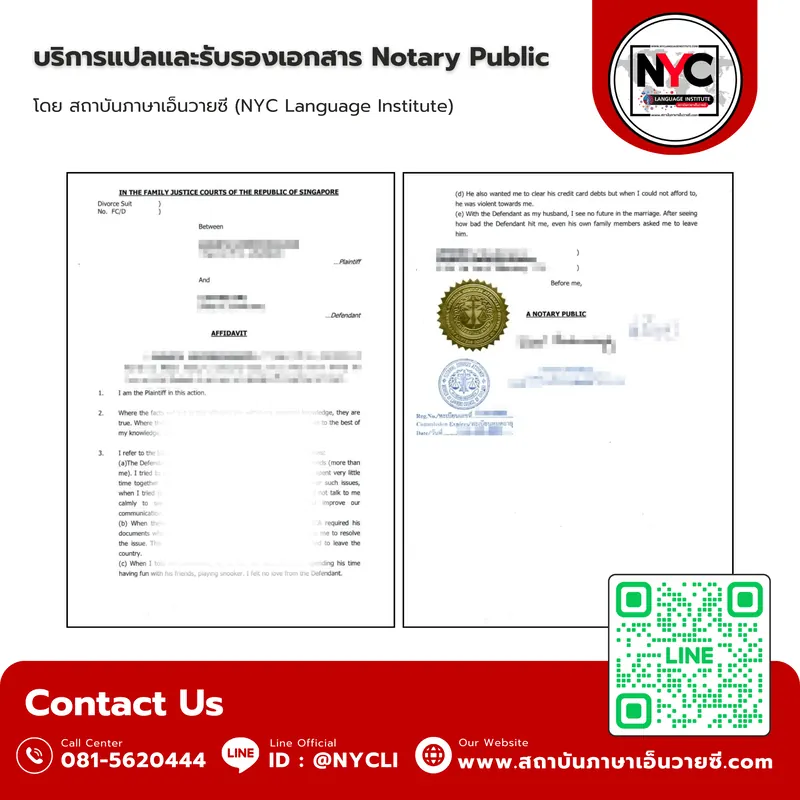
Power of attorney signed in the presence of the certifying attorney
Power of attorney signed in the presence of the certifying attorney — Service illustration; requirements depend on the document and receiving authority
Service Playbook

Notarial Services Attorney in Thailand — scope and documents

Thailand has no separate notary profession. Certification is performed by a Notarial Services Attorney licensed by the Lawyers Council, who certifies signatures and signing in their presence — not the truth of the content.

Documents to prepare

  • • The document to be signed, left unsigned until the appointment
  • • Original passport or Thai ID of every signatory
  • • Recent company affidavit if signing for a legal entity
  • • Company seal where the articles require it
  • • Any wording template the destination requires
  • • An interpreter or translation if a signatory cannot read the document language

Step-by-step process

  1. 1. Send the draft for review — We confirm which form of certification and wording the destination expects.
  2. 2. Attend the signing — Signatories appear in person with original identification.
  3. 3. Attorney issues the certificate — The certification carries the attorney's seal and registration number.
  4. 4. Continue the chain if needed — For foreign government use, the file proceeds to consular legalisation and beyond.

Pitfalls and rejection causes

  • • Pre-signed documents cannot be certified as signed in the attorney's presence.
  • • Signature certification is not a statement that the content is correct or enforceable.
  • • Some jurisdictions demand specific certificate wording — check before booking.
  • • Company affidavits older than the destination's limit are commonly rejected.

Tips from our team

  • • Coordinate multi-party signings into a single appointment.
  • • Prepare two spare sets in case several wet-ink copies are needed.
  • • Tell us the document language ahead so an interpreter can be arranged.

Prefer not to handle the queues yourself, or worried about a rejection? Send us photos of your documents for a free pre-check. We handle the full chain — obtaining certified copies, translation, certification and submission — and keep you updated at each step. Reach us on LINE, phone or email during business hours.

Route Comparison

Notarial services attorney vs government certification

Many cases lose weeks simply because the wrong certifying party was chosen at the start.

RouteWhen to useCertifying authorityApprox. durationRejection risk
Notarial services attorneyThe receiving party is private — a university, bank or overseas counterpartyAttorney licensed by the Lawyers Council of ThailandUsually same daySome foreign government bodies require a further consular layer on top
Consular legalisationThe receiving party is a foreign government authorityDepartment of Consular Affairs, MFA ThailandVariable, by queue and channelSome private documents must have signatures notarised before consular submission is possible
Layered certification (attorney + consular + embassy)Commercial contracts, powers of attorney, or documents used in foreign legal proceedingsAttorney with the Department of Consular Affairs and the destination embassyVariable — allow several weeksSkipping a layer usually means the whole bundle is rejected

Timelines above are practical estimates from live casework and can change with each authority's policy; confirm with the receiving authority before booking travel. If you would rather not test routes by trial and error, our advisers can assess which route fits your case.

Advisory Service

We do not just process documents — we advise you through the whole case

Our team has worked on cross-border documents, certified translation and government liaison since 2015. Most rejections we see are not caused by missing paperwork but by choosing the wrong route on day one, so we always start with a case assessment.

Route assessment

We look at your destination, purpose and deadline, then tell you which certification route applies — and which steps you can skip.

Pre-submission review

Name spelling, consistency across documents, document age and translation format are checked before anything reaches a counter.

Timeline planning

We sequence the steps around your appointment or travel date and flag bottlenecks in advance.

Rejection recovery

We read the refusal reasons, identify the underlying cause, and plan a resubmission that answers what the authority asked for.

Rather not learn by trial and error? Send your case details and document photos for a review — reach us on LINE, phone or email during business hours.

Practical Q&A

Practical questions · Near me / DIY / Required documents

Where can I find a notary public near me in Thailand?

Our only office is at Ladprao 95, Wang Thonglang, Bangkok. Notarial certification must be performed by a suitably licensed attorney. Send your document and the recipient’s instructions through LINE @nycvisa before arranging an appointment; confirm whether the signer must attend in person.

Can I notarise a document myself without a firm?

No. Only a lawyer holding the Lawyers Council notarial-services licence may certify. What you can prepare yourself is the paperwork: the correct original or true copy, and your ID. Signature certification requires you to sign in front of the attorney, so do not sign the document in advance.

Which documents do I need to bring for notarisation?

At minimum: (1) your original passport or Thai ID card; (2) the exact document version you will submit; (3) for company signatories, a company affidavit dated within the period your recipient accepts, plus the seal if used; (4) the destination country and receiving authority, because the wording of the certificate and any onward steps (for example whether MFA legalisation is needed afterwards) depend on the destination.
Practical advice & cautions

Notarial services in Thailand: advice and cautions

Before you start
  • The signer must sign in front of the attorney

    Signature certification confirms the signature was made in person, so bring a valid original ID card or passport and do not sign the document in advance.

  • Confirm whether you actually need a notary

    Requests described as notarisation are often really consular legalisation of a government document or certification of a translation. Clarifying this first avoids repeated work.

  • Confirm the document list before you travel to us

    The type of certification, number of sets and the follow-on steps change what you must bring. Contact our team by phone, LINE or email to confirm first.

  • Bring original documents, not photos or scans

    A certified true copy must be compared against the original in person. If the original is abroad or lost, obtain a certified reissue from the issuing authority first.

Common reasons documents get rejected
  • Assuming Thailand has a common-law notary public

    It does not. Certification is performed by a Notarial Services Attorney registered with the Lawyers Council of Thailand. If your recipient specifically requires a Notary Public, confirm in advance that they accept this form of certification.

  • Expired ID or mismatched name spelling

    Names must match your passport. If you changed your name or the spelling differs, bring the supporting change-of-name evidence.

  • Expecting an apostille issued in Thailand

    Thailand is not a party to the Apostille Convention. Documents for overseas use follow authentication by the Department of Consular Affairs and the destination embassy instead.

  • Stopping before the follow-on steps

    Many files are rejected because they stop at the attorney's certification when the recipient also required consular and embassy authentication. Plan the full chain from the beginning.

Requirements differ by authority and destination country and can change. Confirm current conditions with the receiving authority, or ask our team by phone, LINE or email.

Related services

What clients usually handle next

One document set often moves through several stages — translation, notarial certification, legalization and finally a visa filing. The links below follow that real sequence.

External authority references

Authority requirements change. Verify with the receiving authority before filing, or ask our team by phone, LINE or email.

Choosing a Notarial Services Attorney in Thailand

Thailand has no notary public in the common-law sense. Notarization is performed by a lawyer registered as a Notarial Services Attorney with the Lawyers Council of Thailand. Verify the registration, confirm the receiving party accepts a Thai notarial attestation, and check whether the document also needs consular legalization afterwards.

How to evaluate a provider

  • Registered Notarial Services Attorney — Only registered attorneys may perform notarial acts in Thailand; the registration is verifiable.
  • Correct act for your purpose — Signature witnessing, true-copy certification and affidavits are different acts with different acceptance.
  • Confirms downstream acceptance — Some receiving parties additionally require consular legalization after notarization.
  • Identity verification on record — The attestation depends on documented identity checks at signing.
  • Clear appointment and location terms — Notarial acts require the signer in person; location and timing affect feasibility.

Questions to ask before you commit

  1. Which notarial act does my document need, and will the receiving party accept it as is?
  2. How many working days does it actually take, counted from a complete file?
  3. If the receiving authority rejects or asks for changes, do you correct it, and under what terms?
  4. How can I track status, and who physically holds the original documents?
  5. Are you registered with the Lawyers Council of Thailand as a Notarial Services Attorney?

Your options, and who each suits

OptionBest forWhat to know
Law firm notarial serviceContracts, affidavits and corporate documentsConfirm the specific attorney performing the act is registered.
Your own embassy in BangkokDocuments for your home country that require its own consular officerAppointment availability and accepted act types vary by embassy.
Notarization plus legalization packageDocuments going to a foreign authorityAsk whether the legalization step is quoted separately.

FAQ on choosing a provider

Which notary service is recommended in Bangkok?
Choose a registered Notarial Services Attorney who first confirms which act your document needs and whether the receiving party requires consular legalization afterwards. Ask to see the registration and confirm the attorney performing the act is the one registered.
Is a Thai notarization accepted abroad?
It depends on the receiving authority. Some accept the notarial attestation alone; others require subsequent authentication by the Department of Consular Affairs and the destination embassy. Confirm the requirement with the receiving party before booking.
Notary Knowledge Base

Notarial services in Thailand — questions clients actually ask

First-party answers covering 64+ notarial search topics — affidavits, certified true copies, signature witnessing, powers of attorney and onward legalisation.

Do you travel to clients or work outside Bangkok?

Our only office is at Ladprao 95, Bangkok. For an off-site request, send the location, document and recipient’s requirements first. We will confirm whether the work can be arranged, any personal-attendance requirements and the quoted costs before booking.

Is notarisation alone enough for use abroad?

It depends on the receiving party. Universities, employers and many private counterparties accept an attorney certificate on its own. Foreign government bodies and courts usually require the next layer: legalisation by the Department of Consular Affairs of the Thai Ministry of Foreign Affairs, then legalisation by the destination country's embassy in Thailand. Always ask the receiving party in writing before you start.

What makes a power of attorney fail abroad?

Authority drafted too broadly for the receiving bank or registry, names not matching the passport letter for letter, no expiry or scope for the transaction, and a missing legalisation layer. We draft the scope to the destination's requirement and check the spelling chain across passport, source document and translation before certifying.

Does a certification expire?

There is no statutory expiry, but receiving parties commonly require certification within three or six months, especially banks, immigration authorities and company registries. Start the process once your filing date is known so the certificate is still inside that window when you submit.

Do I have to sign in person?

Yes for signature certification and sworn statements: you must appear with your original passport or Thai ID and sign in front of the attorney. For true copies you must bring the original document. If you are abroad, the practical route is to use a notary in your country of residence, or to schedule the appointment for your next trip to Thailand.

Do Thai documents need to be translated?

Usually yes, into English or the official language of the destination. The widely accepted approach is for the translator to sign a declaration in front of the attorney so the original and the translation are certified together. For Australian filings that specify NAATI, use a NAATI translation instead, because some authorities accept only that format.

How do I verify that the attorney is properly registered?

Ask to see the lawyer's licence and the Lawyers Council registration for notarial services. Every certificate should show the attorney's full name, licence number, signature and seal. If in doubt you can ask the Lawyers Council of Thailand to confirm the registration.

What can a Thai notarial services attorney certify?

Signatures executed in their presence, true copies checked against originals, affidavits and statutory declarations, powers of attorney, translator's declarations, and confirmation that a person appeared and identified themselves. They do not certify that the facts asserted inside a document are true, nor can they guarantee how any foreign authority will decide a case.
Topics covered
เอกสารประกอบและข้อกำหนด: ต้องมาเซ็นต่อหน้าทนายไหม · ใช้พาสปอร์ตหรือบัตรประชาชน · เอกสารภาษาอังกฤษต้องแปลไหม · ผู้ลงนามอยู่ต่างประเทศ · มอบอำนาจแทนได้ไหม · นิติบุคคลต้องใช้หนังสือรับรองบริษัท
บริการหลัก / คำเรียกที่ลูกค้าใช้ค้นหา: notary public ไทย · โนตารี พับลิค · ทนายโนตารี · ทนายความผู้ทำคำรับรองลายมือชื่อและเอกสาร · notarial services attorney · รับรองลายมือชื่อ · รับรองสำเนาถูกต้อง · certify true copy · รับรองคำแปล · notary ใกล้ฉัน
ประเภทงานรับรอง: affidavit · คำให้การเป็นหนังสือ · statutory declaration · power of attorney · หนังสือมอบอำนาจ · certified true copy passport · witness signature · signature verification · certificate of free will (รับรองเจตนา) · รับรองสถานะโสด

แหล่งอ้างอิงทางการ · Authoritative Sources

  1. สถานเอกอัครราชทูตเกาหลีประจำประเทศไทย — Official South Korea authority in Bangkok
  2. MFA Department of Consular Affairs — Thai document legalization authority
  3. Lawyers Council of Thailand under the Royal Patronage — Service-specific authority