ข้ามไปเนื้อหาหลัก / Skip to main content
N
NYC Visa.
Visa & Translation
Tax & Work Permit · Tax × Work-Permit · 💍

Tax × Work Permit · Non-O (Marriage) — Thai spouse

Non-O (Marriage) — Thai spouse — Foreigner married to Thai national, 1-yr stay renewable.

ข้อมูลสำคัญ · Entity Panel
Status & WP
NON-IMM-O · No WP
Tax residency
Tax Resident (≥180 days)
Authority
Immigration Bureau · Section 7.17
TIN
Required
Processing
30 days

Show THB 400k savings or THB 40k/mo income + Khor Ror 2/3 marriage cert — NYC Visa preps both Imm + Khet office docs — this profile is governed by three Thai authorities simultaneously: Immigration (visa), Department of Employment (work permit), and Revenue Department (PIT/CIT). NYC Visa coordinates all three.

Tax rule: If working → PIT + WP needed; if not → no PIT filing but TIN still required. TIN must be obtained from the local Revenue Office · Social Security does not apply.

NYC Visa handles the origin-country pack — police clearance, degree, birth/marriage certificate, bank statement, pension letter — through Apostille or destination embassy + certified translator, accepted by both Revenue and Labour.

Next step: free LINE @nycvisa consult for a case-specific checklist (Immigration Bureau · Section 7.17) and 30-day timeline.

Document pack we prepare
Marriage cert Khor Ror 2/3
Spouse ID/House reg
Bank statement
Photos at home
Police clearance
3,400+
Tax cases/yr
30d
Filed within
12+
Authorities orchestrated
HowTo · ขั้นตอน

How to handle Tax + Work Permit for Non-O (Marriage) — Thai spouse

  1. 1

    NON-IMM-O — WP not required

  2. 2

    Marriage cert Khor Ror 2/3, Spouse ID/House reg, Bank statement

  3. 3

    Origin-country authentication

  4. 4

    Chaeng Wattana legalisation

  5. 5

    Local revenue office + passport + visa

  6. 6

    Immigration Bureau · Section 7.17

FAQ · AEO Block

FAQ · Non-O (Marriage) — Thai spouse

AI Answer Box และ Google SGE มักดึงคำตอบจากบล็อกนี้ไปแสดง

Do Non-O (Marriage) — Thai spouse need a Work Permit?

No — work right is bundled in the visa

Tax-resident status?

Tax Resident (≥180 days) — based on days-in-Thailand and income source

Key tax rule?

If working → PIT + WP needed; if not → no PIT filing but TIN still required

Need a TIN?

Yes — obtain at local Revenue Office before filing PIT

Social Security?

Not applicable

Processing time?

30 business days — via Immigration Bureau · Section 7.17

NYC Visa fees?

Quoted per case — contact our staff by phone, LINE or email (government fees billed at cost).

Why Choose NYC Visa & Translation

How to choose the right Tax × Work Permit · Non-O (Marriage) — Thai spouse provider in Thailand

Choosing the right Tax × Work Permit · Non-O (Marriage) — Thai spouse provider directly impacts the success and turnaround of your case. NYC Visa & Translation has worked with Immigration Bureau · Section 7.17 since 2010, handling a broad real-world caseload across government documents, certified translations, and documents intended for use abroad. Every case is verified through a three-layer QA process: name spelling, document numbers, official seals, and signatures on every page are checked before delivery.

Our team understands official procedures end-to-end — appointments, filings, and coordination with the relevant authorities. You do not have to travel back and forth or risk rejection. Our Tax × Work Permit · Non-O (Marriage) — Thai spouse service supports Express handling that completes in half the standard turnaround.

We provide nationwide pickup and delivery via Kerry Express, Flash Express, and EMS. Bangkok and metropolitan customers receive free delivery; up-country customers can choose home delivery with real-time tracking through our LINE Official account.

Our clients include individuals, students, expatriates, business travellers, multinational companies, and academic institutions. We handle every document type — house registration, ID card, passport, marriage certificate, birth certificate, diploma, transcript, employment certificate, power of attorney, business contracts, and medical records.

Our Tax × Work Permit · Non-O (Marriage) — Thai spouse workflow runs in six clear stages: (1) receive originals and copies, (2) QA-audit the source for issues that would cause rejection, (3) translate through a native-speaker linguist, (4) certify with the authority required by the receiving country, (5) file and follow up at each government touchpoint, and (6) deliver plus retain a signed PDF you can re-download for five years. A single Case Officer owns your file end-to-end, eliminating hand-off errors that plague larger firms.

We invest continuously in compliance practices aligned with ISO/IEC 27001 (information security), Thailand PDPA (personal-data protection), and AES-256 file encryption. Every upload runs over TLS 1.3 only. Enterprise and law-firm clients can request an NDA before intake — our legal team signs same-day.

Beyond single-document work, we bundle end-to-end packages for clients preparing multiple certificates at once — e.g. a "moving abroad" bundle (house registration + birth + marriage + diploma + transcript with MFA + embassy) that reduces the number of trips and total lead time versus filing each item separately. Approval remains at the discretion of the receiving authority; contact our team for scope and fees.

What sets us apart is a 15-year direct working relationship with the destination authority — Immigration Bureau · Section 7.17 — so we anticipate regulation changes, format tweaks, and queue timing before they hit your case, and brief you in advance. Approval outcomes always remain at the sole discretion of the authority; what we control is document completeness, formatting and lodgement timing.

Glossary
Notarial Services Attorney
An attorney licensed by the Lawyers Council of Thailand to certify signatures and document copies.
MFA Legalization
Authentication by Thailand's Ministry of Foreign Affairs for documents to be used overseas.
Apostille
International authentication system under the Hague Convention. Thailand is not a member, so MFA legalization is used instead.
NAATI
Australia's national accreditation authority for translators — required for visa and employment applications in Australia.
Police Clearance
A certificate from the Royal Thai Police, required for visa and overseas employment applications.
Certified Translation
A translation certified to match the original, by an accredited translator or notary public.
Case Officer
A dedicated coordinator who owns your file across translation, certification, and government touchpoints.
Chain Legalization
The sequential chain: source authority → Thai MFA → destination embassy, required for the document to be enforceable abroad.
Sworn Translator
A court-sworn linguist authorised to self-certify translations in many European jurisdictions.
Certified True Copy
A copy certified by the document owner or a Notary Public to stand in for the original.
Pre-submission checklist
  • Original document is clean, unbroken, and legible
  • Name matches your passport exactly
  • All seals and signatures present on every page
  • Target language for certification specified
  • Destination country and receiving authority specified
  • Allow 5–7 business days for standard processing
  • Check document expiry — some countries accept only 3–6 months old
  • Prepare ID/passport copy for the person granting power of attorney
  • Arrange documents in the order required by the receiving authority
  • Have payment method and shipping address ready before intake

Non-O (Marriage) — Thai spouse — Do I need a Work Permit and how am I taxed?

Non-O (Marriage) — Thai spouse — Foreigner married to Thai national, 1-yr stay renewable.

NON-IMM-O Tax Resident (≥180 days) Immigration Bureau · Section 7.17
Service Knowledge Base

Thai tax, accounting and double tax agreements — practical answers

First-party answers on the 180-day Thai tax residence test, foreign-sourced income remitted into Thailand, personal and corporate filings, statutory accounting under the Accounting Act B.E. 2543, and claiming double tax agreement relief — grounded in the Revenue Code and Revenue Department guidance. General information only, not a case-specific tax ruling. Our staff quote fees per matter by phone, LINE or email. (19+ search topics covered)

Do foreign employees file their own Thai tax return?

Yes. Even where the employer withholds tax, the income earner must still file PND.91 or PND.90 depending on income types, within the deadline announced by the Revenue Department for that tax year. Ask your employer for the withholding tax certificate (form 50 Tavi) as evidence. If you also remit foreign income into Thailand, treaty relief should be considered as part of the filing.

What does a double tax agreement actually do?

It allocates taxing rights between two states, can reduce withholding on certain income types, and sets the relief method by exemption or credit. Claiming benefits usually requires a tax residence certificate and the supporting documents the Revenue Department specifies.

How do I obtain a Thai certificate of tax residence?

The Revenue Department issues the certificate of residence used to claim treaty benefits such as reduced withholding tax in a partner country. Applicants normally submit the prescribed form together with identity documents, evidence of the most recent income tax filing and papers showing the foreign-source income concerned. Where the foreign payer needs a legalised English version, the certificate is then processed through the Department of Consular Affairs and, if required, the destination embassy in Thailand. Because forms and submission channels are revised from time to time, confirm the current requirements with the Revenue Department before applying.

When does someone become a Thai tax resident?

Under section 41, paragraph 3 of the Revenue Code, an individual present in Thailand for an aggregate of 180 days or more in a tax year (1 January to 31 December) is a Thai tax resident. The days need not be consecutive, and residence status is independent of visa type or work permit. Residence is the starting point for deciding whether foreign-sourced income brought into Thailand falls within Thai tax.

When is VAT registration required?

A business whose VATable turnover from goods or services exceeds THB 1.8 million per year must register for VAT with the Revenue Department within the prescribed period. The current rate is 7%, maintained by royal decrees renewed periodically. Registered operators must issue tax invoices, keep input and output VAT reports, and file monthly PP.30 returns.

What taxes arise when selling a Thai condominium?

At registration of transfer at the Land Office there is generally a transfer fee, withholding income tax computed under Revenue Code rules, and either specific business tax or stamp duty depending on holding period and the nature of the sale. Actual amounts depend on the appraised value, the sale price and the years held, so let our staff compute from the title deed or condominium ownership certificate before the transfer appointment.

How is Thai tax residence determined?

Principally by the number of days present in Thailand in the tax year set by law, which affects the scope of income taxable in Thailand. Keep verifiable entry and exit records, and check the other country's rules too, since dual residence is possible.

Can a treaty claim be made after tax has already been withheld?

Refund or credit procedures exist in many treaties and in domestic law, but the deadline, the competent office and the evidence required are set by the country where the tax was withheld. Missing the statutory window generally ends the claim regardless of the merits, so confirm the limitation period before assembling documents, and keep the original withholding certificate rather than a copy.
Topics covered
สถานะผู้เสียภาษี: ผู้มีถิ่นที่อยู่ทางภาษีไทย 180 วัน · thai tax resident 180 days · เงินได้จากต่างประเทศนำเข้าไทย · ป.161/2566 ป.162/2566 · เลขประจำตัวผู้เสียภาษีชาวต่างชาติ
อนุสัญญาภาษีซ้อน (DTA): อนุสัญญาภาษีซ้อน ไทย · double tax agreement thailand · หนังสือรับรองถิ่นที่อยู่ทางภาษี R.O.22 · เครดิตภาษีต่างประเทศ · withholding tax dta rate
ภาษีธุรกิจและบัญชี: จดทะเบียนภาษีมูลค่าเพิ่ม 1.8 ล้าน · ภ.ง.ด.50 ภ.ง.ด.51 · ปิดงบการเงิน นำส่ง DBD · ผู้สอบบัญชีรับอนุญาต · corporate income tax thailand 20%
Official references

Need your documents reviewed or your case assessed? Ask our team by phone, LINE, or email. We reply during business hours (Mon–Fri 9:00–18:00, Sat 9:00–15:00, ICT).

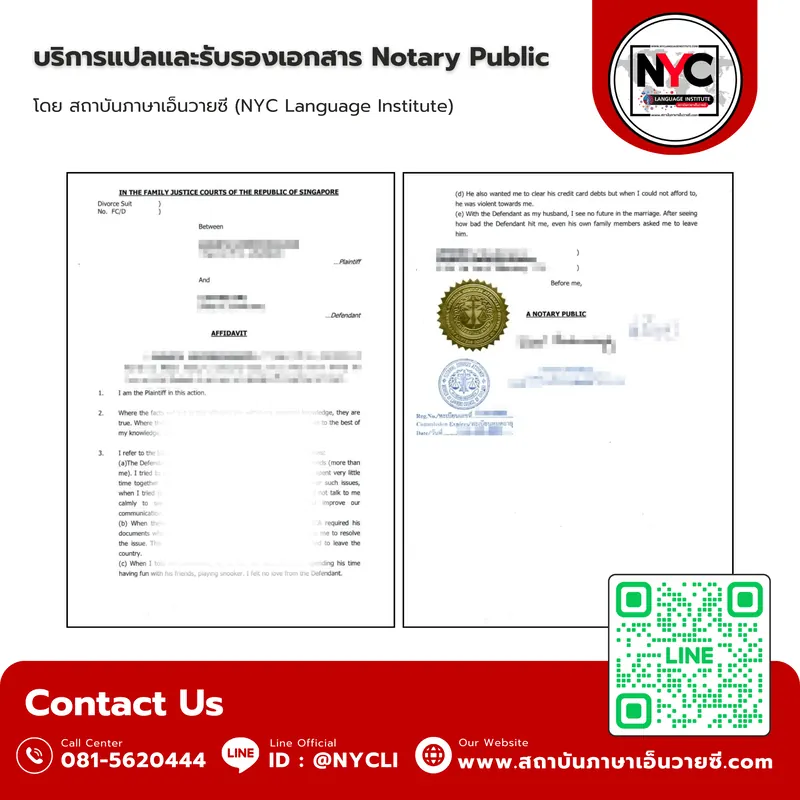
Single-status affidavit with notarial signature certification
Single-status affidavit with notarial signature certificationFrom actual casework by the NYC Visa & Translation team
Service Playbook

Tax documents and Double Tax Agreement (DTA) claims

Claiming DTA relief usually requires a Certificate of Residence (R.O.22) from the Thai Revenue Department together with consistent income evidence, and the translation often has to be certified before use abroad.

Documents to prepare

  • Certificate of Residence (R.O.22)
  • Withholding tax certificate (R.O.21) where tax paid must be evidenced
  • Filed returns: PND.90/91 for individuals or PND.50 for companies
  • Passport / ID and evidence of days present in Thailand
  • Contracts or documents showing the source of income

Step-by-step process

  1. 1. Confirm residence status Verify that the day-count threshold is met for the tax year claimed.
  2. 2. Apply for R.O.22 File the application with the Revenue Department together with income and filing evidence.
  3. 3. Align the supporting set Figures in the returns, contracts and payment evidence must match.
  4. 4. Translate and certify Where the destination requires another language, certify the translation at the Department of Consular Affairs.
  5. 5. Final legalization Apostille or destination embassy, per the receiving tax authority's rules.

Pitfalls and rejection causes

  • The tax year on the R.O.22 must match the year claimed, or the whole file is refused.
  • Mismatches between filed figures and payment evidence trigger requests for more documents.
  • Some countries require their own form signed by the Thai Revenue Department, not only the R.O.22.

Tips from our team

  • Ask the receiving tax authority first whether it wants the R.O.22 or its own country form.
  • Allow for Revenue Department processing queues, especially early in the tax year.
  • Keep certified copies for the following year to avoid repeating the work.

Prefer not to handle the queues yourself, or worried about a rejection? Send us photos of your documents for a free pre-check. We handle the full chain — obtaining certified copies, translation, certification and submission — and keep you updated at each step. Reach us on LINE, phone or email during business hours.

Route Comparison

Comparing cross-border tax routes

Tax residence, treaty relief, and foreign tax credits are separate mechanisms; using the wrong one leads to double taxation.

RouteWhen to useCertifying authorityApprox. durationRejection risk
Certificate of tax residence (R.O.21 / R.O.22)You must prove Thai tax residence to a foreign tax authorityThe Revenue DepartmentVariable, depending on how complete your filed returns areMissing returns for the referenced year block issuance
Claim relief under a double tax agreementYou earn income from a country with a treaty with ThailandThe Revenue Department and the counterpart tax authorityVariable, per the mechanism that country appliesAssuming a treaty exempts all tax — most allocate taxing rights or grant a credit
Refund of over-withheld taxWithholding exceeded the treaty rateThe tax authority of the withholding countryHighly variable — often several monthsMissing the refund filing deadline forfeits the claim

Timelines above are practical estimates from live casework and can change with each authority's policy; confirm with the receiving authority before booking travel. If you would rather not test routes by trial and error, our advisers can assess which route fits your case.

Advisory Service

We do not just process documents — we advise you through the whole case

Our team has worked on cross-border documents, certified translation and government liaison for over 15 years. Most rejections we see are not caused by missing paperwork but by choosing the wrong route on day one, so we always start with a case assessment.

Route assessment

We look at your destination, purpose and deadline, then tell you which certification route applies — and which steps you can skip.

Pre-submission review

Name spelling, consistency across documents, document age and translation format are checked before anything reaches a counter.

Timeline planning

We sequence the steps around your appointment or travel date and flag bottlenecks in advance.

Rejection recovery

We read the refusal reasons, identify the underlying cause, and plan a resubmission that answers what the authority asked for.

Rather not learn by trial and error? Send your case details and document photos for a review — reach us on LINE, phone or email during business hours.

Practical Q&A

Practical questions · Near me / DIY / Required documents

Where does a foreigner start to marry in Thailand?

Start at your embassy in Thailand for an Affirmation of Freedom to Marry, have it translated into Thai and legalised by the Legalization Division of the Department of Consular Affairs, then register at any district office (khet/amphoe) under the Department of Provincial Administration.

Can we do it ourselves, and is an interpreter required?

Every step is open to the couple. On registration day, many registrars require an interpreter and witnesses if the foreign spouse does not understand Thai. Call the specific district office in advance, as interpreter and witness practice varies by office.

What documents are needed, and what if we use the certificate abroad?

Typically: the foreign spouse's original passport, the Thai spouse's ID card and house registration, the legalised affirmation with Thai translation, and divorce or death certificates if previously married. To use the Thai marriage certificate abroad, have it translated and legalised at the Department of Consular Affairs first, then certified by the destination country's embassy where required.
Practical advice & cautions

Family and civil-registration matters: advice and cautions

Before you start
  • Match name spelling to the passport exactly

    Names in translations, registration records and supporting documents must match the passport character for character. A single-letter difference is the most common rejection cause.

  • Discuss inheritance and wills before preparing translations

    Assets in different countries may fall under different laws. Define jurisdiction and the asset list first, then translate and certify only the documents actually required.

  • Obtain freshly issued civil records

    Receiving authorities often limit how old a certified copy may be. Ask about the accepted validity period first, then request the copy and start translation.

  • Foreign divorce papers need a complete certification chain

    Foreign judgments or divorce certificates must be certified under the issuing country's system (apostille or embassy legalisation) before Thai translation and certification. Reversing the order usually means starting again.

Common reasons documents get rejected
  • Filing at the wrong district office

    Some civil-registration matters are tied to the district recorded in the house registration. Filing elsewhere may be refused or take longer.

  • Using records older than the accepted validity period

    Old certified copies of house registration, single-status affirmations or birth certificates can be refused even when the content is correct.

  • Assuming Thai lawyers act as international notaries public

    Thailand has no notary public system. Lawyers registered with the Lawyers Council of Thailand act as Notarial Services Attorneys, and some countries require further certification by the Department of Consular Affairs.

  • Submitting translations that were never legalised

    Most documents for overseas use require translation certification by the Department of Consular Affairs. A translation agency stamp alone is often not accepted.

Requirements differ by authority and destination country and can change. Confirm current conditions with the receiving authority, or ask our team by phone, LINE or email.

What people search for

Frequently searched topics about family and civil registration

Marriage registration with a foreign national
District offices commonly require an affirmation of status from the foreign party's embassy, translated and legalised.
Child travel consent letters
The accepted format and certifier are set by the receiving authority; confirm before drafting.
Using a foreign divorce decree in Thailand
It must be certified in the issuing country first, then translated and legalised in Thailand.
Recording family status in Thailand
Marriages or divorces performed abroad may need to be recorded at a Thai registry office for consistency.

These topics reflect the rules and practice of the relevant authorities and can change. Confirm with the receiving authority, or ask our team by phone, LINE or email.

Related services

What clients usually handle next

One document set often moves through several stages — translation, notarial certification, legalization and finally a visa filing. The links below follow that real sequence.

External authority references

Authority requirements change. Verify with the receiving authority before filing, or ask our team by phone, LINE or email.

Choosing a document translation provider in Thailand

Pick a translation provider by the destination, not by turnaround alone. If the file goes to the Thai Department of Consular Affairs or an embassy, the translator must know the format that office accepts, not just the meaning. Verify three things: the certifier is named and identifiable, the destination accepts that certification format, and names, dates and document numbers match the passport character for character.

How to evaluate a provider

  • The certifier is named and identifiableConsular offices and embassies check who certified the translation, not only the wording.
  • Knows the format the destination acceptsEach embassy differs: attached source copy, letterhead, or prior consular legalization.
  • Character-level verificationMismatched name spelling and dates against the passport is the most common rejection cause.
  • Owns corrections after rejectionSubmissions run on appointment dates; slow corrections cost the applicant the slot.
  • Documented custody of originalsSome civil registry documents are hard to reissue, so intake and return must be traceable.

Questions to ask before you commit

  1. Does my destination require consular or embassy legalization afterwards?
  2. How many working days does it actually take, counted from a complete file?
  3. If the receiving authority rejects or asks for changes, do you correct it, and under what terms?
  4. How can I track status, and who physically holds the original documents?
  5. Who will certify this translation, and will the certifier be named on the document?

Your options, and who each suits

OptionBest forWhat to know
Freelance translatorInformal use where no authority certification is requiredMany embassies will not accept an uncertified translation.
Translation agency with certificationVisa, study and civil registry filingsConfirm the agency also handles the legalization step if the destination requires it.
End-to-end provider (translate + legalize)Files with a fixed appointment deadlineAsk which steps are in-house and which are subcontracted.

FAQ on choosing a provider

Which translation service is recommended for embassy submissions?
Choose one that names the certifier on the translation, knows the exact format your embassy accepts, and verifies names and dates against the passport before certifying. Ask whether they also handle consular legalization so the file does not stall between two vendors.
Does a cheaper translation get rejected more often?
Rejection correlates with format and verification, not price. A translation is rejected when the certifier cannot be identified, the layout does not match the receiving office's requirement, or a name or date differs from the passport.

แหล่งอ้างอิงทางการ · Authoritative Sources

  1. Revenue Department of ThailandPIT/CIT, TIN, Por.161/2566
  2. Department of Employment (MOL)Work Permit issuance
  3. BOI · One-Stop Service CenterLTR / Smart Visa / BOI Work Permit
  4. Immigration BureauNon-Imm visa status