ข้ามไปเนื้อหาหลัก / Skip to main content
N
NYC Visa.
Visa & Translation
Documents for · Destination · 🇨🇭 Switzerland

US–Thai Treaty of Amity Certification · Switzerland 🇨🇭

US–Thai Treaty of Amity Certification engineered specifically for Switzerland 🇨🇭 applications. NYC Visa has processed 1,500+ Switzerland cases via Swiss State Secretariat for Migration (SEM) · Swiss Embassy Bangkok pipelines and knows every สวิสประจำประเทศไทย requirement end-to-end.

ข้อมูลสำคัญ · Entity Panel
Receiving authority
Swiss State Secretariat for Migration (SEM) · Swiss Embassy Bangkok
Embassy / Consulate
สวิสประจำประเทศไทย
ISO
CH
Hague Apostille
Yes
Document language
Deutsch / Français / Italiano
Visa categories covered
6+ classes

Filing documents into Switzerland has destination-specific quirks. Swiss State Secretariat for Migration (SEM) · Swiss Embassy Bangkok requires every document translated into Deutsch / Français / Italiano by a registered translator, notarised by a Notary Public, then legalised by Thailand's MFA Department of Consular Affairs before stamping at the สวิสประจำประเทศไทย in Bangkok. Switzerland is a Hague Apostille party, but since Thailand is NOT, Thai-issued documents still need full MFA + embassy legalization.

เอกสารแปลภาษาเยอรมัน/ฝรั่งเศส beglaubigt ที่ยอมรับโดย SEM และ Kantonale Migrationsamt ทุก canton — Our US–Thai Treaty of Amity Certification team has filed 1,500+ Switzerland cases in the past 3 years. Outcomes remain at the sole discretion of the embassy or authority., and knows the red flags Swiss State Secretariat for Migration (SEM) · Swiss Embassy Bangkok scrutinises (document ordering, signature format, double-apostille, embassy stamp placement).

Clients using our US–Thai Treaty of Amity Certification for Switzerland typically file for: Schengen C, National D, Family Reunion, Student Permit B — frequent documents: Geburtsurkunde, Heiratsurkunde, Strafregisterauszug, Diplome, Arbeitsvertrag. We assemble the entire pack with a destination-appropriate cover letter and certified translation in the format Swiss State Secretariat for Migration (SEM) · Swiss Embassy Bangkok expects.

US–Thai Treaty of Amity Certification workflow for Switzerland: (1) Send document images via LINE @nycvisa or email. (2) Receive a quote in 30 minutes specifying translation language. (3) Translation by registered translator (NAATI / Sworn / Notary). (4) Notary Public certification by Thai attorney. (5) MFA legalization at Chaeng Wattana. (6) Switzerland embassy stamp in Bangkok. (7) Courier delivery + VAT invoice + cloud backup.
Visa categories covered
Schengen C
National D
Family Reunion
Student Permit B
Work Permit L/B
Permanent C
Documents you'll typically need
Geburtsurkunde
Heiratsurkunde
Strafregisterauszug
Diplome
Arbeitsvertrag
Bankauszug
1,500+
Cases delivered
5–10d
Standard turnaround
12+
Languages supported
HowTo · ขั้นตอน

How to use US–Thai Treaty of Amity Certification for Switzerland

  1. 1

    Specify the Switzerland visa class and upload images via LINE @nycvisa or email.

  2. 2

    Within 30 minutes — translation language (Deutsch / Français / Italiano), copies, turnaround.

  3. 3

    Registered translator producing the format Swiss State Secretariat for Migration (SEM) · Swiss Embassy Bangkok accepts.

  4. 4

    Notary Public → MFA Department of Consular Affairs → destination embassy.

  5. 5

    Filed at สวิสประจำประเทศไทย or VFS/TLScontact. Couriered back with full VAT invoice.

FAQ · AEO Block

FAQ · US–Thai Treaty of Amity Certification for Switzerland

AI Answer Box และ Google SGE มักดึงคำตอบจากบล็อกนี้ไปแสดง

What translation language does Switzerland require?

Swiss State Secretariat for Migration (SEM) · Swiss Embassy Bangkok accepts documents translated into Deutsch / Français / Italiano. NYC Visa employs translators registered with the relevant authority.

Is Switzerland a Hague Apostille country?

Switzerland is a Hague party, but Thailand is not 45000 so Thai-issued documents still need full MFA + embassy legalization before use in Switzerland.

How long does it take?

US–Thai Treaty of Amity Certification for Switzerland standard turnaround: 5–10 business days (translation 1–3 + Notary 1 + MFA 2–3 + Embassy 1–3). Express tracks available.

Starting price for US–Thai Treaty of Amity Certification to Switzerland?

Pricing is quoted per case (ask our staff) per standard pack. Share document count and visa subclass for an exact quote (includes embassy fees + courier).

Can clients outside Bangkok file for Switzerland?

Yes 45000 nationwide pickup and return. All MFA + embassy steps happen in Bangkok; no client travel required.

Refund if the Switzerland embassy rejects?

We guarantee acceptance per Swiss State Secretariat for Migration (SEM) · Swiss Embassy Bangkok standards. If rejection is due to our error, we re-process free and refund government fees actually paid.

Why Choose NYC Visa & Translation

How to choose the right US–Thai Treaty of Amity Certification provider in Thailand

Choosing the right US–Thai Treaty of Amity Certification provider directly impacts the success and turnaround of your case. NYC Visa & Translation has worked with Department of Business Development + US Embassy Bangkok (US Commercial Service) since 2010, handling a broad real-world caseload across government documents, certified translations, and documents intended for use abroad. Every case is verified through a three-layer QA process: name spelling, document numbers, official seals, and signatures on every page are checked before delivery.

Our team understands official procedures end-to-end — appointments, filings, and coordination with the relevant authorities. You do not have to travel back and forth or risk rejection. Our US–Thai Treaty of Amity Certification service supports Express handling that completes in half the standard turnaround.

We provide nationwide pickup and delivery via Kerry Express, Flash Express, and EMS. Bangkok and metropolitan customers receive free delivery; up-country customers can choose home delivery with real-time tracking through our LINE Official account.

Our clients include individuals, students, expatriates, business travellers, multinational companies, and academic institutions. We handle every document type — house registration, ID card, passport, marriage certificate, birth certificate, diploma, transcript, employment certificate, power of attorney, business contracts, and medical records.

Our US–Thai Treaty of Amity Certification workflow runs in six clear stages: (1) receive originals and copies, (2) QA-audit the source for issues that would cause rejection, (3) translate through a native-speaker linguist, (4) certify with the authority required by the receiving country, (5) file and follow up at each government touchpoint, and (6) deliver plus retain a signed PDF you can re-download for five years. A single Case Officer owns your file end-to-end, eliminating hand-off errors that plague larger firms.

We invest continuously in compliance practices aligned with ISO/IEC 27001 (information security), Thailand PDPA (personal-data protection), and AES-256 file encryption. Every upload runs over TLS 1.3 only. Enterprise and law-firm clients can request an NDA before intake — our legal team signs same-day.

Beyond single-document work, we bundle end-to-end packages for clients preparing multiple certificates at once — e.g. a "moving abroad" bundle (house registration + birth + marriage + diploma + transcript with MFA + embassy) that reduces the number of trips and total lead time versus filing each item separately. Approval remains at the discretion of the receiving authority; contact our team for scope and fees.

What sets us apart is a 15-year direct working relationship with the destination authority — Department of Business Development + US Embassy Bangkok (US Commercial Service) — so we anticipate regulation changes, format tweaks, and queue timing before they hit your case, and brief you in advance. Approval outcomes always remain at the sole discretion of the authority; what we control is document completeness, formatting and lodgement timing.

Glossary
Notarial Services Attorney
An attorney licensed by the Lawyers Council of Thailand to certify signatures and document copies.
MFA Legalization
Authentication by Thailand's Ministry of Foreign Affairs for documents to be used overseas.
Apostille
International authentication system under the Hague Convention. Thailand is not a member, so MFA legalization is used instead.
NAATI
Australia's national accreditation authority for translators — required for visa and employment applications in Australia.
Police Clearance
A certificate from the Royal Thai Police, required for visa and overseas employment applications.
Certified Translation
A translation certified to match the original, by an accredited translator or notary public.
Case Officer
A dedicated coordinator who owns your file across translation, certification, and government touchpoints.
Chain Legalization
The sequential chain: source authority → Thai MFA → destination embassy, required for the document to be enforceable abroad.
Sworn Translator
A court-sworn linguist authorised to self-certify translations in many European jurisdictions.
Certified True Copy
A copy certified by the document owner or a Notary Public to stand in for the original.
Pre-submission checklist
  • Original document is clean, unbroken, and legible
  • Name matches your passport exactly
  • All seals and signatures present on every page
  • Target language for certification specified
  • Destination country and receiving authority specified
  • Allow 5–7 business days for standard processing
  • Check document expiry — some countries accept only 3–6 months old
  • Prepare ID/passport copy for the person granting power of attorney
  • Arrange documents in the order required by the receiving authority
  • Have payment method and shipping address ready before intake

US–Thai Treaty of Amity Certification for Switzerland — what's required?

US–Thai Treaty of Amity Certification engineered specifically for Switzerland 🇨🇭 applications. NYC Visa has processed 1,500+ Switzerland cases via Swiss State Secretariat for Migration (SEM) · Swiss Embassy Bangkok pipelines and knows every สวิสประจำประเทศไทย requirement end-to-end.

🇨🇭 Switzerland SLA Guarantee
Service Knowledge Base

Work permits, BOI/IEAT privileges, Treaty of Amity and APEC card — practical answers

First-party answers on Thai work authorisation: the standard Department of Employment route, BOI and IEAT channels for skilled experts, US company rights under the Treaty of Amity, and the APEC Business Travel Card for Thai nationals — including which supporting documents must be translated and legalised first. (19+ search topics covered)

Which comes first, the visa or the work permit?

In the usual sequence, the foreign national first holds a non-immigrant visa consistent with the intended employment, then applies for a work permit under the law on managing the employment of foreign workers, administered by the Department of Employment. Continued stay afterwards is decided separately by the Immigration Bureau. The three systems are distinct but interlocking, and a gap in one blocks the next.

What rights does the Treaty of Amity give US companies?

The 1966 Treaty of Amity and Economic Relations lets US nationals and majority US-owned companies operate in Thailand on largely the same footing as Thai nationals, exempt from many restrictions of the Foreign Business Act B.E. 2542, with some sectors still excluded such as land and certain resource activities. Use of the treaty requires nationality certification through the US Embassy and registration with the Department of Business Development.

Is a work permit the same as a visa in Thailand?

No. A visa such as Non-Immigrant B is issued by a Thai embassy or consulate, extensions of stay are approved by the Immigration Bureau, while the work permit itself is issued by the Department of Employment under the Emergency Decree on Managing the Work of Aliens B.E. 2560 (2017). Holding a valid visa does not by itself authorise employment, and working before authorisation carries legal penalties, so both tracks must be planned together.

Can I start working while the application is pending?

Working before authorisation is granted exposes both the worker and the employer to penalties under the foreigners' working management law. The safe course is to agree a start date conditional on issuance, and to keep the employment contract, the position description and the employer's registration documents consistent with what was filed, since discrepancies between the contract and the filing are a frequent cause of rejection.

Do I need a work permit for remote work for a foreign company?

This is fact-specific. The law addresses work performed within the Kingdom rather than only the location of the payer. Visas designed for remote workers carry their own conditions and do not automatically confer the right to work for a business in Thailand. Where Thai clients or a Thai entity become involved, obtain advice before starting to avoid regulatory exposure.

Who can obtain an APEC Business Travel Card?

The card facilitates business travel among participating APEC economies and is issued to Thai business people by the Department of Consular Affairs, subject to endorsement by the designated authorities. Pre-clearance for each economy is decided by that economy, and the card does not grant the right to work abroad.

How are foreign degrees and experience letters handled?

They usually must be translated into Thai or English as required and legalised through the diplomatic chain: certified in the issuing country (apostille where that country is a Convention party), then endorsed by the Royal Thai Embassy, or endorsed by that country's embassy in Thailand and then legalised by the Legalization Division of the Department of Consular Affairs before submission.

How are foreign degrees and experience letters used for a Thai work permit?

They are normally authenticated by the competent authority in the issuing country and by the Royal Thai Embassy there, or by apostille once the Convention enters into force for Thailand on 28 February 2027 where accepted, then translated into Thai and legalised by the Department of Consular Affairs. Experience letters should state the position, exact dates, duties and the issuer's contact details, because verification enquiries do occur. Confirm the document list with the Department of Employment or the receiving office before preparing the file.
Topics covered
คำค้นหลัก: ขอใบอนุญาตทำงานคนต่างชาติ · work permit thailand requirements · BOI work permit e-Expert · one stop service center visa work permit · IEAT work permit นิคมอุตสาหกรรม · treaty of amity company registration · บัตรเอเปค APEC Business Travel Card
เอกสารที่มักต้องแปล/รับรอง: ปริญญาบัตร/ทรานสคริปต์ · หนังสือรับรองประสบการณ์ทำงาน · ใบอนุญาตประกอบวิชาชีพ · หนังสือรับรองบริษัทต่างประเทศ · หนังสือมอบอำนาจ (Power of Attorney) · ทะเบียนสมรส/สูติบัตรของผู้ติดตาม
หน่วยงานที่เกี่ยวข้อง: กรมการจัดหางาน (DOE) · สำนักงานคณะกรรมการส่งเสริมการลงทุน (BOI) · การนิคมอุตสาหกรรมแห่งประเทศไทย (กนอ./IEAT) · กรมพัฒนาธุรกิจการค้า (DBD) · สำนักงานตรวจคนเข้าเมือง (ตม.) · กรมการกงสุล กระทรวงการต่างประเทศ
Official references

Need your documents reviewed or your case assessed? Ask our team by phone, LINE, or email. We reply during business hours (Mon–Fri 9:00–18:00, Sat 9:00–15:00, ICT).

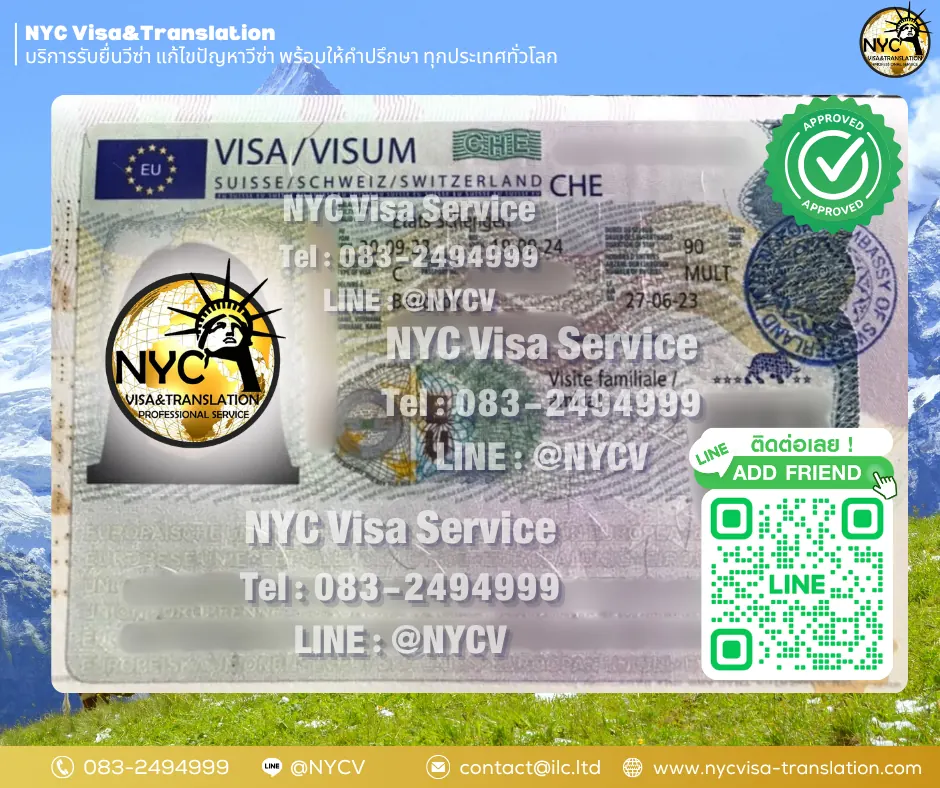
Switzerland visa obtained by a client
Switzerland visa obtained by a clientFrom actual casework by the NYC Visa & Translation team
Service Playbook

Thai work permit — company-side and employee-side documents

Work permits are issued by the Department of Employment and are tied to the employer, position and workplace. Changing job, role or location requires a new filing.

Documents to prepare

  • Company side: current affidavit, shareholder list, financial statements, social security filings
  • Employee side: passport, the correct visa category, and the required medical certificate
  • Degrees and experience letters, legalised at source and translated for Thai use
  • Employment contract and job description
  • Workplace map and photographs where requested
  • Power of attorney for the company's filing agent

Step-by-step process

  1. 1. Check company and role eligibility Registered capital, Thai-to-foreign staff ratio and reserved occupations are verified first.
  2. 2. Prepare foreign documents Qualifications and experience letters must be legalised abroad and translated before filing.
  3. 3. File the application Through the Department of Employment, or a dedicated channel such as the BOI One Stop Service.
  4. 4. Collect and comply Work only within the stated role and location, and renew before expiry.

Pitfalls and rejection causes

  • Working outside the stated role or location breaches the permit conditions.
  • A permit belongs to the employer — it cannot follow you to a new company.
  • Visa and permit expire on different dates; track both.
  • Company documents older than the accepted window must be reissued.

Tips from our team

  • Set reminders at least 45 days before either expiry date.
  • Maintain a standing company document pack to speed up future filings.
  • BOI-promoted companies should use the dedicated channel to cut steps.

Prefer not to handle the queues yourself, or worried about a rejection? Send us photos of your documents for a free pre-check. We handle the full chain — obtaining certified copies, translation, certification and submission — and keep you updated at each step. Reach us on LINE, phone or email during business hours.

Route Comparison

Comparing Thai work permit routes

Different employer types use different channels, and each channel pairs with a different visa category.

RouteWhen to useCertifying authorityApprox. durationRejection risk
Standard filing with the Department of EmploymentThe employer is an ordinary Thai company without BOI promotionDepartment of Employment, Ministry of LabourVariable, driven by how complete the employer's file isThai-to-foreign staff ratios and registered capital not meeting thresholds is the common refusal ground
BOI-promoted company channelThe employer holds a promotion certificate and the position is on the approved listBOI together with the Immigration Bureau and Department of EmploymentGenerally faster than the standard route, still variableA position that differs from the approved list requires an amendment first
Conditional or short-term work authorisationShort assignments or job types covered by specific published rulesDepartment of Employment under the notification in forceShorter than a full applicationWorking beyond the authorised scope is an offence even when a permit exists

Timelines above are practical estimates from live casework and can change with each authority's policy; confirm with the receiving authority before booking travel. If you would rather not test routes by trial and error, our advisers can assess which route fits your case.

Advisory Service

We do not just process documents — we advise you through the whole case

Our team has worked on cross-border documents, certified translation and government liaison for over 15 years. Most rejections we see are not caused by missing paperwork but by choosing the wrong route on day one, so we always start with a case assessment.

Route assessment

We look at your destination, purpose and deadline, then tell you which certification route applies — and which steps you can skip.

Pre-submission review

Name spelling, consistency across documents, document age and translation format are checked before anything reaches a counter.

Timeline planning

We sequence the steps around your appointment or travel date and flag bottlenecks in advance.

Rejection recovery

We read the refusal reasons, identify the underlying cause, and plan a resubmission that answers what the authority asked for.

Rather not learn by trial and error? Send your case details and document photos for a review — reach us on LINE, phone or email during business hours.

Practical Q&A

Practical questions · Near me / DIY / Required documents

Is there a service point near me?

Our main offices are Lat Phrao 95 (Bangkok), Khon Kaen and Udon Thani. We serve the whole country through scans and document courier, and can meet at city rail stations or malls. Ask our team by phone, LINE or email for the most convenient option.

Can I handle this myself?

Many steps can be done personally under the relevant authority's rules. What usually costs time is the wrong sequence, a translation format that does not match the requirement, or a source document version the recipient will not accept. Check the destination checklist before starting and ask us if anything is unclear.

Which documents should I prepare?

Generally the original document from the competent authority, the owner's ID or passport, a translation in the format the destination requires, and a power of attorney if someone acts for you. Details vary by service type — ask our team for a case-specific checklist.
Practical advice & cautions

Business, tax and legal work: advice and cautions

Before you start
  • Use bilingual contracts with a governing version

    Cross-border contracts should state which language version prevails and how disputes are resolved.

  • Separate personal and company banking

    Mixed accounts complicate financial statements and tax explanations, and cause problems when bank evidence supports a visa or work permit.

  • Fix the structure before registration

    Shareholding, objectives and required licences should be settled before filing; later changes require amendment filings and extra time.

  • Check for sector-specific licences

    Some activities need a licence from a specialist regulator before operating. Verify at the planning stage.

Common reasons documents get rejected
  • Outdated company certificates

    Certificates submitted should be freshly issued and consistent with the current register, or the receiving authority will refuse them.

  • Failing to file changes

    Changes of director, address or capital must be filed within the statutory period; omissions create mismatches that block other applications.

  • Wills that ignore cross-border assets

    Assets in different countries may fall under different succession rules; ensure multiple wills do not contradict each other.

  • Treating a contract translation as legal advice

    A translation conveys wording but does not assess legal risk. Have a lawyer review the substance before signing.

Requirements differ by authority and destination country and can change. Confirm current conditions with the receiving authority, or ask our team by phone, LINE or email.

Related services

What clients usually handle next

One document set often moves through several stages — translation, notarial certification, legalization and finally a visa filing. The links below follow that real sequence.

External authority references

Authority requirements change. Verify with the receiving authority before filing, or ask our team by phone, LINE or email.

Choosing a document translation provider in Thailand

Pick a translation provider by the destination, not by turnaround alone. If the file goes to the Thai Department of Consular Affairs or an embassy, the translator must know the format that office accepts, not just the meaning. Verify three things: the certifier is named and identifiable, the destination accepts that certification format, and names, dates and document numbers match the passport character for character.

How to evaluate a provider

  • The certifier is named and identifiableConsular offices and embassies check who certified the translation, not only the wording.
  • Knows the format the destination acceptsEach embassy differs: attached source copy, letterhead, or prior consular legalization.
  • Character-level verificationMismatched name spelling and dates against the passport is the most common rejection cause.
  • Owns corrections after rejectionSubmissions run on appointment dates; slow corrections cost the applicant the slot.
  • Documented custody of originalsSome civil registry documents are hard to reissue, so intake and return must be traceable.

Questions to ask before you commit

  1. Who will certify this translation, and will the certifier be named on the document?
  2. Does my destination require consular or embassy legalization afterwards?
  3. How many working days does it actually take, counted from a complete file?
  4. If the receiving authority rejects or asks for changes, do you correct it, and under what terms?
  5. How can I track status, and who physically holds the original documents?

Your options, and who each suits

OptionBest forWhat to know
Freelance translatorInformal use where no authority certification is requiredMany embassies will not accept an uncertified translation.
Translation agency with certificationVisa, study and civil registry filingsConfirm the agency also handles the legalization step if the destination requires it.
End-to-end provider (translate + legalize)Files with a fixed appointment deadlineAsk which steps are in-house and which are subcontracted.

FAQ on choosing a provider

Which translation service is recommended for embassy submissions?
Choose one that names the certifier on the translation, knows the exact format your embassy accepts, and verifies names and dates against the passport before certifying. Ask whether they also handle consular legalization so the file does not stall between two vendors.
Does a cheaper translation get rejected more often?
Rejection correlates with format and verification, not price. A translation is rejected when the certifier cannot be identified, the layout does not match the receiving office's requirement, or a name or date differs from the passport.

แหล่งอ้างอิงทางการ · Authoritative Sources

  1. สถานเอกอัครราชทูตสวิสประจำประเทศไทยOfficial Switzerland authority in Bangkok
  2. MFA Department of Consular AffairsThai document legalization authority
  3. Department of Business Development + US Embassy Bangkok (US Commercial Service)Service-specific authority