ข้ามไปเนื้อหาหลัก / Skip to main content
N
NYC Visa.
Visa & Translation
หนังสือรับรองคำแปลที่ออกโดยสำนักงานแปลเอกสาร
Documents for · Destination · 🇪🇺 Schengen Area

Remote Interpreting (VRI & OPI) · Schengen Area 🇪🇺

Remote Interpreting (VRI & OPI) engineered specifically for Schengen Area 🇪🇺 applications. NYC Visa prepares Schengen Area applications via EU Visa Information System · VFS Global · TLScontact pipelines and knows every สถานทูตประเทศสมาชิกเชงเก้นในกรุงเทพฯ requirement end-to-end.

ข้อมูลสำคัญ · Entity Panel
Receiving authority
EU Visa Information System · VFS Global · TLScontact
Embassy / Consulate
สถานทูตประเทศสมาชิกเชงเก้นในกรุงเทพฯ
ISO
EU
Hague Apostille
Yes
Document language
Multilingual (per destination country)
Visa categories covered
7+ classes

Filing documents into Schengen Area has destination-specific quirks. EU Visa Information System · VFS Global · TLScontact requires every document translated into Multilingual (per destination country) by a registered translator, notarised by a Notary Public, then legalised by Thailand's MFA Department of Consular Affairs before stamping at the สถานทูตประเทศสมาชิกเชงเก้นในกรุงเทพฯ in Bangkok. Schengen Area is a Hague Apostille party, but since Thailand is NOT, Thai-issued documents still need full MFA + embassy legalization.

ทีม NYC Visa ทำเอกสารยื่น VFS/TLScontext ทุกประเทศเชงเก้น (เยอรมัน/ฝรั่งเศส/อิตาลี/สเปน/เนเธอร์แลนด์/สวิตเซอร์แลนด์ ฯลฯ) ครบ Travel Insurance + Cover Letter + Itinerary professional pack — Our Remote Interpreting (VRI & OPI) team has filed 1,500+ Schengen Area cases in the past 3 years. Outcomes remain at the sole discretion of the embassy or authority., and knows the red flags EU Visa Information System · VFS Global · TLScontact scrutinises (document ordering, signature format, double-apostille, embassy stamp placement).

Clients using our Remote Interpreting (VRI & OPI) for Schengen Area typically file for: Schengen Type C, Multiple Entry, Business, Tourist — frequent documents: Travel insurance €30k, Bank statements 3-6 months, Hotel bookings, Flight reservations, Employment letter. We assemble the entire pack with a destination-appropriate cover letter and certified translation in the format EU Visa Information System · VFS Global · TLScontact expects.

Remote Interpreting (VRI & OPI) workflow for Schengen Area: (1) Send document images via LINE @nycvisa or email. (2) Receive a staff reply within 2 hours during business hours (Mon–Sat 09:00–18:00 Bangkok time); the quotation follows scope review. (3) Translation by registered translator (NAATI / Sworn / Notary). (4) Notary Public certification by Thai attorney. (5) MFA legalization at Chaeng Wattana. (6) Schengen Area embassy stamp in Bangkok. (7) Courier delivery + VAT invoice + cloud backup.
Visa categories covered
Schengen Type C
Multiple Entry
Business
Tourist
Family Visit
Cultural/Sport
Medical Treatment
Documents you'll typically need
Travel insurance €30k
Bank statements 3-6 months
Hotel bookings
Flight reservations
Employment letter
Tax returns
Property documents
5–10d
Standard turnaround
12+
Languages supported
HowTo · ขั้นตอน

How to use Remote Interpreting (VRI & OPI) for Schengen Area

  1. 1

    Specify the Schengen Area visa class and upload images via LINE @nycvisa or email.

  2. 2

    Staff reply within 2 hours during business hours (Mon–Sat 09:00–18:00 Bangkok time); confirm translation language (Multilingual (per destination country)), copies, turnaround.

  3. 3

    Registered translator producing the format EU Visa Information System · VFS Global · TLScontact accepts.

  4. 4

    Notary Public → MFA Department of Consular Affairs → destination embassy.

  5. 5

    Filed at สถานทูตประเทศสมาชิกเชงเก้นในกรุงเทพฯ or VFS/TLScontact. Couriered back with full VAT invoice.

FAQ

FAQ · Remote Interpreting (VRI & OPI) for Schengen Area

What translation language does Schengen Area require?

EU Visa Information System · VFS Global · TLScontact accepts documents translated into Multilingual (per destination country). NYC Visa employs translators registered with the relevant authority.

Is Schengen Area a Hague Apostille country?

Schengen Area is a Hague party, but Thailand is not quoted per case by our team so Thai-issued documents still need full MFA + embassy legalization before use in Schengen Area.

How long does it take?

Remote Interpreting (VRI & OPI) for Schengen Area standard turnaround: 5–10 business days (translation 1–3 + Notary 1 + MFA 2–3 + Embassy 1–3). Express tracks available.

Starting price for Remote Interpreting (VRI & OPI) to Schengen Area?

Pricing is quoted per case (ask our staff) per standard pack. Share document count and visa subclass for an exact quote (includes embassy fees + courier).

Can clients outside Bangkok file for Schengen Area?

Yes quoted per case by our team nationwide pickup and return. All MFA + embassy steps happen in Bangkok; no client travel required.

Refund if the Schengen Area embassy rejects?

No. Acceptance is decided by EU Visa Information System · VFS Global · TLScontact. We prepare documents to its published standards before submission; NYC does not offer refunds, and government fees are non-refundable.

Remote Interpreting (VRI & OPI) for Schengen Area — what's required?

Remote Interpreting (VRI & OPI) engineered specifically for Schengen Area 🇪🇺 applications. NYC Visa prepares Schengen Area applications via EU Visa Information System · VFS Global · TLScontact pipelines and knows every สถานทูตประเทศสมาชิกเชงเก้นในกรุงเทพฯ requirement end-to-end.

🇪🇺 Schengen Area SLA Guarantee
Service Knowledge Base

Outbound visa answer bank for applicants in Thailand — US, UK and Schengen

Answers to the questions Thailand-based applicants actually ask about US visas (DS-160 plus interview), UK visas (online application plus biometrics) and Schengen visas (main-destination rule, 90/180 rule) — including the most common refusal grounds and how Thai civil documents must be translated and legalised by the Department of Consular Affairs first. Based on travel.state.gov, GOV.UK and the EU Visa Code. (30+ search topics covered)

What causes most refusals of documents prepared in Thailand?

Inconsistency rather than insufficiency: names spelled differently across passport, civil-registry extracts and bank records; income evidence that does not match the stated occupation; itineraries that conflict with employment leave dates; and translations lacking the certification the mission requires. Reviewing the file as a whole for internal contradictions is more valuable than adding further documents.

Are VFS Global and TLScontact the decision-makers?

No. They are application and biometric collection centres. The decision belongs to the embassy, consulate or immigration authority of the destination country. Any provider claiming inside contacts or the ability to fast-track a decision should be avoided.

How far ahead should the document chain be started?

Work backwards from the appointment date. Certificates issued by Thai registry offices, their translation, legalisation at the Department of Consular Affairs and, where required, endorsement by the destination mission each carry their own queue. Because several missions require the underlying certificate to be recent, starting too early can be as damaging as starting too late; sequence rather than merely hurry.

How far ahead should an outbound visa file be started?

Allow time for the application centre's appointment queue, the embassy's processing period, and the production of source documents such as employment and financial letters, translations and, where needed, consular legalisation. The factors most often underestimated are appointment scarcity in peak season and issuing bodies that take several working days. Starting early also leaves room to correct name spellings or document formats. Processing itself remains at the deciding authority's discretion and cannot be accelerated by any agent.

What should be done differently after a previous refusal?

Keep the full refusal notice and read the stated grounds closely, because refiling the same bundle usually produces the same outcome. Declare the earlier refusal truthfully on the new form; concealment is treated as misrepresentation and carries heavier consequences. Then strengthen the specific weakness identified — ties to Thailand, source of funds, or consistency between the itinerary and bookings. No adviser can guarantee the outcome of a fresh decision.

What should be done after a visa refusal before reapplying?

Do not resubmit the same file. First decode the refusal notice, which normally cites the ground or code relied on, then re-test three axes: a purpose of travel that is documented, funds whose origin is traceable, and ties to Thailand that make return credible. A new application should add genuinely new evidence rather than reordering the old bundle, and should address the change openly, since missions keep the applicant's history. Diagnosing the real ground before reapplying matters more than volume of paperwork.

How do I apply for a US visa from Thailand?

Complete form DS-160 online in the US Department of State CEAC system, pay the fee through the designated channel, book an interview at the US Embassy Bangkok or the Consulate General in Chiang Mai depending on your district, then attend the interview and biometrics appointment. Only a US consular officer decides the case; no document agency can approve a visa or shorten the queue.

What does a refusal under INA 214(b) mean?

Section 214(b) presumes every nonimmigrant applicant intends to immigrate until they satisfy the officer that they have ties compelling them to return home. It is not a blacklist. You may reapply once your circumstances or the evidence of your ties — employment, property, family obligations in Thailand — have meaningfully changed.
Topics covered
วีซ่าสหรัฐอเมริกา: DS-160 กรอกอย่างไร · วีซ่า B1/B2 คนไทย · สัมภาษณ์วีซ่าอเมริกา · 214(b) ปฏิเสธวีซ่า · หลักฐานความผูกพันกับประเทศไทย · นัดสัมภาษณ์สถานทูตสหรัฐฯ กรุงเทพ · วีซ่านักเรียน F-1 ไทย · administrative processing 221(g)
วีซ่าสหราชอาณาจักร: UK Standard Visitor visa · ยื่นวีซ่าอังกฤษออนไลน์ GOV.UK · biometrics VFS อังกฤษ · maintenance funds วีซ่า UK · sponsor letter อังกฤษ · UK student visa CAS · วีซ่าอังกฤษถูกปฏิเสธ credibility
วีซ่าเชงเก้น: วีซ่าเชงเก้นยื่นประเทศไหน · main destination rule · กฎ 90/180 เชงเก้น · ประกันการเดินทางเชงเก้น · VFS TLScontact เชงเก้น · จองตั๋วและที่พักยื่นวีซ่า · อุทธรณ์วีซ่าเชงเก้น
Official references

Need your documents reviewed or your case assessed? Ask our team by phone, LINE, or email. We reply within two hours during business hours (Mon–Sat 9:00–18:00 ICT).

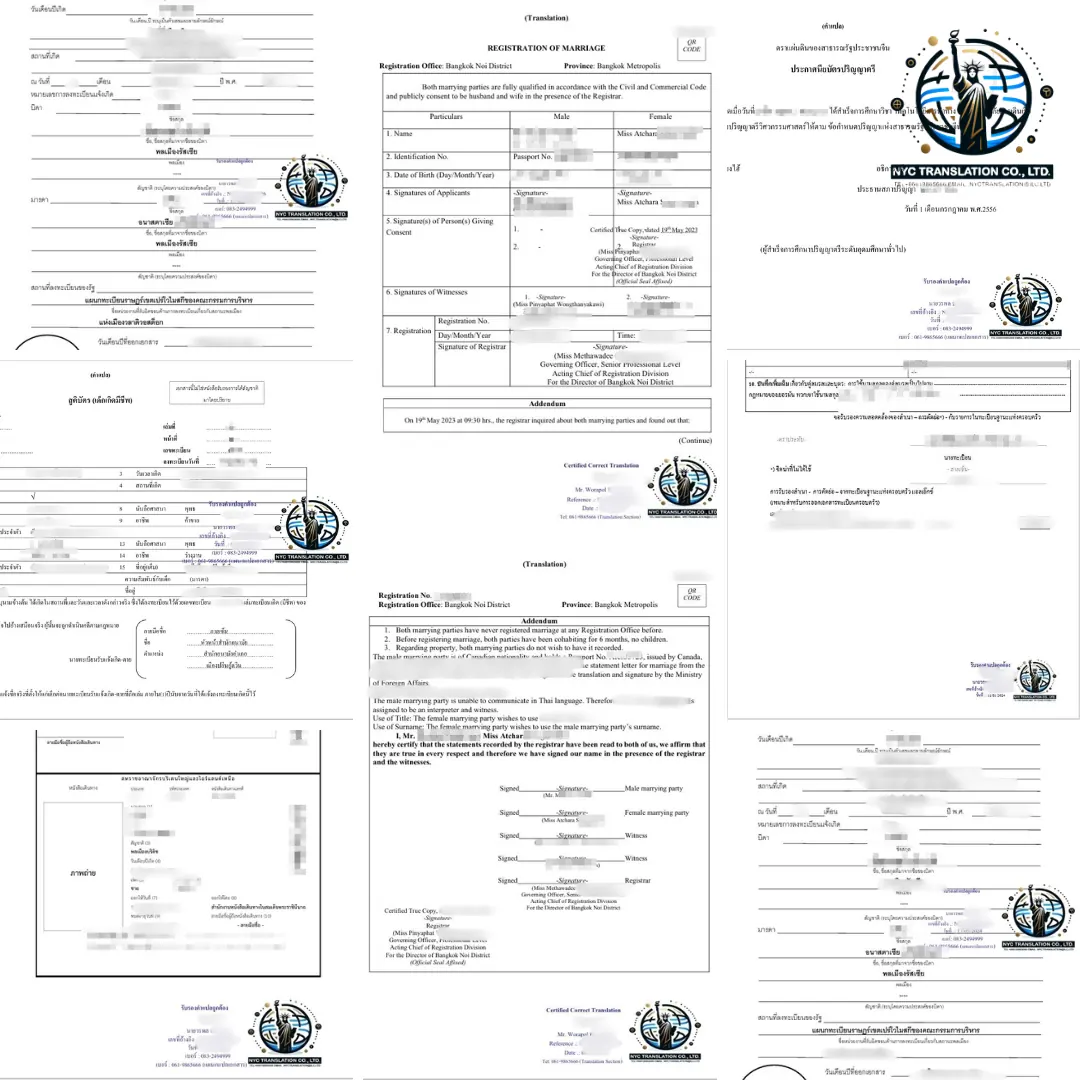
Certificate of translation issued by our translation office
Certificate of translation issued by our translation office — Service illustration; requirements depend on the document and receiving authority
Service Playbook

Outbound visas from Thailand — documents and preparation

We prepare, translate and legalise documents; we do not decide outcomes. Every decision rests entirely with the embassy or immigration authority of the destination country.

Documents to prepare

  • • Passport with sufficient validity and the required blank pages
  • • Completed online application and appointment confirmation
  • • Financial history for the period the destination requires
  • • Ties to Thailand: employment letter, business registration or property records
  • • Itinerary, accommodation and travel insurance as required
  • • Thai documents translated and certified under the destination's system

Step-by-step process

  1. 1. Choose the category and channel — Directly at the mission, or through an appointed centre such as VFS or TLS.
  2. 2. Prepare and translate — Order the bundle to match the form and translate under the accepted system.
  3. 3. Book biometrics and submit — Attend with the complete set on the appointed day.
  4. 4. Track and collect — Check the visa details for accuracy as soon as it is returned.

Pitfalls and rejection causes

  • • Third-party funds or unexplained large deposits are a frequent refusal ground.
  • • A visa does not guarantee entry — the border officer decides.
  • • Form entries that contradict the attachments invite doubt.
  • • Filing close to departure leaves no room for additional document requests.

Tips from our team

  • • Order documents exactly as the embassy checklist lists them.
  • • Prepare explanations for large deposits in advance.
  • • In peak season, file one to two months ahead.

Prefer not to handle the queues yourself, or worried about a rejection? Send us photos of your documents for a free pre-check. We handle the full chain — obtaining certified copies, translation, certification and submission — and keep you updated at each step. Reach us on LINE, phone or email during business hours.

Route Comparison

Comparing outbound visa submission channels

e-Visa, visa application centres (VFS/BLS) and direct embassy filing carry different conditions and risks.

RouteWhen to useCertifying authorityApprox. durationRejection risk
e-Visa / the destination's online systemThe destination offers an online channel for Thai passport holdersThe destination country's immigration authorityVariable, per that system's published practiceUploads outside the file spec, or data not matching the passport, trigger automatic refusal
Via a visa application centre (VFS Global, BLS, etc.)The embassy has outsourced intake and biometricsThe destination embassy, receiving through its appointed centreVariable, by appointment availability and seasonDocuments not ordered to the centre's checklist, costing your appointment slot
Direct filing at the embassy/consulateCountries that still take applications in-house, or special visa categoriesThe destination country's embassy or consulateVariable, per each mission's decision cycleAppointments booked out far ahead, pushing back travel plans

Timelines above are practical estimates from live casework and can change with each authority's policy; confirm with the receiving authority before booking travel. If you would rather not test routes by trial and error, our advisers can assess which route fits your case.

Advisory Service

We do not just process documents — we advise you through the whole case

Our team has worked on cross-border documents, certified translation and government liaison since 2015. Most rejections we see are not caused by missing paperwork but by choosing the wrong route on day one, so we always start with a case assessment.

Route assessment

We look at your destination, purpose and deadline, then tell you which certification route applies — and which steps you can skip.

Pre-submission review

Name spelling, consistency across documents, document age and translation format are checked before anything reaches a counter.

Timeline planning

We sequence the steps around your appointment or travel date and flag bottlenecks in advance.

Rejection recovery

We read the refusal reasons, identify the underlying cause, and plan a resubmission that answers what the authority asked for.

Rather not learn by trial and error? Send your case details and document photos for a review — reach us on LINE, phone or email during business hours.

Practical Q&A

Practical questions · Near me / DIY / Required documents

How do I find certified translation near me?

Our only office is at Ladprao 95, Bangkok. Send clear scans through LINE @nycvisa with the destination country, receiving authority and required date. We will confirm the translation format and whether originals or delivery are needed before you send documents.

Can I translate it myself and have it certified afterwards?

It depends on the recipient. The Department of Consular Affairs certifies a translation by checking it against the original rather than by translator identity, but many embassies and foreign authorities require an independent or accredited translator. Check the destination's rule before self-translating to avoid a rejection cycle.

What do you need from me to start?

Sharp colour scans of every page including seals and signatures, the English spelling of names exactly as printed in the passport, the receiving authority and country, and your deadline. Sending any previously certified translation helps keep terminology and name spelling consistent across the set.
Practical advice & cautions

Interpreting services: booking advice and cautions

Before you start
  • Check the authority's interpreter requirements

    Some district offices, courts and embassies set qualification or identification requirements for interpreters. Confirm with them before the appointment and tell us, so we assign someone who meets the criteria.

  • Allow for travel and waiting time

    District offices, courts and immigration offices have unpredictable queues. Book a buffer rather than stacking appointments on the same day.

  • Use remote interpreting where it fits

    Short meetings, interviews and urgent calls can be handled over phone or video, saving travel time. Test the connection and equipment at least 15 minutes before the start.

  • State the number of speakers and duration

    Assignments longer than half a day or with several simultaneous speakers may need more than one interpreter to maintain quality. Share this when booking.

Common reasons documents get rejected
  • Skipping written translations

    Assignments that reference documents, such as signing a contract or filing an application, usually also need written translations. Spoken interpreting alone may not satisfy the authority's rules.

  • Late booking in a rare language

    Languages with few interpreters in Thailand require longer lead time. Last-minute requests may simply have no available interpreter.

  • Using a relative or friend as interpreter at a government office

    Many authorities refuse interpreters with a personal interest in the case, especially for marriage registration and formal questioning, because impartiality is compromised.

  • Expecting legal advice from the interpreter

    An interpreter conveys speech completely and neutrally; they do not give legal opinions or negotiate for you. Engage a lawyer alongside if advice is needed.

Requirements differ by authority and destination country and can change. Confirm current conditions with the receiving authority, or ask our team by phone, LINE or email.

What people search for

Frequently searched topics about interpreting

Medical interpreting
Share terminology and case history in advance so clinical communication stays accurate.
Embassy and visa interview interpreting
Some missions do not admit accompanying persons to the interview room; check each mission's rule first.
Interpreter at a district office
For registrations involving a foreign spouse, the registrar may require an interpreter and their Thai ID for the record.
Simultaneous vs consecutive interpreting
They differ in equipment, team size and terminology preparation; confirm the mode when booking.

These topics reflect the rules and practice of the relevant authorities and can change. Confirm with the receiving authority, or ask our team by phone, LINE or email.

Related services

What clients usually handle next

One document set often moves through several stages — translation, notarial certification, legalization and finally a visa filing. The links below follow that real sequence.

External authority references

Authority requirements change. Verify with the receiving authority before filing, or ask our team by phone, LINE or email.

Choosing a document translation provider in Thailand

Pick a translation provider by the destination, not by turnaround alone. If the file goes to the Thai Department of Consular Affairs or an embassy, the translator must know the format that office accepts, not just the meaning. Verify three things: the certifier is named and identifiable, the destination accepts that certification format, and names, dates and document numbers match the passport character for character.

How to evaluate a provider

  • The certifier is named and identifiable — Consular offices and embassies check who certified the translation, not only the wording.
  • Knows the format the destination accepts — Each embassy differs: attached source copy, letterhead, or prior consular legalization.
  • Character-level verification — Mismatched name spelling and dates against the passport is the most common rejection cause.
  • Owns corrections after rejection — Submissions run on appointment dates; slow corrections cost the applicant the slot.
  • Documented custody of originals — Some civil registry documents are hard to reissue, so intake and return must be traceable.

Questions to ask before you commit

  1. How many working days does it actually take, counted from a complete file?
  2. If the receiving authority rejects or asks for changes, do you correct it, and under what terms?
  3. How can I track status, and who physically holds the original documents?
  4. Who will certify this translation, and will the certifier be named on the document?
  5. Does my destination require consular or embassy legalization afterwards?

Your options, and who each suits

OptionBest forWhat to know
Freelance translatorInformal use where no authority certification is requiredMany embassies will not accept an uncertified translation.
Translation agency with certificationVisa, study and civil registry filingsConfirm the agency also handles the legalization step if the destination requires it.
End-to-end provider (translate + legalize)Files with a fixed appointment deadlineAsk which steps are in-house and which are subcontracted.

FAQ on choosing a provider

Which translation service is recommended for embassy submissions?
Choose one that names the certifier on the translation, knows the exact format your embassy accepts, and verifies names and dates against the passport before certifying. Ask whether they also handle consular legalization so the file does not stall between two vendors.
Does a cheaper translation get rejected more often?
Rejection correlates with format and verification, not price. A translation is rejected when the certifier cannot be identified, the layout does not match the receiving office's requirement, or a name or date differs from the passport.

แหล่งอ้างอิงทางการ · Authoritative Sources

  1. สถานทูตประเทศสมาชิกเชงเก้นในกรุงเทพฯ — Official Schengen Area authority in Bangkok
  2. MFA Department of Consular Affairs — Thai document legalization authority
  3. NYC Visa Remote Hub — specialist remote interpreters — Service-specific authority