What people search for
NAATI certified translation
688 topics grouped by document type and receiving authority (page 3/9) — requirements change, so confirm with the receiving authority or ask our staff by phone, LINE or email.
688 topics grouped by document type and receiving authority (page 3/9) — requirements change, so confirm with the receiving authority or ask our staff by phone, LINE or email.
Preparation and draft review can run online, but many authorities still require the physical original at the certification stage, so confirm the accepted format in writing first.
If you are outside Bangkok you can courier the original a company registration certificate, enclosing a passport copy and a contact number in the same envelope.
Rush handling can only compress the parts we control, such as drafting and courier legwork; the authority's own queue is outside anyone's control.
The most frequent causes are a name spelling that differs from the passport, an original older than the receiving body allows, and a translation that omits seals or the final page.
Once certified, the a company registration certificate is accepted by the receiving body it was prepared for; if the destination changes, re-check the certification format required.
From overseas you can appoint a representative in Thailand; the power of attorney must first be certified in the form the receiving authority requires.
Prepare at least one spare set: receiving bodies usually retain the certified original, and producing more later means repeating the certification steps.
A representative needs a power of attorney plus ID copies of both parties, and a NAATI-certified translator will check that names match the source document.
The standard sequence is: verify the original, prepare the translation or certification in the required format, certify with a NAATI-certified translator, then re-check before filing.
The baseline set is the original a power of attorney (or an officially certified copy), a passport or ID copy of the holder, and a power of attorney if someone else acts for you.
Turnaround depends on how complete the original is and on the authority's queue at the time, so treat any figure as an approximate range and avoid booking travel before the papers are in hand.
The final certification sits with a NAATI-certified translator; document preparation and translation can be arranged in advance from Bangkok or upcountry.
Preparation and draft review can run online, but many authorities still require the physical original at the certification stage, so confirm the accepted format in writing first.
If you are outside Bangkok you can courier the original a power of attorney, enclosing a passport copy and a contact number in the same envelope.
Rush handling can only compress the parts we control, such as drafting and courier legwork; the authority's own queue is outside anyone's control.
The most frequent causes are a name spelling that differs from the passport, an original older than the receiving body allows, and a translation that omits seals or the final page.
Once certified, the a power of attorney is accepted by the receiving body it was prepared for; if the destination changes, re-check the certification format required.
From overseas you can appoint a representative in Thailand; the power of attorney must first be certified in the form the receiving authority requires.
Prepare at least one spare set: receiving bodies usually retain the certified original, and producing more later means repeating the certification steps.
A representative needs a power of attorney plus ID copies of both parties, and a NAATI-certified translator will check that names match the source document.
The standard sequence is: verify the original, prepare the translation or certification in the required format, certify with a NAATI-certified translator, then re-check before filing.
The baseline set is the original a driving licence (or an officially certified copy), a passport or ID copy of the holder, and a power of attorney if someone else acts for you.
Turnaround depends on how complete the original is and on the authority's queue at the time, so treat any figure as an approximate range and avoid booking travel before the papers are in hand.
The final certification sits with a NAATI-certified translator; document preparation and translation can be arranged in advance from Bangkok or upcountry.
Preparation and draft review can run online, but many authorities still require the physical original at the certification stage, so confirm the accepted format in writing first.
If you are outside Bangkok you can courier the original a driving licence, enclosing a passport copy and a contact number in the same envelope.
Rush handling can only compress the parts we control, such as drafting and courier legwork; the authority's own queue is outside anyone's control.
The most frequent causes are a name spelling that differs from the passport, an original older than the receiving body allows, and a translation that omits seals or the final page.
Once certified, the a driving licence is accepted by the receiving body it was prepared for; if the destination changes, re-check the certification format required.
From overseas you can appoint a representative in Thailand; the power of attorney must first be certified in the form the receiving authority requires.
Prepare at least one spare set: receiving bodies usually retain the certified original, and producing more later means repeating the certification steps.
A representative needs a power of attorney plus ID copies of both parties, and a NAATI-certified translator will check that names match the source document.
The standard sequence is: verify the original, prepare the translation or certification in the required format, certify with a NAATI-certified translator, then re-check before filing.
The baseline set is the original a death certificate (or an officially certified copy), a passport or ID copy of the holder, and a power of attorney if someone else acts for you.
Turnaround depends on how complete the original is and on the authority's queue at the time, so treat any figure as an approximate range and avoid booking travel before the papers are in hand.
The final certification sits with a NAATI-certified translator; document preparation and translation can be arranged in advance from Bangkok or upcountry.
Preparation and draft review can run online, but many authorities still require the physical original at the certification stage, so confirm the accepted format in writing first.
If you are outside Bangkok you can courier the original a death certificate, enclosing a passport copy and a contact number in the same envelope.
Rush handling can only compress the parts we control, such as drafting and courier legwork; the authority's own queue is outside anyone's control.
The most frequent causes are a name spelling that differs from the passport, an original older than the receiving body allows, and a translation that omits seals or the final page.
Once certified, the a death certificate is accepted by the receiving body it was prepared for; if the destination changes, re-check the certification format required.
From overseas you can appoint a representative in Thailand; the power of attorney must first be certified in the form the receiving authority requires.
Prepare at least one spare set: receiving bodies usually retain the certified original, and producing more later means repeating the certification steps.
A representative needs a power of attorney plus ID copies of both parties, and a NAATI-certified translator will check that names match the source document.
The standard sequence is: verify the original, prepare the translation or certification in the required format, certify with a NAATI-certified translator, then re-check before filing.
The baseline set is the original adoption papers (or an officially certified copy), a passport or ID copy of the holder, and a power of attorney if someone else acts for you.
Turnaround depends on how complete the original is and on the authority's queue at the time, so treat any figure as an approximate range and avoid booking travel before the papers are in hand.
The final certification sits with a NAATI-certified translator; document preparation and translation can be arranged in advance from Bangkok or upcountry.
Preparation and draft review can run online, but many authorities still require the physical original at the certification stage, so confirm the accepted format in writing first.
If you are outside Bangkok you can courier the original adoption papers, enclosing a passport copy and a contact number in the same envelope.
Rush handling can only compress the parts we control, such as drafting and courier legwork; the authority's own queue is outside anyone's control.
The most frequent causes are a name spelling that differs from the passport, an original older than the receiving body allows, and a translation that omits seals or the final page.
Once certified, the adoption papers is accepted by the receiving body it was prepared for; if the destination changes, re-check the certification format required.
From overseas you can appoint a representative in Thailand; the power of attorney must first be certified in the form the receiving authority requires.
Prepare at least one spare set: receiving bodies usually retain the certified original, and producing more later means repeating the certification steps.
A representative needs a power of attorney plus ID copies of both parties, and a NAATI-certified translator will check that names match the source document.
The standard sequence is: verify the original, prepare the translation or certification in the required format, certify with a NAATI-certified translator, then re-check before filing.
The baseline set is the original a land title deed (or an officially certified copy), a passport or ID copy of the holder, and a power of attorney if someone else acts for you.
Turnaround depends on how complete the original is and on the authority's queue at the time, so treat any figure as an approximate range and avoid booking travel before the papers are in hand.
The final certification sits with a NAATI-certified translator; document preparation and translation can be arranged in advance from Bangkok or upcountry.
Preparation and draft review can run online, but many authorities still require the physical original at the certification stage, so confirm the accepted format in writing first.
If you are outside Bangkok you can courier the original a land title deed, enclosing a passport copy and a contact number in the same envelope.
Rush handling can only compress the parts we control, such as drafting and courier legwork; the authority's own queue is outside anyone's control.
The most frequent causes are a name spelling that differs from the passport, an original older than the receiving body allows, and a translation that omits seals or the final page.
Once certified, the a land title deed is accepted by the receiving body it was prepared for; if the destination changes, re-check the certification format required.
From overseas you can appoint a representative in Thailand; the power of attorney must first be certified in the form the receiving authority requires.
Prepare at least one spare set: receiving bodies usually retain the certified original, and producing more later means repeating the certification steps.
A representative needs a power of attorney plus ID copies of both parties, and a NAATI-certified translator will check that names match the source document.
The standard sequence is: verify the original, prepare the translation or certification in the required format, certify with a NAATI-certified translator, then re-check before filing.
The baseline set is the original a commercial contract (or an officially certified copy), a passport or ID copy of the holder, and a power of attorney if someone else acts for you.
Turnaround depends on how complete the original is and on the authority's queue at the time, so treat any figure as an approximate range and avoid booking travel before the papers are in hand.
The final certification sits with a NAATI-certified translator; document preparation and translation can be arranged in advance from Bangkok or upcountry.
Preparation and draft review can run online, but many authorities still require the physical original at the certification stage, so confirm the accepted format in writing first.
If you are outside Bangkok you can courier the original a commercial contract, enclosing a passport copy and a contact number in the same envelope.
Rush handling can only compress the parts we control, such as drafting and courier legwork; the authority's own queue is outside anyone's control.
The most frequent causes are a name spelling that differs from the passport, an original older than the receiving body allows, and a translation that omits seals or the final page.
Once certified, the a commercial contract is accepted by the receiving body it was prepared for; if the destination changes, re-check the certification format required.
From overseas you can appoint a representative in Thailand; the power of attorney must first be certified in the form the receiving authority requires.
Prepare at least one spare set: receiving bodies usually retain the certified original, and producing more later means repeating the certification steps.
A representative needs a power of attorney plus ID copies of both parties, and a NAATI-certified translator will check that names match the source document.
Common questions about NAATI-certified translation for Australian submissions, answered from the destination authority's published practice. (241+ search topics covered)
Need your documents reviewed or your case assessed? Ask our team by phone, LINE, or email. We reply during business hours (Mon–Fri 9:00–18:00, Sat 9:00–15:00, ICT).
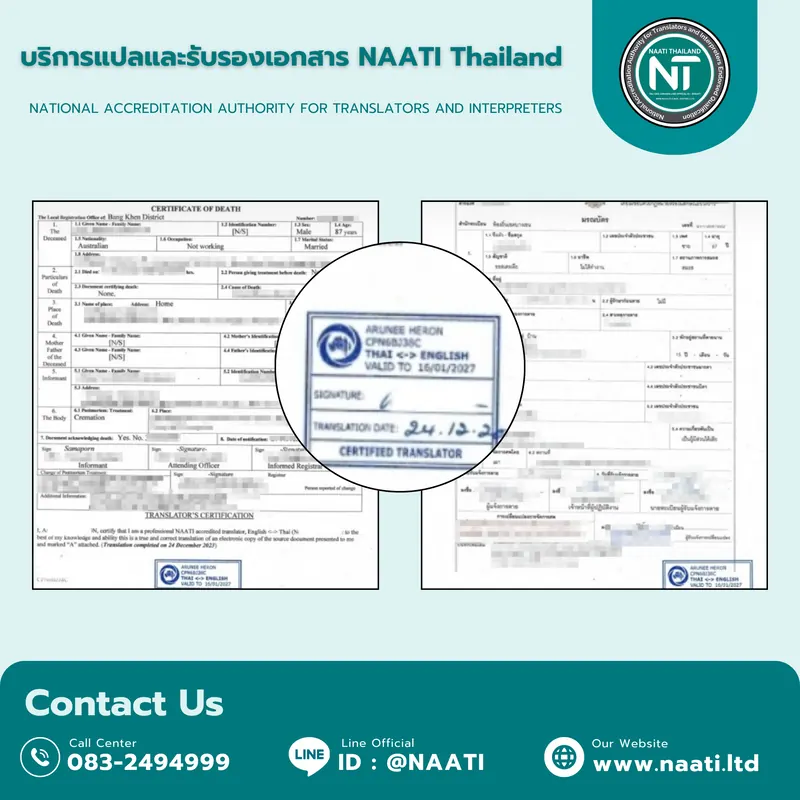
Australian authorities such as the Department of Home Affairs, VETASSESS, AHPRA and universities require translations by a NAATI certified translator, carrying a valid stamp, practitioner number and expiry date.
Prefer not to handle the queues yourself, or worried about a rejection? Send us photos of your documents for a free pre-check. We handle the full chain — obtaining certified copies, translation, certification and submission — and keep you updated at each step. Reach us on LINE, phone or email during business hours.
Most Australian filings need NAATI, but not all — and some cases need both.
| Route | When to use | Certifying authority | Approx. duration | Rejection risk |
|---|---|---|---|---|
| NAATI certified translation | Filing with the Department of Home Affairs, a university, or most Australian bodies | NAATI — Australia's translator and interpreter accreditation body | Usually a few working days | A translation without a verifiable NAATI stamp/number, or translated from an unreadable copy |
| Consular legalisation + Australian Embassy | The receiving body asks for the original to be certified, not just the translation | Department of Consular Affairs and the Australian Embassy | Variable, depending on each queue | Assuming NAATI covers the original — NAATI certifies the translation only |
| Both, in sequence | Partner/family visa cases, or files that previously drew a request for more documents | NAATI together with the Department of Consular Affairs | Variable — allow more time than a single route | Doing the steps out of order, forcing a re-translation after the original is certified |
Timelines above are practical estimates from live casework and can change with each authority's policy; confirm with the receiving authority before booking travel. If you would rather not test routes by trial and error, our advisers can assess which route fits your case.
Our team has worked on cross-border documents, certified translation and government liaison for over 15 years. Most rejections we see are not caused by missing paperwork but by choosing the wrong route on day one, so we always start with a case assessment.
We look at your destination, purpose and deadline, then tell you which certification route applies — and which steps you can skip.
Name spelling, consistency across documents, document age and translation format are checked before anything reaches a counter.
We sequence the steps around your appointment or travel date and flag bottlenecks in advance.
We read the refusal reasons, identify the underlying cause, and plan a resubmission that answers what the authority asked for.
Rather not learn by trial and error? Send your case details and document photos for a review — reach us on LINE, phone or email during business hours.
The Department of Home Affairs applies different rules: translations made in Australia must be done by a NAATI-certified translator, while translations made outside Australia must show the translator's full name, address, telephone number and qualifications on the translation.
Scan at 300 dpi or better so seals, signatures, document numbers and reverse-side text are legible. Anything unreadable must be marked as illegible in the translation, which commonly triggers a request for further documents.
A compliant translation carries a stamp with the practitioner's certification number and expiry date. You can check that number against NAATI's online register and confirm the certification is current on your lodgement date.
Names on the translation must match the passport page you will submit rather than a fresh transliteration. Send a copy of the passport bio page with every order.
Seals, signatures, footnotes and reverse-side text are part of the document. Translations that omit them are commonly rejected.
NAATI certifies the translator's credential, not the document. Where the destination also requires consular authentication, that is a separate step.
If the name on the translation does not match the passport or other documents in the same application, the authority will ask for linking evidence such as a change-of-name certificate.
NAATI certification is subject to recertification cycles. If the stamp's expiry date falls before your lodgement date, the authority may refuse the translation — always check the date on the stamp.
Requirements differ by authority and destination country and can change. Confirm current conditions with the receiving authority, or ask our team by phone, LINE or email.
One document set often moves through several stages — translation, notarial certification, legalization and finally a visa filing. The links below follow that real sequence.
Authority requirements change. Verify with the receiving authority before filing, or ask our team by phone, LINE or email.