🇨🇦Canada Visa Document Translation into Khmer (Cambodian) — Certified & Embassy-Ready
Certified document translation for Canada visa applications into Khmer (Cambodian). Notary, MFA, embassy attestation handled end-to-end. Turnaround 3-5 working days.
Visa Types Covered
TRV, Study Permit, Work Permit, PR (Express Entry)
How long does Canada visa translation into Khmer (Cambodian) take?
Standard 3-5 working days. Express 24-48h available (surcharge applies).
What is the starting price?
สอบถามเจ้าหน้าที่per page; final quote depends on document complexity and target language. Free quote within 1 hour.
Are translations embassy-ready?
Yes — we handle Certified Translation + Notary Affidavit (IRCC-accepted) end-to-end per embassy requirements.
Can you translate all my Thai source documents?
Yes — including ID Card, House Registration, Birth Cert., Marriage Cert. and any other documents.
Is embassy acceptance guaranteed?
100% guarantee — if documents are rejected due to translation/certification errors, we fix and refund our service fee in full.
Service Knowledge Base
Outbound visa answer bank for applicants in Thailand — US, UK and Schengen
Answers to the questions Thailand-based applicants actually ask about US visas (DS-160 plus interview), UK visas (online application plus biometrics) and Schengen visas (main-destination rule, 90/180 rule) — including the most common refusal grounds and how Thai civil documents must be translated and legalised by the Department of Consular Affairs first. Based on travel.state.gov, GOV.UK and the EU Visa Code. (30+ search topics covered)
What counts as evidence of ties to Thailand?
Documents showing why you will return: an employer letter stating position, length of service and approved leave dates; recent payslips; title deeds or a lease; vehicle registration; family obligations such as children's birth certificates; and for business owners, company registration records and tax filings. Many consulates weigh this group heavily because they assess overstay risk rather than wealth alone.
What are the most common refusal grounds?
Weak evidence of ties to Thailand; financial evidence inconsistent with the stated trip or unexplained large deposits; a stated purpose that conflicts with the supporting documents; missing or improperly translated and legalised documents; and previous overstays or inaccurate statements in the application. The remedy is a coherent, internally consistent document set with a verifiable source of funds.
How is the Schengen 90/180 rule calculated?
A short-stay Schengen visa allows a total of 90 days within any rolling 180-day period, counted backwards from any given day inside the area — it does not reset on a calendar basis. Frequent travellers should check remaining days with the European Commission's official short-stay calculator before booking.
What does a refusal under INA 214(b) mean?
Section 214(b) presumes every nonimmigrant applicant intends to immigrate until they satisfy the officer that they have ties compelling them to return home. It is not a blacklist. You may reapply once your circumstances or the evidence of your ties — employment, property, family obligations in Thailand — have meaningfully changed.
What should be done differently after a previous refusal?
Keep the full refusal notice and read the stated grounds closely, because refiling the same bundle usually produces the same outcome. Declare the earlier refusal truthfully on the new form; concealment is treated as misrepresentation and carries heavier consequences. Then strengthen the specific weakness identified — ties to Thailand, source of funds, or consistency between the itinerary and bookings. No adviser can guarantee the outcome of a fresh decision.
What causes most refusals of documents prepared in Thailand?
Inconsistency rather than insufficiency: names spelled differently across passport, civil-registry extracts and bank records; income evidence that does not match the stated occupation; itineraries that conflict with employment leave dates; and translations lacking the certification the mission requires. Reviewing the file as a whole for internal contradictions is more valuable than adding further documents.
What travel insurance is required?
Requirements differ by destination. Schengen applications require travel medical insurance covering emergency treatment and repatriation, meeting a minimum cover amount and valid for the whole intended stay in the Schengen area. The policy must name the insured exactly as in the passport and span all travel dates, including departure and return. Verify the current terms with the deciding consulate before purchasing.
Do VFS or TLS decide visa applications?
No. Application centres receive documents, capture biometrics, schedule appointments and forward files. The decision is made and signed by consular officers of the state concerned. Any claim that a provider can change an outcome through a relationship with an application centre is baseless; what genuinely helps is a complete and internally consistent file.
Topics covered
วีซ่าสหราชอาณาจักร: UK Standard Visitor visa · ยื่นวีซ่าอังกฤษออนไลน์ GOV.UK · biometrics VFS อังกฤษ · maintenance funds วีซ่า UK · sponsor letter อังกฤษ · UK student visa CAS · วีซ่าอังกฤษถูกปฏิเสธ credibility
Need your documents reviewed or your case assessed? Ask our team by phone, LINE, or email. We reply during business hours (Mon–Fri 9:00–18:00, Sat 9:00–15:00, ICT).
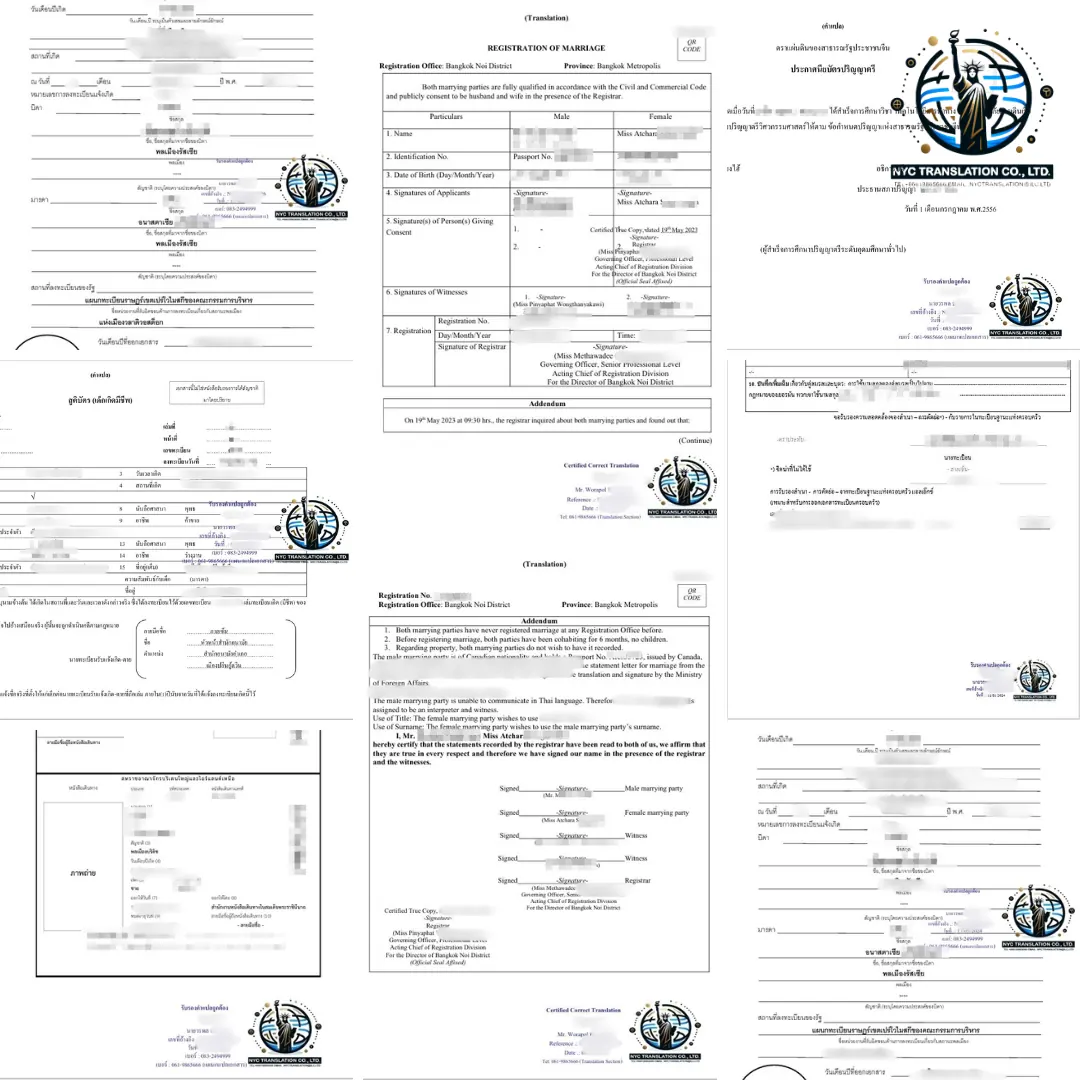
Certificate of translation issued by our translation office — From actual casework by the NYC Visa & Translation team
Service Playbook
Outbound visas from Thailand — documents and preparation
We prepare, translate and legalise documents; we do not decide outcomes. Every decision rests entirely with the embassy or immigration authority of the destination country.
Documents to prepare
• Passport with sufficient validity and the required blank pages
• Completed online application and appointment confirmation
• Financial history for the period the destination requires
• Ties to Thailand: employment letter, business registration or property records
• Itinerary, accommodation and travel insurance as required
• Thai documents translated and certified under the destination's system
Step-by-step process
1. Choose the category and channel — Directly at the mission, or through an appointed centre such as VFS or TLS.
2. Prepare and translate — Order the bundle to match the form and translate under the accepted system.
3. Book biometrics and submit — Attend with the complete set on the appointed day.
4. Track and collect — Check the visa details for accuracy as soon as it is returned.
Pitfalls and rejection causes
• Third-party funds or unexplained large deposits are a frequent refusal ground.
• A visa does not guarantee entry — the border officer decides.
• Form entries that contradict the attachments invite doubt.
• Filing close to departure leaves no room for additional document requests.
Tips from our team
• Order documents exactly as the embassy checklist lists them.
• Prepare explanations for large deposits in advance.
• In peak season, file one to two months ahead.
Prefer not to handle the queues yourself, or worried about a rejection? Send us photos of your documents for a free pre-check. We handle the full chain — obtaining certified copies, translation, certification and submission — and keep you updated at each step. Reach us on LINE, phone or email during business hours.
Route Comparison
Comparing outbound visa submission channels
e-Visa, visa application centres (VFS/BLS) and direct embassy filing carry different conditions and risks.
Route
When to use
Certifying authority
Approx. duration
Rejection risk
e-Visa / the destination's online system
The destination offers an online channel for Thai passport holders
The destination country's immigration authority
Variable, per that system's published practice
Uploads outside the file spec, or data not matching the passport, trigger automatic refusal
Via a visa application centre (VFS Global, BLS, etc.)
The embassy has outsourced intake and biometrics
The destination embassy, receiving through its appointed centre
Variable, by appointment availability and season
Documents not ordered to the centre's checklist, costing your appointment slot
Direct filing at the embassy/consulate
Countries that still take applications in-house, or special visa categories
The destination country's embassy or consulate
Variable, per each mission's decision cycle
Appointments booked out far ahead, pushing back travel plans
Timelines above are practical estimates from live casework and can change with each authority's policy; confirm with the receiving authority before booking travel. If you would rather not test routes by trial and error, our advisers can assess which route fits your case.
Advisory Service
We do not just process documents — we advise you through the whole case
Our team has worked on cross-border documents, certified translation and government liaison for over 15 years. Most rejections we see are not caused by missing paperwork but by choosing the wrong route on day one, so we always start with a case assessment.
Route assessment
We look at your destination, purpose and deadline, then tell you which certification route applies — and which steps you can skip.
Pre-submission review
Name spelling, consistency across documents, document age and translation format are checked before anything reaches a counter.
Timeline planning
We sequence the steps around your appointment or travel date and flag bottlenecks in advance.
Rejection recovery
We read the refusal reasons, identify the underlying cause, and plan a resubmission that answers what the authority asked for.
Rather not learn by trial and error? Send your case details and document photos for a review — reach us on LINE, phone or email during business hours.
Practical Q&A
Practical questions · Near me / DIY / Required documents
How do I find certified translation near me?
You usually do not need to travel: documents are accepted as scans and returned by courier nationwide. If you prefer to meet in person, we have service points at Lat Phrao 95 (Bangkok), Khon Kaen and Udon Thani, plus hand-over meeting points near city rail stations.
Can I translate it myself and have it certified afterwards?
It depends on the recipient. The Department of Consular Affairs certifies a translation by checking it against the original rather than by translator identity, but many embassies and foreign authorities require an independent or accredited translator. Check the destination's rule before self-translating to avoid a rejection cycle.
What do you need from me to start?
Sharp colour scans of every page including seals and signatures, the English spelling of names exactly as printed in the passport, the receiving authority and country, and your deadline. Sending any previously certified translation helps keep terminology and name spelling consistent across the set.
Practical advice & cautions
Document translation: what to prepare and what gets rejected
Before you start
Sequence the steps so originals stay valid
When translation, certification and apostille or embassy steps are chained, allow for each authority's queue and start with the longest step so the underlying original does not age out.
Order fresh certified copies
Many civil-registry and court documents are only accepted if issued recently. Request a newly certified copy before translation rather than reusing an old photocopy.
Name the destination authority before choosing a translation type
Certification systems are not interchangeable. Australian authorities require NAATI-certified translators, while documents used inside Thailand or filed at embassies in Thailand usually need translation certification by the Department of Consular Affairs. Tell us the receiving authority and country first.
Match the passport spelling exactly
Translations must reproduce the given name and surname exactly as printed in the passport you will submit, not a fresh transliteration. Always send the passport bio page together with the documents.
Common reasons documents get rejected
Inconsistent names across the bundle
If you have changed your name or used different spellings, include the official name-change certificate and its translation; otherwise the authority may treat the documents as belonging to different people.
Using the wrong certification system
A consular-certified Thai translation does not replace a NAATI translation for Australian authorities, and a NAATI stamp is not a Thai government certification. Choose the system that matches the destination from the start.
Submitting the translation without the source copy
Many authorities require the source document to be attached to each translated page so the text can be verified. A standalone translation is usually returned.
Self-translated documents
Most authorities refuse translations produced by the applicant or a relative, even if accurate, because there is no identifiable certified translator behind them.
Requirements differ by authority and destination country and can change. Confirm current conditions with the receiving authority, or ask our team by phone, LINE or email.
What people search for
Frequently searched topics about certified translation
Certified translation for legalisation
Translations submitted for legalisation must mirror the original line by line, including seals and signatures.
NAATI translation for Australia
Australian authorities generally require a certified translator's stamp and practitioner number on the translation.
Freshly issued civil records for translation
Many receiving bodies limit how old the source document may be, so obtain a new certified copy before translating.
Thai to English translation for embassies
Each embassy sets its own accepted translator and certification format; request the requirement in writing first.
These topics reflect the rules and practice of the relevant authorities and can change. Confirm with the receiving authority, or ask our team by phone, LINE or email.
Related services
What clients usually handle next
One document set often moves through several stages — translation, notarial certification, legalization and finally a visa filing. The links below follow that real sequence.