ข้ามไปเนื้อหาหลัก / Skip to main content
N
NYC Visa.
Visa & Translation
Non-O-A / O-X · 🇳🇬 Nigerian Applicants

🏖️ Retirement Visa (O-A / O-X) for Nigerian Citizens

Country-specific 2025 guide — consular legalisation chain via Ministry of Foreign Affairs of Nigeria, embassy in Bangkok, common Nigerian pitfalls handled.

Non-O-A is the standard retirement visa for foreigners 50+: THB 800k deposit in Thailand OR pension THB 65k/mo. O-X is the premium 10-year version available to 14 nationalities (G7, EU, AUS, NZ, Switz, Nordics, Canada, Japan) — THB 3M deposit + USD 100k insurance.

Nigerian Applicant · Key Facts
Embassy in Bangkok
Embassy of Nigeria
Apostille member
No (Legalisation)
MFA authority
Ministry of Foreign Affairs of Niger
Visa-exempt to Thailand
No
Visa-on-Arrival eligible
No
Stay length
O-A: 1 ปี ต่อได้ · O-X: 10 ปี (5+5)
Gov fee
~USD 200
NYC fee
THB 18,000–45,000
Processing
15–25 วันทำการ
🇳🇬 Nigerian-Specific Intelligence
Why Nigerian citizens choose this visa

Medical doctors + ED + Tourist.

Nigerian #1 rejection reason

Nigeria not in Hague — additional financial vetting + LOI from Thai sponsor required for most visa classes.

Embassy of Nigerian in Bangkok

Embassy of Nigeria, 11/1 Soi Akkrasena, Sathorn

Official site →
Consular legalisation route

Documents from Nigerian apostilled/legalised via Ministry of Foreign Affairs of Nigeria. Because Nigerian is not in the Hague Apostille Convention, the chain takes 4-5 steps instead of 2.

Eligibility
  • Age 50+
  • No criminal record in home country
  • O-A: THB 800k deposit OR pension THB 65k/mo (total THB 800k/yr)
  • O-X: THB 3M deposit in Thai bank + USD 100k insurance
  • No employment in Thailand
Documents
  • Passport 18+ months
  • Police clearance (≤3 months old)
  • Medical certificate 6 conditions (apostilled)
  • Bank statement showing THB 800k+
  • Pension letter from home country government
  • Thai-issued health insurance (O-A: 40k OPD/400k IPD)
  • TM.7 + photos
  • Thailand address confirmation
How to apply · Non-O-A / O-X · Nigerian applicants
  1. 1Free NYC consult + O-A vs O-X qualification check
  2. 2Document collection + apostille in home country
  3. 3Submit at Thai embassy + receive 90-day visa
  4. 4Enter Thailand + open bank account + deposit funds
  5. 5Visit Immigration for 1-year extension (before day 90)
  6. 690-day reporting + re-entry permit
  7. 7Annual renewal — NYC handles and accompanies

For Nigerian applicants, Step 2 (document legalisation) goes via Ministry of Foreign Affairs of Nigeria then through the Royal Thai Embassy in your country, then Thai MFA in Bangkok.

Choosing a Thai visa consultant as a foreign national

Choose a Thai visa consultant by how well they match a visa category to your actual situation and long-term plan, not by the fastest route in. Ask them to explain the conditions for maintaining status after approval, including 90-day reporting and re-entry permits, and to separate government fees from their service fee.

How to evaluate a provider

  • Matches the category to your real situationThe wrong category at the start can make later extensions impossible.
  • Explains status-maintenance obligations90-day reporting, re-entry permits and financial conditions affect every extension.
  • Separates government fees from service feesYou should know which part the state collects.
  • Tracks regulatory changesNewer long-stay categories are revised periodically.
  • Plans the extension from day oneExtensions depend on evidence gathered during the first period of stay.

Questions to ask before you commit

  1. Which visa category fits my situation and my long-term plan?
  2. After approval, what must I do to maintain status and qualify for an extension?
  3. How many working days does it actually take, counted from a complete file?
  4. If the receiving authority rejects or asks for changes, do you correct it, and under what terms?
  5. How can I track status, and who physically holds the original documents?

Your options, and who each suits

OptionBest forWhat to know
Apply yourselfApplicants comfortable reading official notices with complete documentsYou must track condition changes and reporting deadlines yourself.
Consultant for the first application onlyNew arrivalsPlan the extension path at the first application, not near expiry.
Ongoing annual supportLong-stay residents and familiesDefine whether reporting and extensions are inside the scope.

FAQ on choosing a provider

Which Thai visa consultant is recommended?
Choose one that identifies the category matching your actual situation, explains the post-approval conditions such as 90-day reporting and re-entry permits, and clearly separates government fees from the service fee. Ask how the first application sets up your future extensions.
Can I change visa category later?
Some categories can be changed in-country, while others require a fresh application at a Thai embassy abroad. That is why the category should match your long-term plan from the first application rather than the quickest available entry.

แหล่งอ้างอิงทางการ · Authoritative Sources

  1. Royal Thai Embassy — eVisa PortalOfficial online application
  2. Ministry of Foreign Affairs — Consular AffairsVisa policy & fees
  3. Immigration Bureau ThailandExtension, 90-day, re-entry
  4. Nigerian MFA / Apostille authorityMinistry of Foreign Affairs of Nigeria

Ready to apply for Non-O-A / O-X as a Nigerian citizen?

Free 15-min consult with our Nigerian-experienced team — we coordinate apostille at Ministry of Foreign Affairs of Nigeria and full embassy chain.

Other Thai visa options for Nigerian citizens
Service Knowledge Base

Thailand visa answer bank — LTR, DTV and staying on in Thailand

Answers to the Thailand visa questions applicants actually ask: the BOI-administered LTR visa, the DTV for remote workers and Thai Soft Power activities, filing through Thai e-Visa, and extending stay on form TM.7 — plus which supporting documents must be translated and certified. Based on MFA, Immigration Bureau and BOI announcements. (27+ search topics covered)

How far in advance should documents be dated?

Several Thai and foreign authorities treat civil registration extracts, police clearance and bank evidence as valid only for a limited recent period, and the period is set by the receiving authority rather than by any agency. Ordering fresh extracts too early is a common cause of rework, because the document can expire while the certification chain is still running. Sequence the chain backwards from the appointment date.

To what level must foreign supporting documents be authenticated for a Thai visa?

Documents issued abroad — employment letters, financial confirmations, police certificates, marriage records — are normally authenticated under the issuing country's system and by the Royal Thai Embassy there, or by apostille once the Convention enters into force for Thailand on 28 February 2027 where the receiving office accepts it. When filed inside Thailand, a certified Thai or English translation is usually attached. Requirements differ between individual Thai embassies and consulates, so check the specific mission's published list before preparing the file.

How should financial evidence be presented?

Pair a bank confirmation letter with statements covering the period the authority specifies, ordered so that recurring salary or business income is visible, and annotate any large one-off movements. If a third party supports you, add a sponsorship letter and proof of the relationship. Large deposits landing days before filing without a traceable source are the pattern officers most often question, so build the balance over the required period instead.

Is a two-step translation acceptable for non-English originals?

Direct translation from the original language into Thai or English is safer, because relaying through an intermediate language multiplies the risk of errors in names and dates. Where a direct translator is genuinely unavailable, some authorities accept a certified English translation made in the country of origin, which is then translated into Thai. Confirm the position with the receiving office before commissioning work so the translation is not done twice.

What happens if someone enters Thailand on the wrong visa category?

Holding a category that does not match the actual activity can block an extension of stay, prevent a work permit, or lead to refusal at the border. Changing category inside Thailand is possible in some situations under Immigration Bureau rules, subject to remaining validity and supporting documents; otherwise a fresh application at a Thai embassy abroad is required. Diagnosing the real purpose at the outset is cheaper than correcting the category later.

What is the LTR visa and who decides it?

The Long-Term Resident (LTR) visa is processed through the Board of Investment at ltr.boi.go.th. Applicants submit qualification documents to BOI first, then collect the visa at a Royal Thai Embassy or Consulate abroad, or at Immigration in Thailand where applicable. Approval rests with the authorities, not with a document service provider.

Which LTR categories exist?

BOI publishes four main categories: Wealthy Global Citizen, Wealthy Pensioner, Work-from-Thailand Professional and Highly-Skilled Professional, with dependants permitted under the conditions set for each category.

How long is the LTR valid and how often do I report?

Up to ten years in total, issued for five years and renewable for a further five while qualifications are maintained. LTR holders report annually instead of every 90 days and are granted multiple re-entry as announced.
Topics covered
DTV Visa: DTV visa thailand · destination thailand visa · วีซ่า DTV ทำงานทางไกล · digital nomad visa thailand · DTV soft power มวยไทย · DTV ต่ออายุ 180 วัน · DTV ผู้ติดตาม
การยื่นและการอยู่ต่อ: thai e-visa ยื่นออนไลน์ · ตม.7 ขออยู่ต่อ · เปลี่ยนประเภทการตรวจลงตรา · re-entry permit · แจ้ง 90 วัน · visa exemption 60 วัน
เอกสารที่ต้องแปล/รับรอง: แปลสเตทเมนต์ธนาคารยื่นวีซ่า · แปลหนังสือรับรองการทำงาน · แปลทะเบียนสมรสยื่นวีซ่าไทย · แปลสูติบัตรผู้ติดตาม · รับรองวุฒิการศึกษาเพื่อ LTR · รับรองเอกสารกรมการกงสุล
Official references

Need your documents reviewed or your case assessed? Ask our team by phone, LINE, or email. We reply during business hours (Mon–Fri 9:00–18:00, Sat 9:00–15:00, ICT).
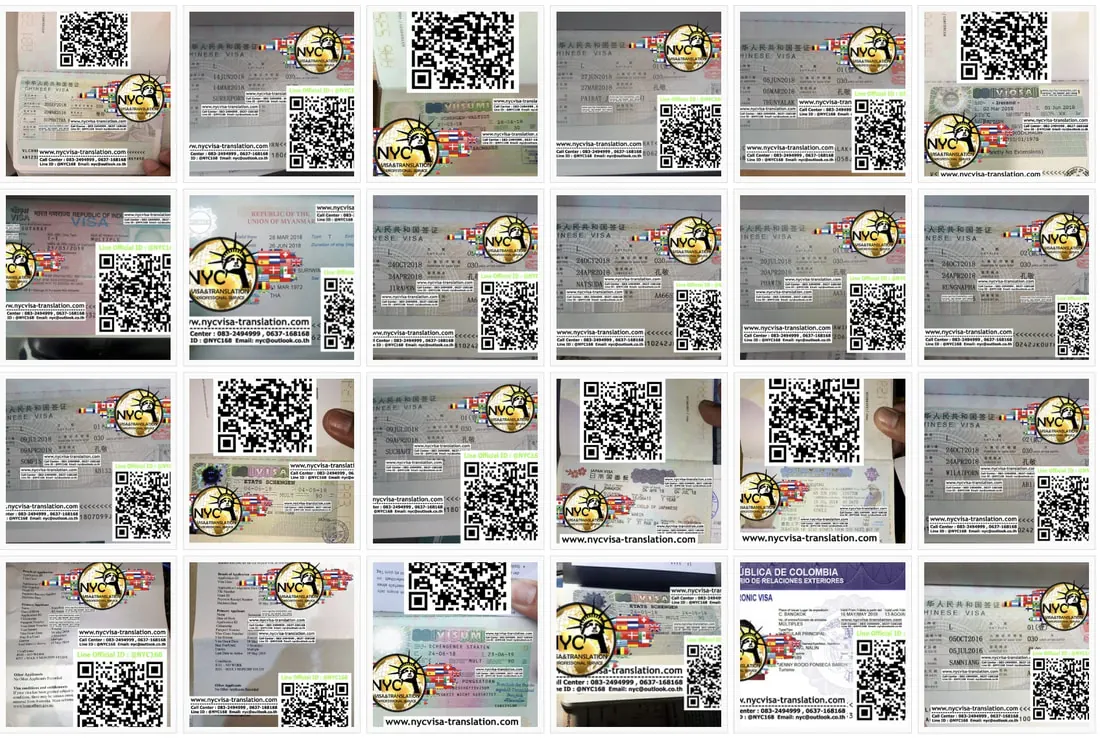
Example of a tourist or visitor visa issued to an applicant
Example of a tourist or visitor visa issued to an applicantFrom actual casework by the NYC Visa & Translation team
Service Playbook

Thai visas and extensions — documents, steps and common mistakes

Keep three concepts separate: the visa (permission to travel), the permission to stay stamped at entry, and the work permit. A visa never guarantees admission — the immigration officer at the border decides.

Documents to prepare

  • Passport with sufficient validity and blank pages
  • The application form for your category plus compliant photos
  • Proof of address in Thailand and a TM.30 filed by the housemaster
  • Financial evidence meeting the category rules, seasoned for the required period
  • Category-specific support: marriage certificate, company affidavit or school acceptance letter
  • Foreign documents translated and legalised through the inbound chain

Step-by-step process

  1. 1. Match the category to your purpose Confirm eligibility criteria before assembling any paperwork.
  2. 2. Prepare and translate documents Foreign records need home-country certification plus a Thai-accepted translation.
  3. 3. File through the correct channel Thai embassy abroad, the e-Visa system, or an immigration office in Thailand as applicable.
  4. 4. Post-approval obligations TM.30 notification, 90-day reporting, and a re-entry permit before leaving the country.

Pitfalls and rejection causes

  • Leaving Thailand without a re-entry permit cancels an extension of stay immediately.
  • 90-day reporting is not a visa extension — they are unrelated obligations.
  • Funds must be seasoned for the stated period, not deposited the day before filing.
  • Holding a visa is not permission to work; a separate work permit is required.

Tips from our team

  • Keep copies of every entry stamp and TM.30 for smoother extensions.
  • Read your permitted-to-stay date from the stamp, not the visa validity.
  • Always carry a spare document set; offices differ in copy requirements.

Prefer not to handle the queues yourself, or worried about a rejection? Send us photos of your documents for a free pre-check. We handle the full chain — obtaining certified copies, translation, certification and submission — and keep you updated at each step. Reach us on LINE, phone or email during business hours.

Route Comparison

Comparing routes into a Thai visa

Applying abroad, applying online, or adjusting status inside Thailand give different lengths of stay and later flexibility.

RouteWhen to useCertifying authorityApprox. durationRejection risk
Apply at a Thai embassy or consulate abroadYou can plan ahead and want the correct category from the outsetRoyal Thai Embassy or Consulate-GeneralVariable by postDocument lists and residency rules differ per post — check that specific post
Official e-Visa systemYour category and country of residence are supported onlineMFA Thailand e-Visa systemVariable — file well before the travel dateFiles not matching the system's format specification are auto-rejected
Change or extend status inside ThailandYou are already in Thailand and meet the published criteriaImmigration BureauVariable — file several days before expiryToo few days remaining forces you to leave and re-apply

Timelines above are practical estimates from live casework and can change with each authority's policy; confirm with the receiving authority before booking travel. If you would rather not test routes by trial and error, our advisers can assess which route fits your case.

Advisory Service

We do not just process documents — we advise you through the whole case

Our team has worked on cross-border documents, certified translation and government liaison for over 15 years. Most rejections we see are not caused by missing paperwork but by choosing the wrong route on day one, so we always start with a case assessment.

Route assessment

We look at your destination, purpose and deadline, then tell you which certification route applies — and which steps you can skip.

Pre-submission review

Name spelling, consistency across documents, document age and translation format are checked before anything reaches a counter.

Timeline planning

We sequence the steps around your appointment or travel date and flag bottlenecks in advance.

Rejection recovery

We read the refusal reasons, identify the underlying cause, and plan a resubmission that answers what the authority asked for.

Rather not learn by trial and error? Send your case details and document photos for a review — reach us on LINE, phone or email during business hours.

Practical Q&A

Practical questions · Near me / DIY / Required documents

Where do I lodge a visa application — must I go to the embassy?

Many countries outsource intake to visa application centres (VFS Global, TLScontact, BLS) with offices in Bangkok and some provinces; others accept lodgement at the embassy or fully online. Channels change by embassy announcement, so confirm the current route before booking. We can pre-check your document set and arrange appointments from any of our three offices.

Can I apply myself, or do I need an agency?

You can always apply yourself; no country requires an agent, and no agent can guarantee approval because the decision is at the consular officer's discretion. The value of assistance is assembling the file exactly to the official checklist, correct translation and certification format, and a focused cover letter.

What are the baseline documents?

Typically a passport with the validity and blank pages the destination requires, the completed application form, photos to the destination's specification, financial evidence for the stated period, proof of employment or study, travel and accommodation plans, and health insurance where required. Always follow that embassy's official checklist, as requirements differ by country.
Practical advice & cautions

Visa and immigration matters: advice and cautions

Before you start
  • Keep every receipt and acknowledgement

    Photograph all filing receipts and stamps; they are key evidence in any later verification.

  • Make funds explainable

    Large deposits made shortly before filing attract questions. Support them with evidence of income and use statements bearing the bank's original seal.

  • Order documents to the authority's checklist

    Assembling the bundle in the required order with an index speeds up assessment and reduces requests for more documents.

  • Read the official conditions first

    Visa conditions change. Check the deciding authority's latest announcement, then use our service to prepare documents and translations that match those conditions.

Common reasons documents get rejected
  • Translations the destination does not accept

    Accepted translator categories differ by country; confirm the required type before ordering.

  • Believing guaranteed-approval claims

    No provider can guarantee an outcome; only the immigration authority or embassy decides. Our role is to make the file accurate and complete so avoidable rejections are reduced.

  • Ignoring post-approval obligations

    Periodic reporting, address notification and work conditions are ongoing duties that affect the next extension.

  • Expired supporting documents

    Civil registry extracts, medical certificates and police clearances have limited validity; old copies make the bundle incomplete.

Requirements differ by authority and destination country and can change. Confirm current conditions with the receiving authority, or ask our team by phone, LINE or email.

What people search for

Frequently searched topics about visas and immigration

Refusal and reapplication
Read the stated reason first and address the actual cause rather than resubmitting the same file.
Notification of residence for foreign nationals
House owners or occupiers must notify the stay of foreign nationals under Thai immigration law.
Extensions and periodic reporting
Long-stay holders must report at the intervals set by the Immigration Bureau.
Documents required for a visa application
Checklists are set by the embassy or receiving authority; always follow their current published notice.

These topics reflect the rules and practice of the relevant authorities and can change. Confirm with the receiving authority, or ask our team by phone, LINE or email.

Related services

What clients usually handle next

One document set often moves through several stages — translation, notarial certification, legalization and finally a visa filing. The links below follow that real sequence.

External authority references

Authority requirements change. Verify with the receiving authority before filing, or ask our team by phone, LINE or email.