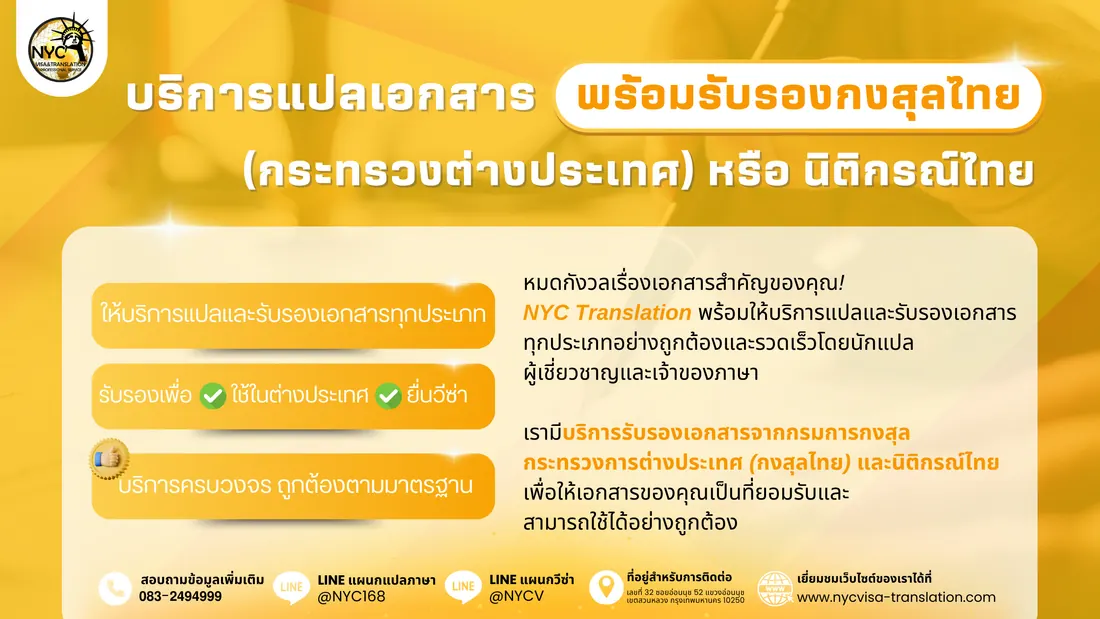
First-party answers on language coverage, Thai civil-registry documents, translator certification, MFA legalisation and onward embassy attestation. (53+ search topics covered)
Can everything be handled remotely?
Translation and proofreading can be handled from high-resolution scans of every page, including stamps and signatures. Legalisation requires physical originals, so those must be couriered in or filed by an authorised representative.
Which languages do you cover?
English, Chinese, Japanese, Korean, German, French, Spanish, Italian, Russian, Arabic, Vietnamese and Burmese among others. Where an authority accepts only certain languages, we translate into English as the pivot language and then into the target language as required.
Do you need original documents?
For MFA legalisation, yes — the original, or a copy certified by the issuing authority (for example a district office for civil-registry records). Self-certified photocopies are generally rejected.
What makes a translation "certified" for Thai official use?
In Thai practice a translation is accepted when it is complete, faithful to the layout of the original, and accompanied by the translator's declaration with name, signature and contact details; for consular use the translator's signature is then certified by the Department of Consular Affairs. Some foreign authorities additionally require a sworn or court-appointed translator of their own country, which is a separate requirement we identify before starting.
How is pricing calculated?
By page or word count, subject matter, language pair and turnaround, plus the actual government fees incurred at the legalisation and embassy stages. A line-by-line quotation is issued before work starts.
Foreign documents used in Thailand — what is the route?
The document is normally authenticated in the issuing country and attested by the Royal Thai Embassy or Consulate there, then translated into Thai and submitted for translation legalisation at the Department of Consular Affairs in Thailand.
Can Thailand issue an Apostille?
Thailand deposited its instrument of accession to the 1961 Apostille Convention on 30 June 2026, and the Convention enters into force for Thailand on 28 February 2027. Until that date Thai documents still follow the two-step route: legalisation by the Department of Consular Affairs, then legalisation by the destination country's embassy in Thailand. Until then, Thai documents follow the traditional chain: MFA legalisation, then destination-embassy attestation.
Do stamps, seals and handwritten notes have to appear in the translation?
Yes. Every stamp, seal, signature block, marginal note and struck-through entry should be represented in the translation, with a bracketed description where the content is illegible. Reviewers compare the translation against the original element by element, and an unexplained omission is read as a discrepancy rather than as a tidy summary.
คำค้นหลัก / ชื่อบริการ: แปลเอกสารรับรองกงสุล · certified translation thailand · แปลเอกสารราชการ · รับรองคำแปล · แปลเอกสารยื่นวีซ่า · sworn translation thai · official document translation bangkok · แปลเอกสารด่วน · แปลไทยเป็นอังกฤษรับรอง · แปลเอกสารพร้อมนิติกรณ์
ชนิดเอกสารราชการที่แปลบ่อย: แปลสูติบัตร · แปลทะเบียนบ้าน · แปลบัตรประชาชน · แปลทะเบียนสมรส · แปลใบหย่า · แปลใบเปลี่ยนชื่อ-สกุล · แปลหนังสือรับรองโสด · แปลใบมรณบัตร · แปลทรานสคริปต์ · แปลปริญญาบัตร · แปลหนังสือรับรองบริษัท · แปลใบขับขี่ · แปลใบรับรองแพทย์ · แปลหนังสือรับรองการทำงาน · แปลสเตทเมนต์ธนาคาร
คู่ภาษาที่ขอมากที่สุด: แปลไทย-อังกฤษ · แปลไทย-จีน · แปลไทย-ญี่ปุ่น · แปลไทย-เกาหลี · แปลไทย-เยอรมัน · แปลไทย-ฝรั่งเศส · แปลไทย-สเปน · แปลไทย-อิตาลี · แปลไทย-รัสเซีย · แปลไทย-อาหรับ · แปลไทย-เวียดนาม · แปลไทย-พม่า