Certified translation in 40+ languages — MOFA / embassy / NAATI / ATA accredited translators
Overview
Certified translation by 80+ professional translators in 40+ languages (EN, ZH, JA, KO, DE, FR, ES, IT, RU, AR, MY, KH, LA, VI, ID, and more). Certified to MOFA Thailand / embassy / NAATI Australia / ATA US / EU sworn translator standards. Accepted for visas, courts, universities, professional bodies, marriage registration, and company setup.
Price
contact our team
per A4 page
Turnaround
Estimated per case — our team confirms the timeframe in the quotation
Not recommended — embassies and MOFA only accept translations from registered translators with certification block + signature + registration number. Self-translation is returned and wastes 1–2 weeks.
NAATI vs MOFA vs ATA — what's the difference?
MOFA = Thai standard for documents used in Thailand. NAATI = Australia/NZ registered translator (required for visa 500/186/189). ATA = American Translators Association for USCIS. NYC covers all three.
How much for passport translation?
Bio page TH↔EN — fee quoted per case by our team. Used for marriage/bank/vehicle registration.
Chinese Traditional or Simplified?
Specify your choice — Simplified for mainland China, Traditional for HK/Taiwan/Macau. NYC has translators for both.
How long for a 50-page document?
Depends on language and urgency — for large volumes 2–3 translators work in parallel. Timeframe confirmed in the quotation.
Service Knowledge Base
Certified translation in Thailand — questions clients actually ask
First-party answers on language coverage, Thai civil-registry documents, translator certification, MFA legalisation and onward embassy attestation. (53+ search topics covered)
Can Thailand issue an Apostille?
Thailand deposited its instrument of accession to the 1961 Apostille Convention on 30 June 2026, and the Convention enters into force for Thailand on 28 February 2027. Until that date Thai documents still follow the two-step route: legalisation by the Department of Consular Affairs, then legalisation by the destination country's embassy in Thailand. Until then, Thai documents follow the traditional chain: MFA legalisation, then destination-embassy attestation.
What makes a translation "certified" for Thai official use?
In Thai practice a translation is accepted when it is complete, faithful to the layout of the original, and accompanied by the translator's declaration with name, signature and contact details; for consular use the translator's signature is then certified by the Department of Consular Affairs. Some foreign authorities additionally require a sworn or court-appointed translator of their own country, which is a separate requirement we identify before starting.
Can everything be handled remotely?
Translation and proofreading can be handled from high-resolution scans of every page, including stamps and signatures. Legalisation requires physical originals, so those must be couriered in or filed by an authorised representative.
How long does the process take?
Translation itself is usually a few business days depending on volume and language pair. MFA legalisation has both standard and express channels with different cut-off times and fees — check the Department of Consular Affairs website for current schedules before booking a visa appointment.
Which romanisation of a Thai name should a certified translation use?
Always follow the spelling in the passport, even where it differs from standard transliteration, because receiving authorities check against the travel document first. If older records use a different spelling, ask the translator to add an explanatory note, and in some cases obtain an official same-person certificate. Never silently change a spelling inside the translation: that makes the text diverge from the source and undermines the certification.
Company documents for use abroad — what is needed?
Typically a current company affidavit from the Department of Business Development, plus the shareholder list and memorandum of association if the destination requests them. All should be registrar-certified copies before translation and legalisation.
Foreign documents used in Thailand — what is the route?
The document is normally authenticated in the issuing country and attested by the Royal Thai Embassy or Consulate there, then translated into Thai and submitted for translation legalisation at the Department of Consular Affairs in Thailand.
Do you need original documents?
For MFA legalisation, yes — the original, or a copy certified by the issuing authority (for example a district office for civil-registry records). Self-certified photocopies are generally rejected.
Need your documents reviewed or your case assessed? Ask our team by phone, LINE, or email. We reply within two hours during business hours (Mon–Sat 9:00–18:00 ICT).
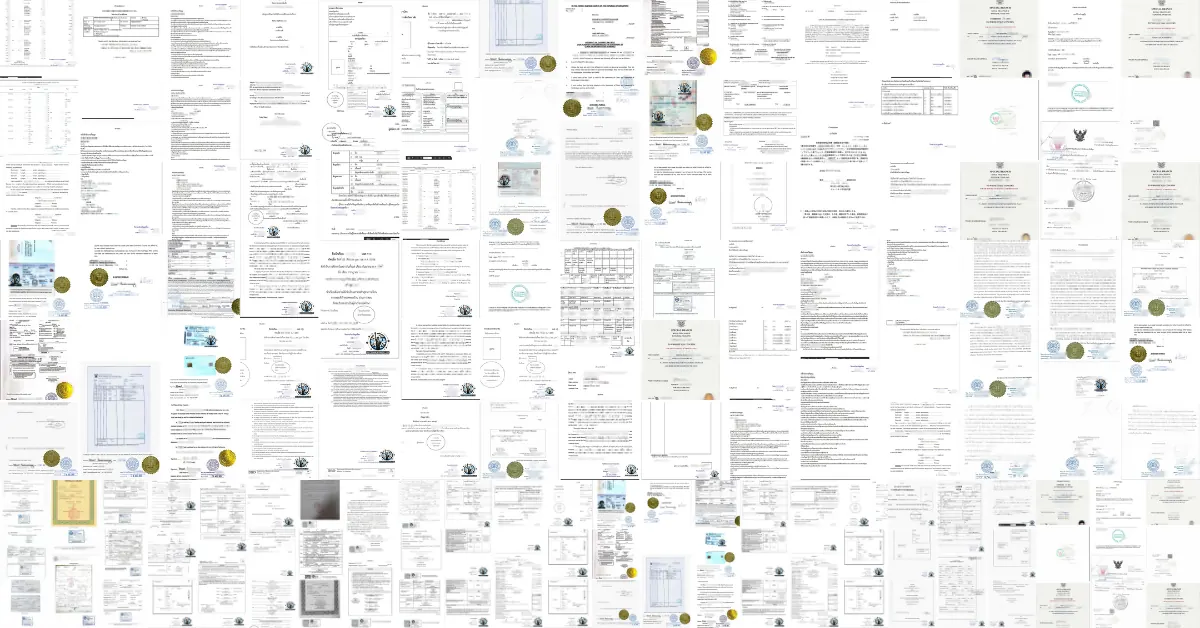
Official document translation with a certificate of translation — Service illustration; requirements depend on the document and receiving authority
Service Playbook
Certified translation — documents, steps and pitfalls
Before translating anything, identify the certification system the receiving authority accepts: NAATI (Australia), sworn translators (Germany, France, Spain, Italy), certified translation with a Certificate of Accuracy (US/UK), or a Ministry of Justice registered translator for Thai courts.
Documents to prepare
• Original or freshly issued certified copy from the issuing authority (not a photocopy)
• Passport copies of every person named, so spellings match exactly
• Any written requirement from the receiving body (university, embassy, employer)
• A list of preferred spellings for names of companies, temples or villages
• Power of attorney if someone else handles the process for you
• High-resolution colour scans for the pre-check before originals are sent
Step-by-step process
1. Confirm destination and system — Tell us the country, authority and purpose so the correct certification route is chosen from the start.
2. Pre-check the source document — Validity, seals and name spelling against the passport are verified before translation begins.
3. Translate and double-review — A translator plus an independent reviewer check figures, dates and official body names.
4. Issue the certification — A Certificate of Accuracy is attached, or the file is routed into the sworn/NAATI system required.
5. Continue the legalisation chain — For foreign government use, the file continues to the Department of Consular Affairs and the destination-specific step.
Pitfalls and rejection causes
• Name spelling that differs from the passport is the number one cause of rejection.
• Self-translation or a provider outside the accepted system is usually refused even when accurate.
• Do not unstaple or rebind a certified set — broken cross-page seals invalidate it.
• Some documents have a short acceptance window; plan backwards from your appointment date.
Tips from our team
• Agree on the English names of Thai authorities up front to avoid follow-up queries.
• Keep one spare certified set before submitting anything.
• If several countries are involved, say so early so one original set can serve all of them.
Prefer not to handle the queues yourself, or worried about a rejection? Send us photos of your documents for a free pre-check. We handle the full chain — obtaining certified copies, translation, certification and submission — and keep you updated at each step. Reach us on LINE, phone or email during business hours.
Route Comparison
Which certified-translation format will be accepted
"Certified translation" does not mean the same thing everywhere — each receiving body accepts a different format.
Thai documents going to a foreign authority via its embassy
Department of Consular Affairs, MFA Thailand
Variable, depending on queue and submission channel
A layout that does not match the consular template is refused at the counter
Translation by an accredited/sworn translator abroad (NAATI, sworn translator)
Destination is Australia or a sworn-translator jurisdiction
That country's accreditation body, e.g. NAATI
Variable, usually a few working days
Using a translator whose accreditation lapsed, or a translation without the stamp/registration number
Translation certified by a notarial services attorney
The receiving party is private — a university, employer or overseas bank
Attorney licensed by the Lawyers Council of Thailand
Usually same day to a few days
Many foreign government bodies will not accept this in place of consular legalisation
Timelines above are practical estimates from live casework and can change with each authority's policy; confirm with the receiving authority before booking travel. If you would rather not test routes by trial and error, our advisers can assess which route fits your case.
Advisory Service
We do not just process documents — we advise you through the whole case
Our team has worked on cross-border documents, certified translation and government liaison since 2015. Most rejections we see are not caused by missing paperwork but by choosing the wrong route on day one, so we always start with a case assessment.
Route assessment
We look at your destination, purpose and deadline, then tell you which certification route applies — and which steps you can skip.
Pre-submission review
Name spelling, consistency across documents, document age and translation format are checked before anything reaches a counter.
Timeline planning
We sequence the steps around your appointment or travel date and flag bottlenecks in advance.
Rejection recovery
We read the refusal reasons, identify the underlying cause, and plan a resubmission that answers what the authority asked for.
Rather not learn by trial and error? Send your case details and document photos for a review — reach us on LINE, phone or email during business hours.
Practical Q&A
Practical questions · Near me / DIY / Required documents
How do I find certified translation near me?
Our only office is at Ladprao 95, Bangkok. Send clear scans through LINE @nycvisa with the destination country, receiving authority and required date. We will confirm the translation format and whether originals or delivery are needed before you send documents.
Can I translate it myself and have it certified afterwards?
It depends on the recipient. The Department of Consular Affairs certifies a translation by checking it against the original rather than by translator identity, but many embassies and foreign authorities require an independent or accredited translator. Check the destination's rule before self-translating to avoid a rejection cycle.
What do you need from me to start?
Sharp colour scans of every page including seals and signatures, the English spelling of names exactly as printed in the passport, the receiving authority and country, and your deadline. Sending any previously certified translation helps keep terminology and name spelling consistent across the set.
Practical advice & cautions
Document translation: what to prepare and what gets rejected
Before you start
Order fresh certified copies
Many civil-registry and court documents are only accepted if issued recently. Request a newly certified copy before translation rather than reusing an old photocopy.
Sequence the steps so originals stay valid
When translation, certification and apostille or embassy steps are chained, allow for each authority's queue and start with the longest step so the underlying original does not age out.
Send full-page colour scans
Scan in colour at 300 dpi or higher, showing seals, signatures, document numbers and page edges, including any stamped reverse side. Illegible areas must be marked as such in the translation, which invites rejection.
Tell us the fixed terms
Company names, institution names, academic titles and drug names should follow the English form already used in your other filings so the whole bundle stays consistent.
Common reasons documents get rejected
Altering figures or date formats
Translations must preserve the source data, including correct conversion of Buddhist-era years with the calendar system stated. A single mistyped digit voids the document.
Self-translated documents
Most authorities refuse translations produced by the applicant or a relative, even if accurate, because there is no identifiable certified translator behind them.
Leaving page elements untranslated
Seals, signatures, reverse-side text and marginal notes must all be rendered or described. Omitting them is one of the most common rejection causes.
Using the wrong certification system
A consular-certified Thai translation does not replace a NAATI translation for Australian authorities, and a NAATI stamp is not a Thai government certification. Choose the system that matches the destination from the start.
Requirements differ by authority and destination country and can change. Confirm current conditions with the receiving authority, or ask our team by phone, LINE or email.
What people search for
Frequently searched topics about certified translation
Thai to English translation for embassies
Each embassy sets its own accepted translator and certification format; request the requirement in writing first.
Freshly issued civil records for translation
Many receiving bodies limit how old the source document may be, so obtain a new certified copy before translating.
NAATI translation for Australia
Australian authorities generally require a certified translator's stamp and practitioner number on the translation.
Certified translation for legalisation
Translations submitted for legalisation must mirror the original line by line, including seals and signatures.
These topics reflect the rules and practice of the relevant authorities and can change. Confirm with the receiving authority, or ask our team by phone, LINE or email.
Related services
What clients usually handle next
One document set often moves through several stages — translation, notarial certification, legalization and finally a visa filing. The links below follow that real sequence.